el cisne negro
≈ From memoryOur world is shaped by rare, unpredictable, and high-impact events that we cannot predict but can only prepare for by building robust systems.
In one sentence
The "Black Swan" is an outlier event that carries an extreme impact, is impossible to predict using standard probability models, and is only explained away as "inevitable" after it occurs.
Why read this (and who it's for)
This book is a corrective for the human brain's inherent flaws in processing probability and risk. It is for investors, policy-makers, engineers, and anyone who makes decisions based on "expert" forecasts. It solves the problem of intellectual arrogance: the belief that because we can model the past, we can predict the future. After reading, you will stop asking "What is the most likely outcome?" and start asking "What is the worst-case outlier, and how can I survive it?"
The Big Idea
Taleb argues that our modern world is built on a fundamental misunderstanding of probability. We live in a "Mediocristan" of predictable, bell-curve events (like height or weight), but we try to apply those same rules to "Extremeistan"—the realm of wars, financial crashes, and technological breakthroughs. In Extremeistan, the outliers are the story; they are not deviations from the norm, they are the drivers of history.
The core logic is that because we cannot predict the specific timing or nature of a Black Swan, we must stop trying to "forecast" them. Instead, we must build Antifragile systems—structures that benefit from disorder and volatility. We must move from a "prediction" mindset to a "preparedness" mindset, acknowledging that the most important events in history are those that were never seen coming.
Key ideas
The Black Swan
- What it is — An event that is a surprise, has a massive impact, and is explained away with hindsight. It is the "unknown unknown."
- Why it matters — If you believe the future will look like a slightly modified version of the past, you are vulnerable to total ruin when a structural shift occurs.
- In the book — The discovery of America by Columbus. It was a massive, world-altering event that no one saw coming, yet we now treat it as a historical certainty.
Mediocristan vs. Extremeistan
- What it is — Mediocristan is the realm of Gaussian distributions (the Bell Curve) where outliers don't matter much (e.g., the height of people). Extremeistan is the realm of Power Laws, where the outliers are the data (e.g., the wealth of individuals or the size of earthquakes).
- Why it matters — Most of our modern statistics and "expert" models are designed for Mediocristan, making them dangerously useless for predicting extreme events like market crashes or pandemics.
- In the book — Taleb compares the distribution of human height (Mediocristan) to the distribution of wealth (Extremeistan).
The Ludic Fallacy
- What it is — The belief that the risks of the real world can be modeled by the rules of games (like dice or cards).
- Why it matters — In a game, the rules are fixed and the "randomness" is contained. In the real world, the "rules" change, and the "randomness" can be infinite.
- In the book — Taleb critiques the idea that "Expected Value" (EV) is a sufficient metric for decision-making, because EV doesn't account for the risk of "ruin" (going to zero).
The Narrative Fallacy
- What it is — Our tendency to construct a coherent story about the past to make it seem predictable, even though it was actually a result of random chance.
- Why it matters — We use stories to justify our current beliefs, which prevents us from seeing the true randomness of history.
- In the book — The way we explain the rise of the Roman Empire or the success of a specific company as a "logical" progression of events, ignoring the thousands of random variables that actually played a role.
The Problem of Induction
- What it is — The philosophical problem that just because something happened in the past doesn't mean it will happen again.
- Why it matters — We assume the "Turkey" rule: a turkey is fed every day and assumes the farmer is its friend, until the day before Thanksgiving.
- In the book — The Turkey analogy: the turkey's "data" suggests the farmer is a provider, but the "Black Swan" is the arrival of Thanksgiving.
Nonlinearity and Nonlinearity
- What it is — The idea that small changes can lead to massive, disproportionate effects (and vice versa).
- Why it matters — Most of our systems (social, economic, biological) are nonlinear. Small errors can snowball into systemic collapses.
- In the book — The way a small spark can start a forest fire, or how a small change in a social network can lead to a massive revolution.
Frameworks & tools
The "Convexity" Filter
Use this to evaluate any investment, career move, or project. You want "Positive Convexity"—situations where the upside is huge and the downside is capped.
- Identify the Downside: What is the "ruin" scenario? (e.g., losing your house, your reputation, or your entire savings).
- Assess the Upside: Is there a "hidden" opportunity that could be 10x or 100x the initial investment?
- The Rule of Ruin: If the downside is "ruin" (permanent loss), the trade is off, regardless of how high the potential upside is.
- Seek Asymmetry: Look for "Options." In finance, an option gives you the right, but not the obligation, to act. In life, look for things that require little effort but offer huge rewards (e.g., writing a book, starting a side project).
The "Anti-Prediction" Protocol
When faced with a long-term forecast (e.g., "What will the economy look like in 10 years?"), stop trying to guess the what. Instead, build a system that survives any outcome.
- Identify the Variables: What are the 3-5 things that actually matter?
- Stress Test: Instead of asking "Will X happen?", ask "If X happens, can I survive?"
- Build Redundancy: Ensure you have multiple sources of income, diverse skills, and a "moat" of safety.
- Ignore the "Experts": Recognize that most experts are just narrating the past, not predicting the future.
Memorable examples & stories
The Turkey Analogy
A turkey is fed and pampered by a farmer for months. Based on all available data, the turkey concludes that the farmer is its best friend and that the "system" is safe. Then, on Thanksgiving, the system collapses. Lesson: Past performance is not a guarantee of future safety, especially when the "rules" are hidden.
The 1987 Stock Market Crash
The market crashed with no obvious fundamental cause. It was a "Black Swan" of the financial world. Lesson: Markets can move in ways that defy all "logical" models because they are driven by human psychology and feedback loops, not just math.
The Discovery of America
Columbus didn't know he was finding a new continent; he thought he was finding a trade route. The impact was a total reconfiguration of the world. Lesson: The most significant events in history are often the ones that were not intended and were not predicted.
Key quotes
"The biggest risks are the ones we don't see coming." (Paraphrased) Why it matters: It shifts the focus from "risk management" (mitigating known risks) to "uncertainty management" (preparing for the unknown).
"History is the study of the unexpected." (Paraphrased) Why it matters: It reminds us that the "outliers" are the only things that actually matter in the long run.
"The problem with predicting the future is that the future is not a continuation of the past." (Paraphrased) Why it matters: It challenges the very foundation of modern forecasting.
How to apply it
This week
- Identify your "Turkey" moments: Look at your life. Where are you assuming a system is safe just because it hasn't failed yet? (e.g., a job, a relationship, a financial plan).
- Audit your "Expert" sources: Identify three "experts" you follow. Ask yourself: "Are they actually predicting the future, or are they just telling a story about the past?"
- Find a "Small Bet": Identify one thing you can do that has a low cost of failure but a high potential for a "Black Swan" win (e.g., sending a cold email, starting a blog).
Ongoing
- Practice Convexity: Always prioritize "Optionality." Before committing to a major life change, ask: "Does this give me more options or fewer?"
- Build Robustness: Diversify your "survivability." Ensure you have a "Margin of Safety" in your finances, your health, and your skills.
- Ignore the Noise: Stop trying to predict the daily fluctuations of the news. Focus on the structural integrity of your own "system."
Common pitfalls
- The "I can predict it" Trap: People often think they've understood the book but then immediately try to use it to "predict" the next Black Swan. You cannot predict a Black Swan; you can only prepare for one.
- Over-correction: Don't become a hermit who ignores all data. You still need data to navigate daily life; you just need to stop over-weighting the "predictable" data when it comes to high-impact, rare events.
- The "Expert" Fallacy: Beware of people who claim to have "solved" the math of the future. If they can't explain why their model fails to account for the "Unknown Unknowns," they are just narrating a story.
Connects to
- Antifragile (Taleb): The logical successor. While The Black Swan identifies the problem (unpredictable outliers), Antifragile provides the solution (how to build systems that thrive on that chaos).
- Thinking, Fast and Slow (Kahneman): Provides the psychological foundation for why our brains are so bad at probability (System 1 vs. System 2).
- The Lean Startup (Ries): A practical application of "Optionality" and "Convexity"—testing small ideas quickly to see if they have "Black Swan" potential before committing resources.
If you remember only three things
- The Black Swan: Rare, high-impact, unpredictable events shape our world.
- Mediocristan vs. Extremeistan: Don't use Bell Curve logic (height/weight) to predict Power Law events (wealth/disasters).
- Convexity: Seek situations where the downside is capped and the upside is unlimited.
Internalize it
- Reflection questions
- What is one area of my life where I am relying on "past data" to assume a future that might not happen?
- If my primary source of income disappeared tomorrow, what "redundancies" do I have in place?
- In what ways am I currently pursuing "concave" goals (high risk, low/limited reward)?
- How can I make my career more "Antifragile" by gaining skills that are useful in multiple, unrelated industries?
- Flashcards Q: What is the definition of a Black Swan? A: An outlier event that is unpredictable, has a massive impact, and is explained away as "obvious" after it happens.
Q: What is the difference between Mediocristan and Extremeistan? A: Mediocristan is the realm of predictable, Bell Curve distributions (e.g., height). Extremeistan is the realm of Power Laws and extreme outliers (e.g., wealth).
Q: What is the "Turkey" analogy? A: A turkey is fed by a farmer every day and assumes the farmer is a friend, until the day before Thanksgiving when the system changes.
Q: What is the "Ludic Fallacy"? A: The mistake of thinking that real-world risks can be modeled by the rules of games.
Q: What does "Convexity" mean in the context of decision-making? A: Seeking situations where the potential upside is much larger than the potential downside (positive asymmetry).
Q: Why is "Expected Value" (EV) insufficient for risk? A: Because EV doesn't account for "ruin"—the possibility of a single event wiping you out completely.
Q: What is the Narrative Fallacy? A: Our tendency to create a coherent story about the past to make it seem predictable, even though it was actually driven by random chance.
Fidelity note
This summary is based on a high-level synthesis of Taleb's core arguments in The Black Swan. I am highly confident in the distinction between Mediocristan/Extremeistan and the Turkey analogy. I am less certain of specific, minor anecdotes used in the middle of the book, so I have focused on the core philosophical pillars that define the work. Readers should verify the specific "Power Law" mathematical formulas if they require a technical deep-dive into the statistics.
More from Nassim Nicholas Taleb
 A logica do Cisne Negro - Edicao revista e ampliada - O impacto do altamente improvavelNassim Nicholas Taleb
 AntifragileNassim Nicholas Taleb
 Dynamic hedgingNassim Nicholas Taleb
 EXISTE LA SUERTENassim Nicholas Taleb
 Fooled by RandomnessNassim Nicholas Taleb
 Siyah Kugu - Olasiliksiz Gorunenin EtkisiNassim Nicholas Taleb
 Skin in the GameNassim Nicholas Taleb
 Statistical Consequences of Fat TailsNassim Nicholas Taleb
 The Bed of ProcrustesNassim Nicholas Taleb
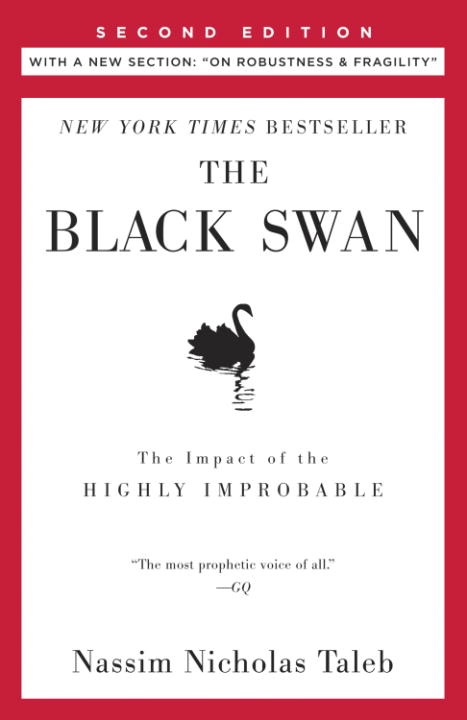 The Black SwanNassim Nicholas Taleb