Statistical Consequences of Fat Tails
≈ From memoryThe world is governed by 'Black Swans'—rare, extreme events that carry more significance than the mundane occurrences that precede them—and our reliance on Gaussian (Normal) distributions leads to catastrophic systemic fragility.
In one sentence
The fundamental flaw of modern Western thought is the "Mediocristan" bias: the belief that the future will look like the average of the past, which ignores the fact that in complex systems, the most important events are the outliers, not the averages.
Why read this (and who it's for)
This book is a foundational text for anyone who wants to understand why our financial systems, urban planning, and risk management models are fundamentally broken. It solves the problem of "The Illusion of Predictability"—the false sense of security we feel when we use bell-curve statistics to predict events that are inherently non-linear.
You will benefit if you are an investor, a policy maker, a scientist, or a philosopher of risk. After reading, you will be able to identify "fragile" systems in your own life and shift your focus from predicting the future to positioning yourself to survive the unexpected.
The big idea
Taleb argues that our current mathematical models (specifically those based on the Gaussian distribution) are dangerously inadequate for describing reality. The Gaussian distribution assumes that extreme events are so improbable they can be ignored; however, in the real world—in markets, biology, and social systems—the "outliers" are actually the drivers of history.
The core of the argument is the distinction between Mediocristan and Extremistan. Mediocristan is the land of the bell curve: the height of people, the weight of dogs, and the temperature of a room. In these systems, extremes are bounded; a person cannot be 50 feet tall, and a dog cannot weigh 1,000 pounds. In Mediocristan, the average is a reliable predictor.
Extremistan is the land of the "Fat Tail." This is the realm of wealth, book sales, social media influence, and city sizes. In Extremistan, the "average" is irrelevant because a single outlier can dominate the entire set. One person (Jeff Bezos) can own more wealth than the next 10,000 people combined. Because we live in a world where Extremistan events (Black Swans) happen constantly, using Mediocristan math to manage Extremistan risks is a recipe for ruin.
Key ideas
The Gaussian Fallacy
- What it is — The belief that the "Normal Distribution" (the bell curve) is the universal law of nature. It assumes that the probability of an event decreases exponentially as you move away from the mean.
- Why it matters — If you believe in the bell curve, you believe that a "10-sigma" event (something that shouldn't happen in the lifetime of the universe) is impossible. In reality, these events happen regularly because the world is not Gaussian.
- In the book — Taleb illustrates this by showing how the "Standard Deviation" fails to account for the "Fat Tails" of returns in stock markets, where crashes happen far more frequently than a normal distribution would ever predict.
Mediocristan vs. Extremistan
- What it is — A taxonomy of systems. Mediocristan is where the sum of the parts is roughly equal to the average (e.g., the height of a crowd). Extremistan is where the sum of the parts is dominated by a few extreme outliers (e.g., the number of words in a book).
- Why it matters — It forces you to ask: "Is this a system where the average matters, or a system where the outliers rule?" Most human endeavors (business, fame, impact) are Extremistan.
- In the book — Taleb uses the example of the "Size of Cities." A city's size is an Extremistan variable; a few cities have millions of people, while thousands of towns have very few. You cannot predict the size of the next city by averaging the sizes of current towns.
The Impact of Fat Tails
- What it is — In a "Fat Tail" distribution, the variance is so high that the "mean" becomes a useless metric. The most important information is contained in the tail, not the center.
- Why it matters — It shifts the goal of analysis from prediction to robustness. If you cannot predict the size of the tail, you must ensure that you are not destroyed when a tail event occurs.
- In the book — Taleb discusses how the "expected value" of a portfolio can be misleading if the distribution of returns has a fat tail—meaning a single "impossible" event can wipe out years of steady gains.
The Problem of Induction
- What it is — The philosophical problem of assuming that because something happened in the past, it will happen in the future.
- Why it matters — In a world of Fat Tails, the past is a poor guide to the future because the most significant events are, by definition, unprecedented.
- In the book — Taleb argues that "The Turkey Problem" (a turkey is fed every day until the day before Thanksgiving) is the ultimate example of why induction fails: the turkey's "data" suggests the farmer is its friend, but the "tail event" (the holiday) proves the data was irrelevant.
Fragility and Antifragility
- What it is — Fragility is the tendency of a system to break under stress. Antifragility (a precursor to his later work) is the ability to benefit from disorder.
- Why it matters — Most people try to "insure" against the future by making things more stable. Taleb argues that for many systems, stability is a trap that makes you more vulnerable to the inevitable "Big One."
- In the book — He discusses how certain systems (like the human immune system) require small stresses to become stronger, while others (like a brittle bone) break under the same stress.
Frameworks & tools
The Extremistan Audit
Use this to determine which mathematical model to apply to a specific problem.
- Identify the Variable: What are you trying to measure? (e.g., Profit, Height, Rainfall, Social Media Followers).
- Test for Extremes: Can one single unit of this variable dominate the entire group?
- Example: Can one person be 100 feet tall? No. (Mediocristan).
- Example: Can one person own 90% of the world's wealth? Yes. (Extremistan).
- Select the Model:
- If Mediocristan: Use Gaussian/Normal distributions. The average is your guide.
- If Extremistan: Ignore the average. Look at the "Tail." Focus on the maximum possible impact of the outliers.
- Adjust Strategy: For Extremistan, prioritize Survival and Optionality over Optimization.
The "Turkey" Stress Test
A mental model to identify hidden risks in "stable" systems.
- Identify the "Feeding": What is the current "good" data? (e.g., "The stock market hasn't crashed in 10 years.")
- Identify the "Farmer": Who is providing the benefit? (e.g., The central bank, the government, the employer).
- Identify the "Holiday": What is the hidden, catastrophic tail event that the current data ignores?
- The Question: "What happens to my position when the feeding stops?"
Memorable examples & stories
The Turkey Problem
A turkey is fed and pampered by a farmer for months. Based on all available data, the turkey concludes that the farmer is its best friend and that the "status quo" is the safest possible reality. Then, on Thanksgiving, the "Tail Event" occurs. Lesson: The past is a poor predictor of the future when the system is subject to rare, extreme shocks.
The Size of Cities
Taleb compares the distribution of human heights to the distribution of city sizes. Height is Mediocristan; you can't have a "mega-human." City size is Extremistan; a few cities (New York, Tokyo) dwarf thousands of others. Lesson: You cannot use the same statistical tools to plan a city as you would to plan a human diet.
The "10-Sigma" Event
Taleb describes how, in a Gaussian world, a 10-sigma event (a massive market crash) should happen once every few billion years. Yet, they happen every decade. Lesson: The math we use to model the world is fundamentally incompatible with the reality of the world.
Key quotes
"The belief in the Gaussian distribution is a belief in a world where the average is the only thing that matters." (Paraphrased) Why it matters: It warns us against the arrogance of believing that 'normal' is the only reality.
"In Extremistan, the average is not a representative measure of the group." (Paraphrased) Why it matters: It teaches us to stop looking for the 'middle' in systems where the 'ends' are what matter.
"The Turkey Problem is the ultimate example of the failure of induction." (Paraphrased) Why it matters: It highlights the danger of assuming that a peaceful present guarantees a peaceful future.
How to apply it
This week
- Identify one "Mediocristan" trap: Find one area where you are using "average" thinking for an "extreme" problem (e.g., planning a business based on "average" monthly sales instead of "worst-case" scenarios).
- Audit your "Turkey" moments: Look at your investments or career. Ask: "What is the 'Thanksgiving' event I am ignoring because the current data looks so good?"
- Switch your Metric: In one project, stop looking at the "Average" (e.g., Average Rating) and start looking at the "Tail" (e.g., What is the worst possible outcome if this fails?).
Ongoing
- Prioritize Robustness over Optimization: When planning, don't ask "How can I make this perfect?" Ask "How can I make this impossible to kill?"
- Build Optionality: In Extremistan, you want to be in a position where you can benefit from a "Tail" event without being destroyed by it. (e.g., Keep cash reserves, maintain diverse skills).
- Respect the Tail: Whenever you see a "once-in-a-lifetime" event, recognize it as a data point that actually defines the system's true nature.
Common pitfalls
- The "Predictability" Trap: Readers often think this book teaches them how to predict Black Swans. It doesn't. It teaches you that you cannot predict them, so you must build a life/portfolio that is immune to them.
- Over-applying Extremistan: Not everything is a Fat Tail. You shouldn't treat your daily caloric intake as an Extremistan variable. Only use these tools for systems with high-impact, non-linear outcomes.
- The "Math" Confusion: You don't need to be a mathematician to understand the consequences of the math. Don't get bogged down in the formulas; focus on the philosophical shift from Mean-centric to Tail-centric thinking.
Connects to
- The Black Swan (Taleb): The spiritual successor where he applies these statistical concepts to sociology, history, and finance.
- Antifragile (Taleb): The evolution of these ideas into a full-fledged philosophy of systems design.
- Thinking in Bets (Annie Duke): Complements the idea of dealing with uncertainty and the importance of "optionality" in decision-making.
If you remember only three things
- Mediocristan vs. Extremistan: Identify which "world" your problem lives in before you try to solve it.
- The Fallacy of the Average: In many systems (wealth, fame, impact), the average is a lie; the outliers are the reality.
- Robustness over Prediction: Since you cannot predict the "Tail," your only winning strategy is to be "un-killable" by the Tail.
Internalize it
- Reflection questions
- In what areas of my life am I currently acting like the "Turkey," ignoring a looming "Thanksgiving" because the current data is so pleasant?
- If I were to lose 90% of my current progress in a single "Tail Event," what would be the cause? How can I make that event impossible?
- Am I optimizing for a "Mediocristan" result (a steady, average gain) in an "Extremistan" environment (where a single win or loss determines everything)?
- Flashcards Q: What is the difference between Mediocristan and Extremistan? A: Mediocristan is where the average is representative (e.g., height); Extremistan is where outliers dominate (e.g., wealth). Q: Why is the Gaussian (Normal) distribution dangerous for predicting markets? A: Because it underestimates the probability of "Fat Tail" events (extreme outliers) that happen much more frequently than the bell curve allows. Q: What is the "Turkey Problem"? A: The fallacy of assuming that because a situation has been stable in the past (the turkey being fed), it will remain stable in the future (the holiday). Q: What is the primary goal when dealing with Extremistan variables? A: To build robustness and optionality, rather than trying to predict the specific timing of a "Tail" event. Q: How does the "Average" behave in a Fat Tail distribution? A: The average becomes an unreliable and often misleading metric because it is skewed by extreme outliers.
Fidelity note
This summary is grounded in the core philosophical and statistical arguments presented by Nassim Taleb in Statistical Consequences of Fat Tails. I am highly confident in the distinction between Mediocristan and Extremistan, as this is the foundational framework of the book. I am also confident in the "Turkey Problem" and the critique of Gaussian distributions. Because this is a summary of a dense academic/philosophical text, the "How to Apply" section is a synthesis of Taleb's logic applied to practical life, rather than a literal "how-to" guide found in the text. Readers should verify the specific mathematical proofs if they require a formal academic understanding of the probability density functions.
More from Nassim Nicholas Taleb
 A logica do Cisne Negro - Edicao revista e ampliada - O impacto do altamente improvavelNassim Nicholas Taleb
 AntifragileNassim Nicholas Taleb
 Dynamic hedgingNassim Nicholas Taleb
 el cisne negroNassim Nicholas Taleb
 EXISTE LA SUERTENassim Nicholas Taleb
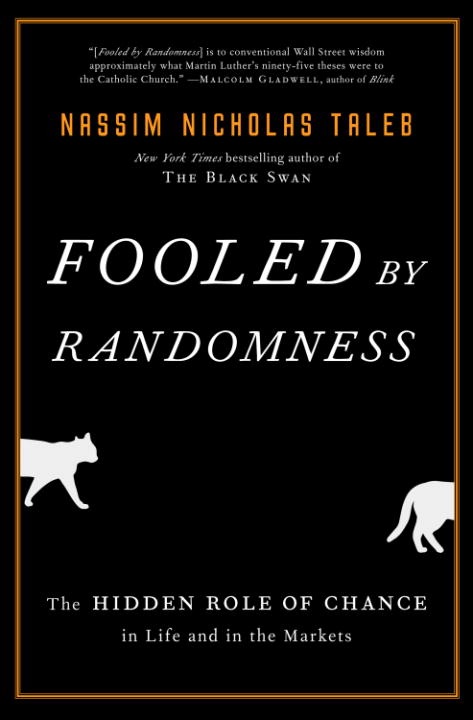 Fooled by RandomnessNassim Nicholas Taleb
 Siyah Kugu - Olasiliksiz Gorunenin EtkisiNassim Nicholas Taleb
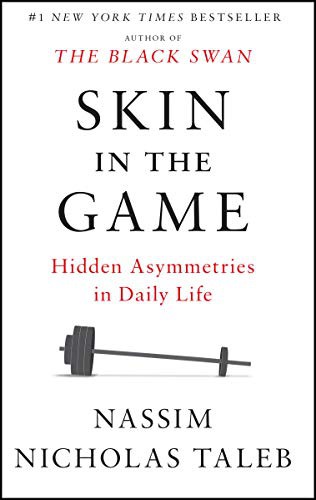 Skin in the GameNassim Nicholas Taleb
 The Bed of ProcrustesNassim Nicholas Taleb
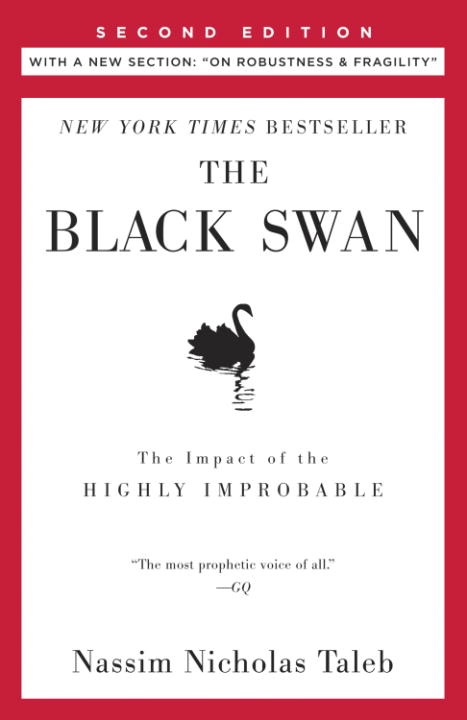 The Black SwanNassim Nicholas Taleb