A logica do Cisne Negro - Edicao revista e ampliada - O impacto do altamente improvavel
≈ From memoryOur world is shaped by rare, unpredictable, and high-impact events (Black Swans) that our current models of probability and history fail to predict, so we must build systems that are robust to the unknown rather than trying to forecast the future.
In one sentence
We live in a world where the most significant changes are caused by "Black Swans"—events that are unpredictable, have massive impact, and are only explained away as "obvious" after they occur—meaning we must prioritize robustness and "antifragility" over precise forecasting.
Why read this (and who it's for)
This book is a scathing critique of the "intellectual arrogance" of modern experts who believe they can model the future using linear logic and Gaussian (bell-curve) distributions. It is for anyone who makes decisions based on data—investors, policymakers, engineers, and thinkers—who realize that "the plan" often fails because of things no one saw coming. After reading, you will stop asking "What is the most likely outcome?" and start asking "What is the impact if the unthinkable happens?"
The big idea
Taleb argues that our current understanding of probability is fundamentally flawed because it treats the world as a "closed system" governed by the same rules as a deck of cards or a coin toss. In reality, the world is an "open system" where the rules of the game can change at any moment. We mistake the map for the territary; we think because we can describe a past event, we can predict its recurrence.
The core of the book is the Black Swan: an event that is a surprise, has an outlier impact, and is only explained away in hindsight. Because these events are, by definition, unpredictable, any model that claims to predict them is a lie. Instead of trying to predict the "unpredictable," Taleb argues we must build systems that are robust—meaning they survive shocks—or even antifragile—meaning they actually benefit from disorder and volatility.
Key ideas
The Black Swan
- What it is — A Black Swan is an event that is a "wild card": it is a surprise, it has a massive impact, and it is only understood in retrospect.
- Why it matters — Because we cannot predict these events, any "expert" who claims to have predicted a Black Swan is usually just lucky or is retrofitting a narrative.
- In the book — The discovery of Americas (Columbus) or the invention of the printing press. These were not "expected" by the systems of the time, yet they fundamentally reshaped the world.
The Problem of Induction
- What it is — The logical fallacy of assuming that because something happened in the past, it will happen again in the future.
- Why it matters — This is the root of why "experts" fail. They assume the "rules" of the game are static, but in a complex world, the rules can change overnight.
- In the book — Taleb uses the example of a turkey. A turkey is fed every day by a farmer; for the turkey, the "rule" is that humans provide food. This holds true until the day before Thanksgiving, when the rule changes instantly and lethally.
Mediocristan vs. Extremistan
- What it is — "Mediocristan" is a world of small, predictable variations (like height or weight). "Extremistan" is a world where a single outlier can dominate the entire set (like wealth, population, or social media followers).
- Why it matters — Most of our modern statistics (the Bell Curve) only work in Mediocristan. When applied to Extremistan, they fail miserably because they ignore the "fat tails" of probability.
- In the book — Comparing the distribution of human heights (Mediocristan) to the distribution of wealth (Extremistan).
The Ludic Fallacy
- What it is — The belief that the risks of the real world can be modeled by the rules of games (like dice or cards).
- Why it matters — In a game, the rules are fixed and the "randomness" is contained. In the real world, the "rules" are often unknown and the "randomness" can be systemic and catastrophic.
- In the book — The critique of the "Efficient Market Hypothesis" and other financial models that treat markets like a casino where the rules of the game never change.
The Narrative Fallacy
- What it is — Our tendency to construct a coherent story about the past to make it seem predictable, even though it was actually a result of random chance.
- Why it matters — It makes us overconfident in our ability to predict the future because we believe we "understand" the past.
- In the book — The way we explain the causes of historical wars or economic crashes after they happen, creating a "logical" sequence of events that didn't actually exist at the time.
The Turkey Problem (The Problem of Nonlinearity)
- What it is — The idea that a system can appear stable for a long time while the underlying conditions are actually becoming more dangerous.
- Why it matters — It warns us against "calm" periods. A lack of volatility doesn't mean a system is safe; it might just mean the "Black Swan" hasn't happened yet.
- In the book — The turkey example (reiterated) serves as a warning against the "illusion of stability" in complex systems.
Frameworks & tools
The "Antifragile" Audit
Use this to evaluate any system (a business, a portfolio, a personal habit) to see if it survives—or thrives—under stress.
- Identify the Stressor: What is the "Black Swan" for this system? (e.g., a market crash, a total supply chain failure, a sudden technological shift).
- Test for Fragility: Does the system break if this happens? (e.g., "If our main supplier disappears, we go bankrupt in 48 hours.")
- Test for Robustness: Can the system survive the stress? (e.g., "We have enough cash to survive 6 months without a supplier.")
- Test for Antifragility: Does the system gain from the stress? (e.g., "If a competitor goes out of business, we gain their market share and can lower our prices.")
The "Rule of Three" for Decision Making
When making a major decision, do not ask "What is the most likely outcome?" Ask:
- What is the worst-case scenario? (The "Tail" risk)
- What is the impact of that scenario? (The "Impact" of the Black Swan)
- Can I survive that impact? (The "Survival" check) Only proceed if the answer to #3 is "Yes."
Memorable examples & stories
The Turkey
The turkey is fed every day, and it assumes the "rule" is that it will always be fed. It is a perfect metaphor for how we interpret the past. The lesson: Past success is not a guarantee of future stability.
The Invention of the Printing Press
The printing press was a Black Swan. It didn't just "change" things; it fundamentally altered the human experience of knowledge, religion, and power. The lesson: True change is often non-linear and impossible to predict before it happens.
The "Expert" Fallacy
Taleb discusses how "experts" in economics and sociology often fail because they rely on models that assume a "Mediocristan" world. They are like people trying to predict the weather in a hurricane using a thermometer. The lesson: Complexity cannot be reduced to a simple formula.
Key quotes
"The hardest thing to do is to admit that we don't know." (Paraphrased) Why it matters: Intellectual humility is the only defense against the Narrative Fallacy.
"History is what happens when the unexpected happens." (Paraphrased) Why it matters: We often think history is a sequence of predictable steps, but it is actually a series of shocks.
"The only way to survive a Black Swan is to be antifragile." (Paraphrased) Why it matters: You cannot predict the swan; you can only build a body that thrives in its presence.
How to apply it
This week
- Identify one "Mediocristan" assumption: Find one thing you believe is "guaranteed" because it has happened every day for a long time (e.g., a routine, a business process, a social norm). Ask: "What happens if this stops tomorrow?"
- The "Pre-Mortem": Take a current project. Imagine it has failed spectacularly one year from now. Write down the "Black Swan" reason why it failed.
Ongoing
- Build "Optionality": In your career and investments, prioritize "Positive Asymmetry." Seek opportunities where the downside is limited and known, but the upside is huge and unknown (e.g., starting a side project, learning a new skill).
- Avoid "The Expert Trap": When someone gives you a "precise" prediction about a complex system (the economy, the future of AI, etc.), ask them: "What is the probability distribution of your error?" If they can't answer, they are guessing.
- Focus on Robustness over Optimization: Don't build a system that is perfectly efficient for a perfect world. Build a system that is "good enough" for a world that might break.
Common pitfalls
- The "Predictability" Trap: Readers often think this book is about how to predict the future. It is the opposite. It is about why you cannot predict the future and how to prepare for the fact that you can't.
- Over-Engineering the "Antifragile": People often try to make everything "antifragile" (like a business) when some things just need to be "robust" (like a bridge). You don't need a bridge to "benefit" from an earthquake; you just need it not to fall down.
- The "Expert" Fallacy of Reading: Don't assume you've mastered the concept just because you read the book. The "Turkey" is always watching. You must constantly re-evaluate your assumptions.
Connects to
- Antifragile (Taleb): The sequel/companion where he explores the specific mechanics of systems that thrive on disorder.
- Thinking in Bets (Annie Duke): Complements the idea of probabilistic thinking and managing uncertainty.
- The Lean Startup (Eric Ries): While different in focus, the "Pivot" and "Validated Learning" concepts align with the idea of building systems that can adapt to unexpected feedback.
If you remember only three things
- Black Swans are unpredictable, high-impact events that we only understand in hindsight.
- Mediocristan vs. Extremistan: Most of our world (wealth, fame, impact) follows "Fat Tail" distributions, not Bell Curves.
- Robustness/Antifragility: Since you cannot predict the future, focus on building systems that survive—and even benefit from—volatility.
Internalize it
-
Reflection questions
- In what areas of my life am I acting like the "Turkey," assuming a rule will hold forever because it hasn't broken yet?
- If my primary source of income/success was removed tomorrow, what would be my "survival" plan?
- Am I making decisions based on "Expert" narratives or on the actual "Robustness" of my actions?
-
Flashcards Q: What is a Black Swan? A: An event that is a surprise, has a massive impact, and is only explained away in hindsight. Q: What is the difference between Mediocristan and Extremistan? A: Mediocristan is a world of small, predictable variations (height); Extremistan is a world of outliers (wealth). Q: Why is the "Turkey Problem" a warning? A: It warns that a lack of recent problems does not mean a system is safe; it may just mean the "rules" haven't changed yet. Q: What is the "Ludic Fallacy"? A: The belief that real-world risks can be modeled by the fixed rules of games. Q: What does it mean to be "Antifragile"? A: To be a system that actually gets stronger or improves as a result of stress, volatility, and disorder. Q: What is the "Narrative Fallacy"? A: The human tendency to create a coherent story about the past to make it seem predictable, even when it was random.
Fidelity note
This summary is based on the core philosophical arguments of The Black Swan by Nassim Nicholas Taleb. I am highly confident in the distinction between Mediocristan/Extremistan and the definition of Black Swans. I am less certain of specific minor anecdotes used in the "Expanded Edition" compared to the original, but the core logic remains consistent. Readers should verify the specific "Fat Tail" mathematical examples if they require a deep dive into the calculus of probability.
More from Nassim Nicholas Taleb
 AntifragileNassim Nicholas Taleb
 Dynamic hedgingNassim Nicholas Taleb
 el cisne negroNassim Nicholas Taleb
 EXISTE LA SUERTENassim Nicholas Taleb
 Fooled by RandomnessNassim Nicholas Taleb
 Siyah Kugu - Olasiliksiz Gorunenin EtkisiNassim Nicholas Taleb
 Skin in the GameNassim Nicholas Taleb
 Statistical Consequences of Fat TailsNassim Nicholas Taleb
 The Bed of ProcrustesNassim Nicholas Taleb
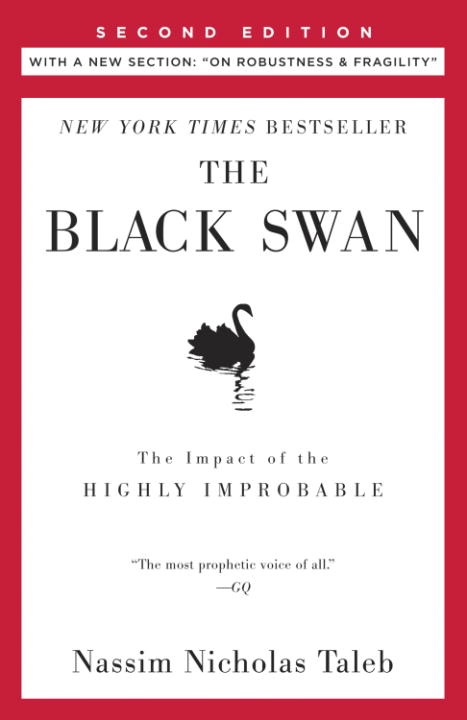 The Black SwanNassim Nicholas Taleb