The Black Swan
≈ From memoryOur world is shaped by rare, unpredictable events that have massive impacts, yet we are cognitively wired to ignore this reality in favor of comforting narratives and flawed models.
In one sentence
The most significant events in human history—from the invention of the printing press to the rise of the internet—are "Black Swans": occurrences that are impossible to predict, yet whose effects are so profound they reshape our entire reality.
Why read this (and who it's for)
Most people believe they can manage risk by looking at the past and predicting the future. Taleb argues that this is a fundamental delusion. This book is for anyone who makes decisions based on "normal" data—investors, leaders, engineers, and thinkers—who need to understand why our standard models of probability fail when things get truly weird. After reading this, you will stop trying to predict the unpredictable and start building systems that are robust enough to survive the unexpected.
The big idea
We live in a world where the "extreme" is not an outlier; it is the rule. However, because our brains are evolved to find patterns and stories, we suffer from a collective delusion: we believe that because we can explain why something happened after the fact, we could have predicted it before it happened. This is the core of the Black Swan.
Taleb argues that our reliance on "Mediocristan" logic—the belief that things like human height or weight follow a bell curve where extremes are rare—is disastrous when applied to "Extremistan." In Extremistan (wealth, success, social media, book sales), a single outlier can dominate the entire system. Because we use Mediocristan tools to measure an Extremistan world, we are constantly blindsided by events that seem impossible until they occur.
The ultimate goal of the book is to teach you epistemological humility. You must recognize that your models of the world are not "true"—they are merely useful maps that often fail exactly when you need them most. To survive, you must stop trying to predict what will happen and start preparing for how things might break.
Key ideas
Mediocristan vs. Extremistan
- What it is — Mediocristan describes systems where the extremes are never significant (e.g., the weight of people in a room). Extremistan describes systems where a single outlier can be larger than all other participants combined (e.g., the wealth of individuals or the impact of an idea).
- Why it matters — Most of our modern tools—standard deviation, Gaussian distributions, and "average" expectations—only work in Mediocristan. If you apply these to Extremistan (like the stock market or technological innovation), you will be destroyed by a "tail event" that your model said was impossible.
- In the book — Taleb uses the example of human height: if you measure 1,000 people, the tallest person isn't significantly taller than the average. But if you measure wealth, the richest person can be worth more than all other 999 combined.
The Ludic Fallacy
- What it is — This is the belief that because we can model a system as a game (like poker or chess), the game's rules will mirror reality. It assumes that "simulated" risk is the same as "real-world" risk.
- Why it matters — When you treat life like a game with known rules, you ignore the fact that in the real world, the rules can change without warning. You become overconfident because your model works in a controlled environment (the lab/the simulation), but it fails when "the house" changes the rules.
- In the book — Taleb points out that while we can simulate a game of dice, we cannot simulate the "real" risks of a market crash or a pandemic because those systems don't have fixed, known rules.
The Narrative Fallacy
- What it is — Our tendency to construct a coherent story to explain why an event happened after it has already occurred. We take a series of random events and weave them into a "logical" sequence.
- Why it matters — This makes us believe we understand the world when, in reality, we are just telling ourselves stories to feel safe. It prevents us from seeing that many things happen for no reason at all—they are simply random.
- In the book — Taleb explains how historians write about the "inevitable" rise of empires, ignoring the sheer amount of luck and random chance involved in those events.
The Turkey Problem
- What it is — A turkey is fed by a farmer every day for 1,000 days. Each day, the turkey's model of the world becomes more reinforced: "The human provides food." Then, on Day 1,001 (Thanksgiving), the human kills the turkey.
- Why it matters — This is the ultimate warning against using a stable past to predict an unstable future. Just because something hasn't happened yet doesn't mean it can't happen; it might just mean you haven't been lucky enough to see it yet.
- In the book — The turkey represents any person or institution that assumes "the way things have always been" is a guarantee of how they will be in the future.
The Problem of Induction
- What it is — The philosophical problem that just because the sun rose today doesn't mean it must rise tomorrow. We assume the future will resemble the past, but there is no logical proof for this.
- Why it matters — Our entire scientific and economic methodology relies on induction (observing patterns to predict the future). Taleb argues we must be wary of this because "the past is not always a guide to the future," especially in systems that are prone to sudden, structural shifts.
- In the book — Taleb discusses how we assume the "rules" of the world are constant, but they are actually subject to change at any moment without warning.
Frameworks & tools
The Extremistan Audit (Risk Assessment)
Use this to identify where you are over-relying on "normal" logic for "extreme" environments.
- Identify the Domain: Is the activity you are involved in a Mediocristan or Extremistan domain? (Ask: Can one single event/person dominate 90% of the results?)
- Analyze the Distribution: If it is Extremistan, stop looking at "averages." Look for the "tails"—the extreme highs and lows.
- Assess Vulnerability: Ask, "What happens if a 'one-in-a-million' event occurs today?" If the answer is "everything I own disappears," you are exposed to a Black Swan.
- Build Robustness: Instead of trying to predict the specific event, build a system that survives any extreme event (e.g., diversification, redundant systems, and "optionality").
The Rule of Three for Prediction
When evaluating a prediction or a "guaranteed" outcome, apply this filter:
- The Narrative Test: Is this explanation just a story? Does it conveniently link unrelated events to make them seem inevitable? (If yes, it's likely a Narrative Fallacy).
- The Turkey Test: Is the person making this prediction relying on a long period of stability to predict a future that might be fundamentally different?
- The Ludic Test: Is this model based on a "game" with fixed rules? If the real-world environment allows for rule changes, the model is useless.
Memorable examples & stories
The Turkey and the Farmer
A turkey is fed every day by a farmer. For 1,000 days, the turkey's data shows that the human is a benevolent provider of food. The turkey’s "model" of the world is perfect—until Thanksgiving Day. The Lesson: A perfect track record in a stable environment can be the most dangerous indicator of impending doom when an environment shifts.
The Invention of the Airplane
Before the airplane, the idea of human flight was considered impossible. Once it happened, people began to treat it as "normal." We now look at the history of aviation and think, "Well, it was bound to happen eventually," but that is a Narrative Fallacy. It was an extreme outlier that changed everything. The Lesson: We rewrite history to make the past seem predictable, which makes us less prepared for the next unpredictable leap.
The 2008 Financial Crisis
The financial models used before 2008 assumed that markets were "Mediocristan"—that they followed a bell curve and that extreme crashes were impossible. They failed to account for the fact that the financial system is an Extremistan environment where feedback loops can cause explosive, non-linear reactions. The Lesson: When you ignore the "tails" of a distribution because they seem unlikely, you leave yourself open to total ruin when those tails eventually manifest.
Key quotes
"History is what we call and say is past. The past is what is gone." (Paraphrased) Why it matters: It reminds us that our interpretation of history is often just a story we tell ourselves to make sense of the chaos.
"The biggest mistake is thinking that because something is hard to predict, it is impossible to prepare for." (Paraphrased) Why it matters: You don't need to know what will happen; you just need to be prepared for any possibility.
"We are not only ignorant of the future, we are ignorant of our own ignorance." (Paraphrased) Why it matters: This is the core of epistemic humility—recognizing that our "knowledge" is often just a lack of awareness regarding what we don't know.
How to apply it
This week
- Identify your "Turkey" moment: Look at one area of your life (finances, career, health) where you have assumed things will stay the same because they have been stable for a long time. Write down what would happen if that stability vanished tomorrow.
- Audit your "Mediocristan" thinking: Find a piece of advice you've taken based on an "average." Ask yourself: "Does this apply to an Extremistan environment where one outlier can change everything?"
- Stop seeking the "Why": The next time something unexpected happens (a flight delay, a missed deadline), resist the urge to create a complex narrative of why it happened. Accept that some things are just random noise.
Ongoing
- Build for Robustness, not Optimization: In your career and investments, prioritize systems that can survive a "crash" over those that are perfectly tuned for "normal" conditions. (e.g., keep a cash reserve, maintain multiple skill sets).
- Cultivate Optionality: Seek out opportunities that have limited downside but huge upside. This is the only way to profit from Extremistan—by being positioned to benefit from the "Black Swans" you can't predict.
- Practice Epistemic Humility: Whenever you feel 100% certain about a future prediction, pause and ask: "What data am I ignoring because it doesn't fit my story?"
Common pitfalls
- The Prediction Trap: Many readers think this book teaches them how to predict Black Swans. It does not. You cannot predict them by definition. The goal is to build a life that is indifferent to their occurrence.
- Over-Correction: Do not stop planning for the future entirely. Planning is still necessary; however, you must shift from "Plan A" (the expected outcome) to "Robustness" (surviving multiple possible outcomes).
- Ignoring the "Gray Swans": Not every outlier is a Black Swan. Some risks are known and measurable (like a hurricane's path). Don't ignore these just because they aren't "impossible."
Connects to
- Antifragile by Nassim Taleb: The logical successor to The Black Swan. While this book explains why the world is unpredictable, Antifragile explains how to build systems that actually benefit from disorder and volatility.
- Thinking, Fast and Slow by Daniel Kahneman: Provides the psychological foundation for why our brains are so prone to the Narrative Fallacy and why we struggle with probabilistic thinking.
- The Lean Startup by Eric Ries: While not a philosophy book, it applies Taleb's principles of "optionality" and "testing" to business—iterating quickly because you cannot predict exactly what the market will do.
If you remember only three things
- Mediocristan vs. Extremistan: Most of our mental models work for height and weight, but they fail miserably for wealth, success, and impact.
- The Turkey Problem: Past stability is not a guarantee of future safety; it can actually be a mask for hidden risks.
- Robustness over Prediction: Stop trying to guess the "Black Swan" events. Instead, build a life and a portfolio that are "antifragile"—designed to survive and thrive regardless of what the unexpected brings.
Internalize it
-
Reflection questions
- In what areas of my life am I relying on "the way things have always been" as a predictor for tomorrow?
- If a "one-in-a-million" event happened in my career today, would I be destroyed or would I be able to pivot?
- What stories am I telling myself about my past successes that might be masking the role of pure luck?
-
Flashcards Q: What is the difference between Mediocristan and Extremistan? A: Mediocristan is where extremes are insignificant (e.g., height); Extremistan is where a single outlier can dominate the system (e.g., wealth).
Q: What is the "Turkey Problem"? A: The belief that because something has happened consistently in the past, it is guaranteed to continue happening in the future.
Q: What is the Narrative Fallacy? A: Our tendency to create a coherent story to explain why an event happened after the fact, making us believe we could have predicted it.
Q: Why is "Predicting" Black Swans impossible? A: Because by definition, a Black Swan is an outlier that lies outside our current body of knowledge and expectations.
Q: What is the Ludic Fallacy? A: The belief that because we can model a situation as a game with rules, those rules will perfectly represent real-world risks.
Q: How should one respond to an Extremistan environment? A: By seeking "optionality" and building robust systems rather than trying to predict specific outcomes.
Fidelity note
I have high confidence in the core conceptual framework of this summary (Mediocristan/Extremistan, Narrative Fallacy, Turkey Problem). These are the pillars of Taleb's work. I am less certain about the specific nuances of his mathematical proofs regarding probability distributions, as he often uses them to illustrate philosophical points rather than as a textbook for statistics. Readers should verify any specific historical dates or complex statistical formulas in the original text if they intend to use them for academic purposes.
Keep going — related reads


More from Nassim Nicholas Taleb
 A logica do Cisne Negro - Edicao revista e ampliada - O impacto do altamente improvavelNassim Nicholas Taleb
 AntifragileNassim Nicholas Taleb
 Dynamic hedgingNassim Nicholas Taleb
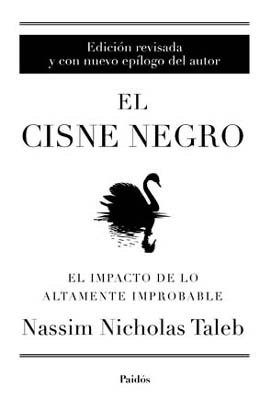 el cisne negroNassim Nicholas Taleb
 EXISTE LA SUERTENassim Nicholas Taleb
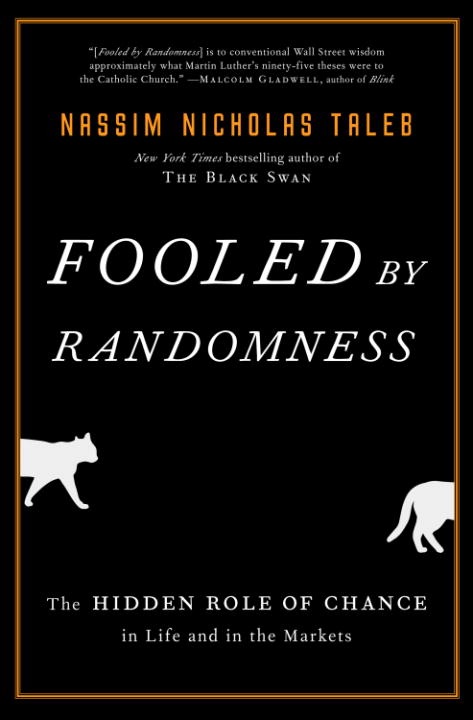 Fooled by RandomnessNassim Nicholas Taleb
 Siyah Kugu - Olasiliksiz Gorunenin EtkisiNassim Nicholas Taleb
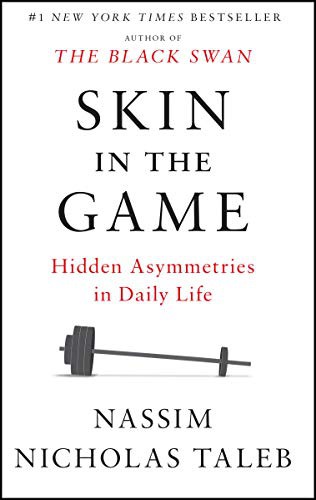 Skin in the GameNassim Nicholas Taleb
 Statistical Consequences of Fat TailsNassim Nicholas Taleb
 The Bed of ProcrustesNassim Nicholas Taleb