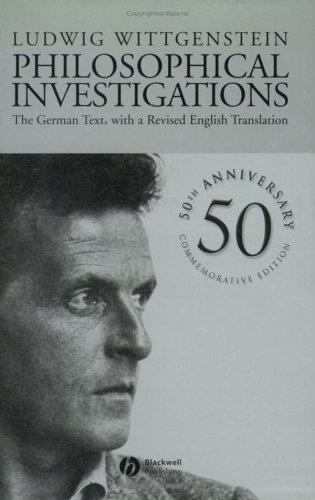
Philosophical Investigations
≈ From memoryPhilosophy is not a search for hidden truths, but an attempt to untangle the knots in our thinking caused by the misuse of language.
In one sentence
Meaning is not a mental state or a reference to an object; meaning is use within a shared human activity called a "language-game."
Why read this (and who it's for)
Most people approach philosophy as a search for "The Truth"—a hidden, objective reality that words are trying to point toward. Wittgenstein argues that we get into philosophical trouble when we treat language like a mirror of the world rather than a toolkit for living in it.
This book is for:
- The intellectual perfectionist who feels they are "missing" the true meaning of things.
- The linguist or communicator who wants to understand how social context shapes meaning.
- The philosopher/student who wants to move beyond abstract theorizing and into a grounded understanding of how human thought actually functions.
After reading this, you will stop asking "What does this word mean in an abstract sense?" and start asking "How is this word being used in this specific activity?" You will develop a "therapeutic" approach to your own mental confusion, identifying when your thoughts have become tangled by linguistic slips.
The big idea
Wittgenstein’s central thesis is a radical shift from his earlier work (Tractatus). In the Tractatus, he tried to find a perfect logical structure for language. In Philosophical Investigations, he argues that language is not a formal system of logic; it is a human activity.
He argues that we learn to speak by participating in "Forms of Life"—the shared human behaviors, cultures, and biological realities that provide the ground for communication. Just as a child learns to walk or eat before they can speak, a human learns to participate in "Language Games" (Sprachspiele). A language game is an activity where words are used as tools: a command, a greeting, a joke, a report of a fact, or a prayer.
The "problem" of philosophy arises when we take these tools out of their context. When we ask, "What is the essence of Justice?" or "What is the true meaning of 'Time'?", we are treating words as if they refer to some ghostly, independent entity outside of human activity. Wittgenstein argues that there is no "hidden" meaning behind the word; the meaning is the way it functions within the game. To understand a concept, you must see how it is used in the actual practice of life.
Key ideas
Language Games (Sprachspiele)
- What it is — The idea that speaking a language is not just "expressing" thoughts; it is an activity governed by rules, much like a game (e.g., chess, soccer). Every act of speaking is part of a specific game with its own goals and constraints.
- Why it matters — It shifts the focus from representation to participation. You cannot understand a word in isolation; you can only understand it by knowing what "moves" are allowed within that specific social activity.
- In the book — Wittgenstein compares language to games because, like games, they have rules and are practiced by participants. He notes that some games are similar (like board games), but they all share a common "family resemblance" of being rule-governed activities.
Meaning as Use
- What it is — The meaning of a word is not an internal mental image or an external object; the meaning of a word is its use in the language-game. To know what a word means is to know how to employ it correctly within a social context.
- Why it matters — This destroys the "mentalist" view that words represent private thoughts. It suggests that if you want to know what someone means by a word, don't look inside their head; look at how they are using the word in the world.
- In the book — He argues that when we ask for the meaning of a word like "love" or "justice," we often fail because we aren't looking at how those words are used in actual human interactions, but rather trying to find a singular, abstract definition that doesn't exist.
Family Resemblances
- What it is — Concepts do not have a single "essence" or a set of necessary and sufficient conditions. Instead, they have a network of overlapping similarities, much like the physical features of members of a family (e.g., some have the same nose, others the same eyes).
- Why it matters — It explains why we can't find a "core" definition for things like "Game." There is no single feature common to all games; there is only a complicated web of similarities that allows us to group them together.
- In the book — He uses the example of "Games." A board game, a ball game, and a card game share many features (rules, competition, scoring), but there is no one single feature that belongs to all three.
The Rule-Following Paradox
- What it is — To follow a rule is not a mental act; it is an observable behavior. If I tell you "Follow this rule," and you ask "How?", the answer is: "Do as I say." There is no hidden "rule-following" mechanism in the brain; there is only the practice of doing what the rule prescribes.
- Why it matters — It challenges the idea that we can "know" a rule perfectly in our minds before we act. Rules are only validated through consistent, socially recognized behavior.
- In the book — Wittgenstein explores how we might think we "understand" a rule (like a mathematical formula), but he argues that understanding is actually the ability to apply it correctly across various contexts of practice.
The Private Language Argument
- What it is — It is impossible to have a language that is entirely private—one where only one person can understand the meanings. Because "meaning" requires the possibility of being wrong, and you can only be wrong if there is a standard for correctness, meaning must be public.
- Why it matters — This strikes at the heart of Cartesian dualism (the idea that our inner thoughts are private). It argues that even our internal sensations (like "pain") are understood through a public vocabulary we've acquired through social interaction.
- In the book — He uses the example of a person trying to keep a diary of their internal sensations. If they use a private sign for a sensation, they have no way to check if they are using that sign correctly tomorrow. Without an external "check," there is no rule; without a rule, there is no language.
Forms of Life (Lebensformen)
- What it is — Language is not a standalone system; it is embedded in human behavior, biology, and culture. To speak a language is to share a "Form of Life"—a shared way of living that makes the game possible.
- Why it matters — It reminds us that communication is grounded in our shared humanity. You cannot learn a language without also learning the behaviors, reactions, and social norms that accompany it.
- In the book — He argues that "to imagine a new language" would require imagining a new way of living entirely. Language isn't just a set of labels; it's an expression of our shared human activity.
Frameworks & tools
The "Language Game" Diagnostic
Use this when you find yourself confused by a philosophical concept or a person's confusing statement. Instead of asking "What is the definition?", analyze the game:
- Identify the Activity: What is the person actually doing? (Are they trying to warn me? Are they trying to joke? Are they trying to define a category?)
- Identify the Rules: What are the unspoken rules of this specific context? (e.g., In a joke, the rule is "subvert expectation." In a scientific paper, the rule is "empirical verification.")
- Identify the Moves: How is the word being used as a tool here? Is it a command? A question? A label?
- Locate the Break: Where did the confusion happen? Did someone try to use a "joke" move in a "scientific" game? Or did they try to find an "essence" where there is only a "family resemblance"?
Family Resemblance Mapping
Use this when you are trying to categorize something and keep hitting a wall because you can't find a single "perfect" definition.
- List Examples: Write down 5–10 examples of the thing you are trying to define (e.g., "What is a 'good' employee?").
- Identify Overlaps: Instead of looking for one trait they all share, look for the overlapping traits (punctuality, skill, attitude, reliability).
- Map the Web: Recognize that the category is held together by a web of similarities rather than a single "core" property. This allows you to accept the category without needing a perfect definition.
Memorable examples & stories
The Game Analogy
Wittgenstein uses various types of games—ball games, board games, card games—to show that while they all fall under the umbrella of "Games," there is no single feature common to all of them. Instead, they share a complex network of overlapping similarities (rules, competition, scoring). The lesson: Concepts like "Game" or "Art" don't have an essence; they have family resemblances.
The Beetle in the Box
Imagine a box with something inside it that everyone calls a "beetle." No one can look inside. If the contents of the box don't affect the way we use the word "beetle," then the actual content of the box is irrelevant to the language-game. The lesson: When we say "I have an internal feeling/thought," if that thought doesn't change how we interact with the world, then the "thing" inside our heads isn't part of the meaning of the word.
The Diary of Sensations
Imagine a person who tries to keep a private diary of their inner sensations. They decide to put a sign in their diary every time they feel a certain sensation. However, since no one else can see the diary and there is no external standard for what that sensation "is," the person has no way of knowing if they are applying the sign correctly. The lesson: A purely private language is impossible because meaning requires a public standard of correctness.
Key quotes
- "The meaning of a word is its use in the language." (Paraphrased) Why it matters: This shifts philosophy from metaphysics to linguistics and behavior.
- "To imagine a new language would mean to imagine a new form of life." (Paraphrased) Why it matters: It highlights that communication is inseparable from our shared human experience.
- "Philosophical problems arise when language goes on holiday." (Paraphrased) Why it matters: This is the core of his therapeutic approach—problems occur when we use words outside of their proper "games."
How to apply it
This week
- The "Context" Audit: The next time you find yourself frustrated by a vague concept (e.g., "Why is this so unfair?"), stop and ask: "In what game is the word 'unfair' being used here? What was the expected move that wasn't made?"
- Identify Family Resemblances: Pick a category you struggle to define (e.g., "What makes a good friend?"). Instead of looking for one trait, list 5 overlapping traits that apply to different friends in your life.
Ongoing
- The Therapeutic Approach: When you feel a philosophical "knot" in your mind—a feeling of being stuck on a deep, unsolvable question—treat it as a linguistic tangle. Ask: "What is the rule I'm assuming here? Is this word actually doing what I think it's doing?"
- Practice Rule-Following: When learning a new skill (a language, an instrument, a sport), focus on the practice of the rules rather than the mental "understanding" of them. Mastery comes from the repetition of the game, not the contemplation of the rulebook.
Common pitfalls
- The "Socialist" Trap: People often think Wittgenstein means that meaning is only social. He doesn't mean we lack private thoughts; he means that a private thought cannot be meaningful in the sense of being a language-game because it lacks the public check of rules.
- Over-Literalizing "Games": Don't think of "Language Games" as literal games with winners and losers. They are metaphors for any rule-governed human activity (like praying, cursing, or reporting).
- The "Meaning is Only Use" Extreme: While meaning is use, this doesn't mean that the experience of the world is irrelevant. It means that our description of the experience only gains meaning when it is integrated into our shared activities with others.
Connects to
- J.L. Austin, "How to Do Things with Words": Extends Wittgenstein’s idea of language as an activity by focusing on "Speech Act Theory"—how we perform actions (promising, ordering, naming) through words.
- Martin Heidegger: Challenges and complements Wittgenstein's view of "Language" and "Being." While Wittgenstein focuses on the use of language in life, Heidegger looks at how Language is the house of Being itself.
If you remember only three things
- Meaning is not a hidden thing; it is how we use words in social activities (Language Games).
- Concepts like "Game" or "Art" don't have an essence; they have family resemblances.
- Philosophical problems are usually just linguistic tangles—we get confused when we take words out of their natural "games" and try to treat them as abstract objects.
Internalize it
-
Reflection questions
- When I say "I understand," what am I actually saying? Am I saying I have a mental map, or that I know how to play the game correctly?
- Can I identify a "Form of Life" (a shared social activity) that makes my current job/hobby possible? What would happen if that form of life were removed?
- When I get frustrated by a complex idea, can I stop and ask: "Is this a real problem, or is the word just 'going on holiday' from its usual use?"
-
Flashcards Q: What is a "Language Game"? A: An activity where words are used as tools according to specific rules within a social context.
Q: How does Wittgenstein define "Meaning"? A: Meaning is Use. To know what a word means is to know how to use it in a language-game.
Q: What is the difference between an "essence" and a "family resemblance"? A: An essence is a single, necessary feature; family resemblance is a network of overlapping similarities (like features in a human family).
Q: Why is a "Private Language" impossible? A: Because meaning requires a standard of correctness, which can only exist if there is a public rule/community to check against.
Q: What does Wittgenstein mean by "Philosophical problems arise when language goes on holiday"? A: Problems occur when we use words outside of their practical, rule-governed activities and try to treat them as abstract, independent entities.
Fidelity note
I have a high level of confidence in the core concepts presented here (Language Games, Meaning as Use, Family Resemblances, Private Language). These are the "pillars" of Philosophical Investigations. However, because Wittgenstein's style is notoriously difficult and non-linear, some of his more nuanced distinctions regarding the "Rule-Following" paradox or the specific nuances of "Forms of Life" can be subtle. Readers should verify the specific "Beetle in a Box" and "Private Language" arguments against the text to see the full depth of his logic.
Keep going — related reads


More from Ludwig Wittgenstein
 Bemerkungen über die FarbenLudwig WittgensteinBemerkungen über die FarbenLudwig Wittgenstein
 Lectures, Cambridge, 1932-1935Ludwig Wittgenstein
 Letters to Russell, Keynes, and MooreLudwig Wittgenstein
 Notebooks, 1914-1916Ludwig Wittgenstein
 On certainty =Ludwig Wittgenstein
 Philosophische BemerkungenLudwig Wittgenstein
 Philosophische UntersuchungenLudwig Wittgenstein
 Remarks on the Philosophy of Psychology, Volume 1 (Remarks on the Philosophy of Psychology)Ludwig Wittgenstein
 Tractatus logico-philosophicusLudwig Wittgenstein