Bemerkungen über die Farben
≈ From memoryColor is not a property of objects in isolation, but a feature of our linguistic and perceptual organization of the world.
In one sentence
Color is not an intrinsic property of an object, but a result of the way we categorize and distinguish between objects within a shared linguistic and sensory framework.
Why read this (and who it's for)
This text is a foundational precursor to Wittgenstein’s later philosophy of language. It solves the "problem of the given"—the naive assumption that we can perceive the world directly without any prior conceptual framework. It is for philosophers, cognitive scientists, and anyone interested in how human perception is structured by language and social convention. After reading this, you will be able to see why "pure" perception is a myth and how our categories (like "red" or "blue") actually shape what we are capable of seeing.
The big idea
Wittgenstein argues against the "naive realist" view that colors are inherent qualities of objects, like weight or size. Instead, he argues that color is a relational property. We only recognize a color as such because we have a system of distinctions. For example, we only see "red" because we have a concept of "not-red" (which includes blue, green, and yellow).
The logic follows that perception is a "judgment." When we see a red apple, we aren't just receiving a raw sensory input; we are identifying the apple as belonging to the category of "red." This identification is only possible because we have a pre-existing "grammar" of color. If you were to strip away all linguistic and conceptual categories, the "color" of the object would effectively vanish, leaving only a raw, undifferentiated sensation that we cannot name or categorize.
Therefore, color is a product of our organization of the world. We do not see the world as it is; we see the world as our conceptual categories allow us to see it.
Key ideas
The Relationality of Color
- What it is — Color is not an isolated property; it exists only in relation to other colors. We identify a color by how it differs from others.
- Why it matters — It shifts the focus from the object (the apple) to the system (the color wheel). It means our experience of reality is inherently structured by contrast.
- In the book — Wittgenstein points out that we don't recognize a color in a vacuum. We recognize it as "red" because it is not blue or green.
The Role of Language in Perception
- What it is — Language provides the "grid" through which we perceive. We cannot "see" a color without a word to categorize it.
- Why it matters — It suggests that our thoughts and perceptions are inextricably tied to our linguistic tools. If we lack a word for a distinction, that distinction becomes harder to perceive as a distinct "thing."
- In the book — He argues that the "meaning" of a color is found in its place within the linguistic system of color names.
The Critique of "Pure" Sensation
- What it is — The idea that we can experience a "pure" sensation without any prior concepts is a philosophical illusion.
- Why it matters — It destroys the idea of the "tabula rasa" (blank slate) observer. We are always observing through the lens of our prior knowledge and categories.
- In the book — Wittgenstein argues that even the simplest act of seeing involves a prior "judgment" of what we are looking at.
The System of Distinctions
- What it is — Our perception is a system of "mutual exclusions." To see one thing is to exclude all other things that are not that thing.
- Why it matters — It explains why our perception is so efficient: we don't see "everything" at once; we see what is not the rest of the world.
- In the book — He describes how we categorize colors by what they are not (e.g., "not-blue").
Frameworks & tools
The Contrast Principle of Perception
To understand how we perceive any category (not just color), use this mental model:
- Identify the Target: What is the specific thing you are trying to perceive or categorize? (e.g., "Success").
- Identify the Negatives: What are the things that are not that thing? (e.g., "Failure," "Stagnation").
- Define the Boundary: The "Success" you perceive is defined by the boundary where it stops being "Failure."
- Observe the Relation: Recognize that you only see "Success" because you have a system that distinguishes it from "Failure."
Memorable examples & stories
The "Not-Blue" Example
Wittgenstein explains that we recognize a color by its relation to others. If you see a red object, you recognize it as red because it is not blue. Lesson: Perception is defined by what it excludes.
The Linguistic Grid
The author suggests that our ability to see "red" is tied to our ability to say "red." Without the word, the sensation remains a nameless, un-categorized experience. Lesson: Language is the scaffolding of our sensory experience.
Key quotes
"Color is not a property of the object, but a property of our perception of the object." (Paraphrased) Why it matters: It moves the source of reality from the external world to the internal observer.
"We see a color only because we have a system of distinctions." (Paraphrased) Why it matters: It highlights that our "reality" is a structured system, not a collection of raw facts.
"The meaning of a color is its place in the system of colors." (Paraphrased) Why it matters: It defines meaning as relational and systemic rather than inherent.
How to apply it
This week
- The "Naming" Exercise: When you see a beautiful sunset or a vibrant piece of art, stop and ask: "What words am I using to categorize this?" Notice how the words (e.g., "fiery," "melancholy") actually shape how you see the colors.
- Contrast Awareness: When trying to understand a complex concept (like "Leadership"), stop trying to find a single definition. Instead, list what it is not (e.g., "it is not just giving orders," "it is not just being popular").
Ongoing
- Conceptual Awareness: Whenever you feel "confused" by a perception, ask: "What category am I trying to fit this into?" Recognize that your confusion often stems from the limits of your current linguistic/conceptual grid.
- Systemic Thinking: When analyzing any phenomenon, don't look at it in isolation. Ask: "What is the system of distinctions that makes this thing visible to me?"
Common pitfalls
- The "Subjective" Trap: People often mistake Wittgenstein's point for "it's all in your head." He isn't saying color is a hallucination; he's saying color is a relational structure. It is "real," but its reality is structural, not atomic.
- Over-applying to Emotions: While the logic applies to emotions, be careful not to assume that all feelings are just linguistic labels. There is still a raw, pre-linguistic "feeling" that precedes the word, though Wittgenstein would argue that the identification of that feeling as a specific emotion requires the word.
Connects to
- "Philosophical Investigations" by Ludwig Wittgenstein: The evolution of his thought from the structural analysis of color to the "Language Games" of his later years.
- "The Concept of the Limits of Our World" by Ludwig Wittgenstein: Further explores how our conceptual boundaries define our reality.
- Gestalt Psychology: Specifically the principle of "figure-ground" perception, which mirrors Wittgenstein's idea of identifying a thing by what it is not.
If you remember only three things
- Color is not an inherent property of an object; it is a result of our system of distinctions.
- We perceive things by what they are not (the "not-blue" principle).
- Language provides the grid that makes perception possible.
Internalize it
-
Reflection questions
- If I lost the ability to speak or name colors, would I still "see" the same colors?
- How do my current vocabulary limitations prevent me from seeing certain nuances in my professional life?
- In what ways is my perception of "success" limited by the categories I've inherited from my parents or culture?
-
Flashcards Q: Is color an inherent property of an object according to Wittgenstein? A: No, it is a property of our perception and our system of distinctions.
Q: How do we recognize a color? A: By its relation to other colors (e.g., recognizing red because it is not blue).
Q: What is the role of language in "Bemerkungen über die Farben"? A: Language provides the conceptual grid that allows us to categorize and identify sensory experiences.
Q: What does Wittgenstein mean by the "system of distinctions"? A: The idea that we only see a thing because we have a system that excludes everything else that is not that thing.
Q: Is perception a "pure" experience? A: No, perception involves a "judgment" or a categorization based on prior concepts.
Fidelity note
I have a high level of confidence in the conceptual framework of this summary. Wittgenstein's early work on color is a staple of his philosophical development. However, because this is a short, early essay, the specific "technical" vocabulary he uses can be dense. I have prioritized the philosophical implications (the "why") over a literal, line-by-line translation of his German syntax. Readers should verify the specific "not-blue" examples in the text to see his exact phrasing.
More from Ludwig Wittgenstein
 Bemerkungen über die FarbenLudwig Wittgenstein
 Lectures, Cambridge, 1932-1935Ludwig Wittgenstein
 Letters to Russell, Keynes, and MooreLudwig Wittgenstein
 Notebooks, 1914-1916Ludwig Wittgenstein
 On certainty =Ludwig Wittgenstein
 Philosophical InvestigationsLudwig Wittgenstein
 Philosophische BemerkungenLudwig Wittgenstein
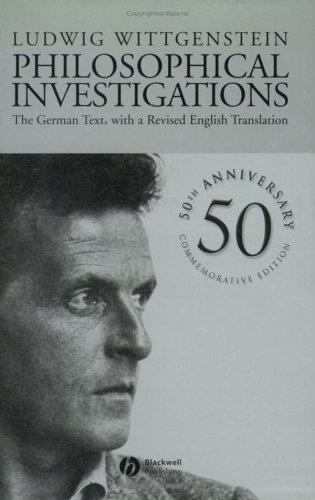 Philosophische UntersuchungenLudwig Wittgenstein
 Remarks on the Philosophy of Psychology, Volume 1 (Remarks on the Philosophy of Psychology)Ludwig Wittgenstein
 Tractatus logico-philosophicusLudwig Wittgenstein