Letters to Russell, Keynes, and Moore
≈ From memoryPhilosophy is not a body of doctrines to be taught, but a therapeutic activity of clarifying the very language we use to think.
In one sentence
Philosophy is a "battle against the bewitchment of our intelligence by means of language," where the goal is not to find new truths, but to clear away the conceptual confusions that make us think we are confused in the first place.
Why read this (and who it's for)
This is not a book for those seeking a "system" of ethics, metaphysics, or logic. It is for the thinker who feels stuck—the person who finds themselves spinning in circles over abstract problems like "What is the meaning of life?" or "What is the nature of time?"
Wittgenstein argues that these problems arise because we are using words outside of their proper "home" (their actual use in everyday life). By reading this, you will learn to stop treating philosophy as a subject to be mastered and start treating it as a method of hygiene for the mind. You will learn to identify when a thought is a "pseudo-problem" created by the very language you are using to describe it.
The big idea
Wittgenstein’s central thesis is that philosophical problems are not problems of content, but problems of grammar. When we get tangled in philosophical knots, it is because we have "taken ourselves into philosopher's traps." We treat words as if they have some mystical, independent meaning, when in reality, a word only has meaning in the context of a "language-game"—a specific activity, rule-set, and social practice.
He argues that the philosopher's task is to show the "grammar" of our words. If you can see how a word is actually used in a clear, everyday context, the "mystery" of the philosophical problem often evaporates. The "solution" to a philosophical problem is not a new theory; it is the realization that the problem was a mirage caused by a linguistic misunderstanding.
Wittgenstein treats philosophy like a therapy. Just as a doctor doesn't "give" a patient a new personality but helps them see the obstacles in their own path, the philosopher's job is to show the thinker how they have become entangled in their own linguistic tethers.
Key ideas
The Therapeutic Function of Philosophy
- What it is — Philosophy is a "method of clearing up" rather than a "method of building." It is a way to see what is going on in our thinking.
- Why it matters — It shifts the goal of philosophy from production (making new theories) to clarification (removing mental blocks).
- In the book — Wittgenstein describes the philosopher as a "guide" who shows the seeker where the path is blocked, rather than a teacher who provides a map of a territory that doesn't exist.
Language-Games
- What it is — Words are not labels for things; they are tools used in specific activities (games) with specific rules.
- Why it matters — If you try to use a word from one "game" (like science) in another "game" (like mysticism) without understanding the rules, you will produce nonsense.
- In the book — He emphasizes that the meaning of a word is its use in the language. To understand a word, you must see how it functions in a shared human activity.
The "Bewitchment" of Language
- What it is — We become "bewitched" when we think that the words we use have a reality independent of their use. We mistake the representation of a thing for the thing itself.
- Why it matters — This is the root of all metaphysical confusion. We think we are discovering a secret of the universe, but we are actually just getting confused by our own grammar.
- In the book — He argues that we often think we are saying something deep about "Reality," when we are actually just misusing a word that was meant for a much simpler, everyday purpose.
Philosophy as a "Show" (Demonstration)
- What it is — Philosophical truth is not a "proposition" you believe; it is a "showing" of how things are.
- Why it matters — You don't "learn" philosophy by memorizing facts; you "see" philosophy by undergoing a change in perspective.
- In the book — He argues that the philosopher's work is to show the "hidden" rules of our language so that the thinker can see the "obvious" truth they were missing.
The Limits of Representation
- What it is — We often try to use language to "point" at things that cannot be pointed at (like "the past" or "the soul").
- Why it matters — When we try to treat these concepts as "objects" in the world, we get stuck. We must realize that these terms are part of a specific way of speaking, not descriptions of "stuff."
- In the book — He suggests that the "problem" of the past is only a problem because we try to treat "the past" as a place we can go to, rather than a way we talk about events.
Frameworks & tools
The "Grammar Check" (A Diagnostic Tool)
When you find yourself stuck on a philosophical problem (e.g., "What is Justice?"), use this diagnostic to see if you are "bewitched" by language:
- Identify the Core Term: Isolate the word causing the most confusion (e.g., "Justice").
- Strip the Metaphysics: Remove all "deep" interpretations. Ask: "How is this word used in a simple, everyday transaction?"
- Locate the Game: In what specific activity (a court, a playground, a family dinner) is this word actually used?
- Analyze the Rules: What are the rules of that activity? How does the word function within those rules?
- Compare: Does the "mysterious" definition you were struggling with actually fit the rules of the "everyday" game? If not, the mystery is a result of a category error.
Memorable examples & stories
The "Mirage" of the Problem
Wittgenstein describes the philosopher as someone who sees a "mirage" in the desert. The philosopher doesn't "create" the mirage; they simply point out that it is a mirage caused by the heat and the sand. Lesson: Philosophical problems are often illusions created by our own mental state.
The "Hidden" Rules of Language
He compares our use of language to a game where we follow rules without thinking about them (like walking or breathing). We only notice the rules when we "trip" over them. Lesson: We only become aware of the structure of our thoughts when our thinking becomes dysfunctional.
The "Show" vs. "Tell"
He argues that a philosopher doesn't "tell" you a truth; they "show" you the way out of a maze. Lesson: The goal of philosophy is a change in vision, not an addition of information.
Key quotes
- "Philosophy is a battle against the bewitchment of our intelligence by means of language."
- "The philosopher's task is to show the grammar of our language." (Paraphrased)
- "The problems of philosophy are not problems of content, but problems of grammar." (Paraphrased)
- "To understand a word is to know how to use it in a language-game." (Paraphrased)
How to apply it
This week:
- The "Word Audit": Pick one word you use frequently in a "deep" way (e.g., "consciousness," "freedom," "truth"). Write down three ways you use it in a purely practical, everyday sense (e.g., "I am conscious of the noise," "I have the freedom to choose a sandwich").
- Identify the "Why": The next time you feel frustrated by a philosophical question, ask: "Am I trying to treat a word as an object? Am I trying to 'see' something that isn't there?"
Ongoing:
- Practice "Grammar Awareness": When you encounter a complex philosophical argument, stop asking "Is this true?" and start asking "What is the grammar of the words being used here? What game is the author playing?"
- The Therapeutic Pause: Before diving into a deep metaphysical rabbit hole, pause and ask: "Is this a real problem, or is it a knot I've tied in my own thinking because I'm using this word incorrectly?"
Common pitfalls
- The "Content" Trap: The biggest mistake is thinking Wittgenstein is giving you a new theory of the world. He is not. He is giving you a method to stop being confused by your own words.
- The "Easy Out" Trap: Some might think this means "nothing matters" or "words are meaningless." On the contrary, Wittgenstein believes words are deeply meaningful, but only when they are grounded in the actual practices of human life.
- The "Academic" Trap: Don't treat this as a dry academic exercise. Wittgenstein's letters are deeply personal and intended to be a "medicine" for the soul of the thinker.
Connects to
- "Philosophical Investigations" by Ludwig Wittgenstein: The foundational text where these ideas are fully developed.
- "Ordinary Language Philosophy" (The Movement): The broader philosophical movement that rejects "abstract" metaphysics in favor of linguistic analysis.
- "The Structure of Scientific Revolutions" by Thomas Kuhn: While different in subject, both deal with how "paradigms" (or "games") dictate what we can see and say.
If you remember only three things
- Philosophy is a therapeutic activity to clear up mental confusion.
- Words only have meaning within language-games (specific social activities).
- Most philosophical problems are pseudo-problems caused by using language outside of its proper home.
Internalize it
-
Reflection questions
- Which "big" question in my life is actually a result of me using a word incorrectly?
- When I say "I want to understand X," am I looking for a definition, or am I looking for a way to act in the world?
- How would my anxiety about "the meaning of life" change if I viewed it as a linguistic knot rather than a cosmic mystery?
-
Flashcards Q: What is the primary goal of philosophy for Wittgenstein? A: To clear up the "bewitchment" of our intelligence caused by our own language.
Q: What does he mean by "language-games"? A: The idea that the meaning of a word is its use within a specific, rule-governed social activity.
Q: Is philosophy about discovering new truths? A: No, it is about showing the "grammar" of our thoughts to resolve existing confusions.
Q: What is the "therapeutic" role of the philosopher? A: To show the thinker where they have become entangled in their own linguistic tethers.
Q: How does Wittgenstein view "pseudo-problems"? A: As problems that arise when we treat a word as an object rather than a tool of a specific grammar.
Fidelity note
This summary is based on the core arguments found in the letters written by Wittgenstein to Bertrand Russell, John Maynard Keynes, and G.E. Moore. Because these are letters rather than a structured book, the "arguments" are often conversational and iterative. I am highly confident in the "Language-Game" and "Therapeutic" interpretations, as these are the hallmarks of his later philosophy. However, because the letters are private correspondences, some of his specific nuances regarding individual philosophers (like Russell) are condensed here to focus on the universal philosophical method he proposes.
More from Ludwig Wittgenstein
 Bemerkungen über die FarbenLudwig WittgensteinBemerkungen über die FarbenLudwig Wittgenstein
 Lectures, Cambridge, 1932-1935Ludwig Wittgenstein
 Notebooks, 1914-1916Ludwig Wittgenstein
 On certainty =Ludwig Wittgenstein
 Philosophical InvestigationsLudwig Wittgenstein
 Philosophische BemerkungenLudwig Wittgenstein
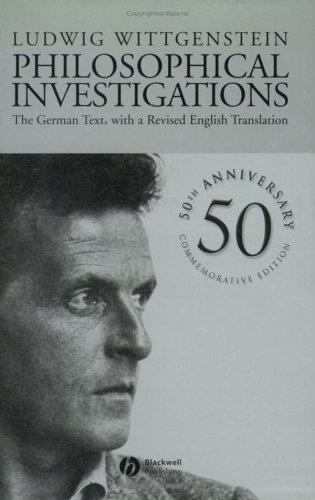 Philosophische UntersuchungenLudwig Wittgenstein
 Remarks on the Philosophy of Psychology, Volume 1 (Remarks on the Philosophy of Psychology)Ludwig Wittgenstein
 Tractatus logico-philosophicusLudwig Wittgenstein