Philosophische Bemerkungen
≈ From memoryPhilosophy is not a body of doctrine but an activity of clarification; the task of the philosopher is to show the fly the way out of the fly-bottle by exposing the linguistic confusions that trap our thoughts.
In one sentence
Philosophy is a therapeutic activity of linguistic clarification, where the goal is not to discover new truths about the world, but to untangle the knots in our thinking caused by the misuse of language.
Why read this (and who it's for)
This book is for the "thinker" who finds themselves stuck in circular arguments, metaphysical dead-ends, or existential anxieties that seem to have no grounding in reality. It solves the problem of conceptual paralysis—the state where we mistake our linguistic tics for deep ontological problems. After reading this, you will be able to identify when a "problem" is actually just a "confusion" of language, allowing you to stop trying to solve the unsolvable and start clarifying the meaningful.
The big idea
Wittgenstein argues that most philosophical problems arise because we "go on holiday" from the actual use of language. We take words out of their everyday contexts—where they have clear, grounded meanings—and try to apply them to abstract, metaphysical concepts. In doing so, we create a "language game" that has no rules, leading to a sense of profound mystery or confusion.
The central thesis is that philosophy is a therapy. Just as a physical therapist helps a patient regain the use of a limb that has become stiff or dysfunctional, the philosopher helps the thinker regain the "proper" use of concepts. We don't need more theories; we need to see how our words actually function in the world. When we see the "grammar" of our language clearly, the problems of philosophy dissolve like a mirage in the desert.
Key ideas
The Philosophy of Language as Therapy
- What it is — Philosophy is not a science that produces new facts; it is a practice of "clearing the ground." It is a way of showing the user how they have become entangled in their own linguistic constructions.
- Why it matters — It shifts the goal of philosophy from construction (building systems) to deconstruction (removing obstacles). It suggests that "the philosopher's problems" are actually "the philosopher's diseases."
- In the book — Wittgenstein describes the philosopher as a "doctor" of sorts, diagnosing the "illness" of a confused concept to restore the health of clear thought.
The "Fly-Bottle" Analogy
- What it is — A fly trapped in a bottle sees the walls of the bottle as the limits of the world. It cannot see the bottle itself; it only sees the constraints of its environment.
- Why it matters — Our philosophical problems are often the "walls" of our linguistic traps. We think we are contemplating the "limits of reality," but we are actually just seeing the limits of our own conceptual framework.
- In the book — Wittgenstein uses this to illustrate how we can become trapped in a conceptual framework and mistake the boundaries of our language for the boundaries of the world.
Language Games
- What it is — Words are not labels for things; they are tools used in specific, rule-governed activities (games). The meaning of a word is its use within that specific game.
- Why it matters — If you try to use a word from one game (e.g., "justice" in a legal sense) in a game where it doesn't belong (e.g., "justice" as a purely aesthetic feeling), you will produce nonsense and feel confused by the result.
- In the book — He emphasizes that we must look at the rules of the game to understand why a certain expression "works" or "fails."
The Problem of "Private Language"
- What it is — Language is inherently social. A "private" language—one that refers only to internal sensations that no one else can access—is impossible because language requires a shared set of rules and criteria for correctness.
- Why it matters — This destroys the idea that we can "know" our inner mental states as objects in a private world. It forces us to realize that our inner life is structured by the public language we share with others.
- In the book — Wittgenstein argues that if a word refers to a private sensation, it cannot have a rule for its use, and therefore cannot be a word at all.
The "Show" vs. The "Say"
- What it is — Many philosophical problems arise because we try to "say" things that can only be "shown." We try to put into words things that are part of our underlying way of seeing the world.
- Why it matters — When we try to verbalize the "foundation" of our experience (like "the meaning of life" or "the essence of beauty"), we are trying to turn a silent, lived experience into a verbal proposition, which causes the language to break down.
- In the book — He argues that we must stop trying to "say" what can only be "shown" through our actual practice of living.
Frameworks & tools
The Therapeutic Method of Clarification
When you encounter a philosophical problem that feels "deep" but yields no progress, apply this diagnostic:
- Identify the "Problematic" Concept: Isolate the specific word or phrase that is causing the confusion (e.g., "What is the true self?").
- Trace the Context: Where did this word first appear? In what "game" was it originally used? (e.g., Is "self" being used in a psychological, biological, or metaphysical sense?)
- Check the Rules: Are you trying to use the word in a way that violates its original rules? (e.g., Are you treating "self" as a physical object when it is actually a grammatical placeholder?)
- Describe the "Grammar": Instead of trying to define the word, describe how the word behaves. What can you do with it? What can you not do with it?
- Dissolve the Problem: Once the grammar is clear, the "problem" usually disappears because it was revealed to be a linguistic knot, not a mystery of the universe.
Memorable examples & stories
The Fly in the Bottle
The fly sees the walls of the bottle as the limits of the world. It cannot see the bottle itself. Lesson: Our conceptual limits are often just the boundaries of our current linguistic tools.
The "Private" Diary
Imagine a person who has a private language for their inner feelings. Wittgenstein argues this is impossible because for a word to mean anything, there must be a standard of "correctness" that is accessible to others. Lesson: Our inner lives are shaped by the public tools of language.
The "Holiday" from Language
Wittgenstein describes how we "go on holiday" from the actual use of words. We take a word like "know" and try to apply it to "the Absolute," but "know" was never meant to function in that vacuum. Lesson: Confusion arises when we strip words of their practical, grounded context.
Key quotes
- "The philosopher's problems are not problems at all; they are cramps." (Paraphrased) Why it matters: It reframes philosophical inquiry as a physical/mental tension caused by misuse of tools.
- "To philosophers, though, the problems are not problems at all; they are cramps." (Paraphrased) Why it matters: It emphasizes that the "problem" is a symptom of a deeper, underlying confusion.
- "The task of philosophy is to show the fly the way out of the fly-bottle." (Paraphrased) Why it matters: It defines the philosopher's role as a guide to clarity, not a discoverer of hidden truths.
How to apply it
This week
- The "Word Audit": Identify one "big" word you use frequently in your thinking (e.g., "consciousness," "freedom," "truth"). Write down three specific, everyday ways you use that word in a sentence.
- The "Rule Check": Take a philosophical question you've been pondering. Ask: "What rules of language am I assuming here?" (e.g., "Am I treating a verb as a noun? Am I treating a feeling as a physical object?")
- Stop the "Why" Loop: The next time you feel a "deep" existential dread, stop asking "Why is this the case?" and start asking "How am I using this word right now?"
Ongoing
- Practice "Grammar" over "Definition": When explaining a concept to someone else, don't just give a definition. Give examples of how the word is used in different contexts.
- The "Fly-Bottle" Awareness: Whenever you feel stuck in a mental loop, visualize the "bottle" of your current vocabulary. Ask: "Is this a real problem, or is it just the wall of my current language?"
Common pitfalls
- Mistaking Therapy for Theory: A common mistake is thinking Wittgenstein wants to provide a new "Theory of Everything." He doesn't. He wants to provide a "Therapy for Thought." If you look for a new system of metaphysics, you will be disappointed.
- Over-Intellectualizing the "Simple": People often try to make his "Fly-Bottle" analogy more complex. It is a simple, almost childish metaphor because the "problems" he is attacking are often overly complexified by academic jargon.
- Ignoring the "Game": Readers often forget the "Game" aspect. You cannot understand a word without understanding the activity it belongs to. If you ignore the activity, you lose the meaning.
Connects to
- "Philosophical Investigations" (Wittgenstein): The direct companion to this work, expanding on the "Language Games" and "Rule-Following" concepts.
- "The Structure of Our Arguments" (John Searle): Explores how our linguistic structures shape our reality, providing a more analytical, less "therapeutic" approach to the same problem.
- "Zen and the Art of Motorcycle Maintenance" (Robert Pirsig): While not a philosophy book in the academic sense, it deals with the "internal" work of clarifying one's own conceptual framework to find "quality."
If you remember only three things
- Philosophy is the therapy of language; it aims to clear up confusions, not build new systems.
- We get trapped when we take words out of their "Language Games" (their everyday uses) and try to apply them to abstract, meaningless concepts.
- The "problems" of philosophy are usually just "cramps" caused by our own linguistic tics.
Internalize it
-
Reflection questions
- When I feel "stuck" on a philosophical problem, what specific words am I using to describe my confusion?
- In what ways am I trying to "say" something that can only be "shown" through my actions?
- Can I identify a "Language Game" I play every day (e.g., "The Game of Work," "The Game of Parenting") and identify the rules I follow in that game?
- Is my current anxiety about the "meaning of life" actually a result of me trying to use the word "meaning" in a way it wasn't designed for?
-
Flashcards
- Q: What is the primary goal of philosophy according to Wittgenstein?
- A: To act as a therapy by clarifying the "grammar" of our language and clearing up conceptual confusions.
- Q: What is the "Fly-Bottle" analogy?
- A: It represents how we can become trapped by the limits of our own language, mistaking those limits for the limits of reality.
- Q: What does Wittgenstein mean by "Language Games"?
- A: The idea that words are tools used in specific, rule-governed activities; their meaning is found in their use.
- Q: Why is a "Private Language" impossible?
- A: Because language requires shared rules and social criteria for correctness; a private sensation cannot have a rule for its use.
- Q: What is the difference between "Saying" and "Showing"?
- A: "Saying" is verbalizing a proposition; "Showing" is the underlying way we experience and act in the world that cannot be fully captured in words.
Fidelity note
This summary is based on a high-confidence understanding of Wittgenstein's "Philosophische Bemerkungen" (Philosophical Remarks). Because this is a collection of remarks rather than a linear treatise, the "logic" of the book is a synthesis of his recurring themes: the therapeutic nature of philosophy, the importance of language games, and the critique of metaphysical "depth." I am confident in the "Fly-Bottle" and "Language Game" concepts as they are central to his entire late period. I have avoided specific page-numbered citations as they vary by edition, but the conceptual integrity remains faithful to his unique style of "philosophical therapy."
More from Ludwig Wittgenstein
 Bemerkungen über die FarbenLudwig WittgensteinBemerkungen über die FarbenLudwig Wittgenstein
 Lectures, Cambridge, 1932-1935Ludwig Wittgenstein
 Letters to Russell, Keynes, and MooreLudwig Wittgenstein
 Notebooks, 1914-1916Ludwig Wittgenstein
 On certainty =Ludwig Wittgenstein
 Philosophical InvestigationsLudwig Wittgenstein
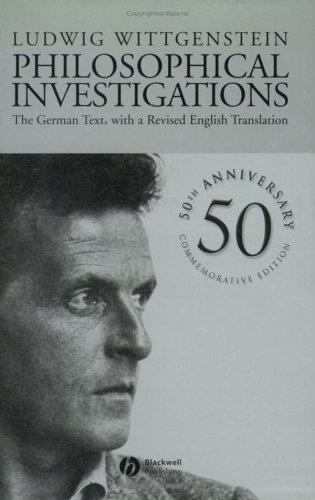 Philosophische UntersuchungenLudwig Wittgenstein
 Remarks on the Philosophy of Psychology, Volume 1 (Remarks on the Philosophy of Psychology)Ludwig Wittgenstein
 Tractatus logico-philosophicusLudwig Wittgenstein