Meditations on First Philosophy
≈ From memoryTo find an unshakable foundation for knowledge, one must systematically doubt everything until only the undeniable remains.
In one sentence
Descartes employs a method of radical skepticism to strip away all uncertain beliefs, ultimately discovering that the existence of a thinking self is the only foundational certainty from which all other knowledge can be reconstructed.
Why read this (and who it's for)
This book is the "ground zero" of modern Western philosophy. It addresses the fundamental problem of epistemology: How do I know that what I see, feel, and think is actually true?
If you have ever felt that your senses might be deceiving you—or if you’ve wondered how we can be certain of anything in a world where perception is often flawed—Descartes provides the ultimate toolkit for auditing your beliefs. You will emerge from this book with a rigorous mental framework for identifying "clear and distinct" truths and an understanding of why the human mind is considered a unique, thinking substance separate from the physical body.
The big idea
The central thesis of Meditations is that we cannot trust our senses or our common-sense assumptions about the world because they are frequently unreliable. To find a foundation for science and philosophy, Descartes argues we must perform a "mental demolition"—a systematic stripping away of every belief that has even a shadow of a doubt.
This isn't skepticism for the sake of being cynical; it is Methodological Doubt. Descartes wants to find a "First Philosophy"—a bedrock of absolute certainty. He treats his own mind like an architect inspecting a building: he will pull down every brick (belief) that might be structurally unsound until he finds the foundation (the Cogito) that cannot be removed without destroying the very act of questioning itself.
Once he finds this foundation—the existence of a thinking "I"—he then works to rebuild the world. He argues that because he possesses an idea of a perfect, infinite being (God), and because he is a finite, imperfect being, that idea must have been placed in his mind by a perfect source. This allows him to trust his clear perceptions again, eventually proving that the external world exists and that our bodies are physical machines governed by laws of motion.
Key ideas
Methodological Doubt
- What it is — The practice of treating any belief that can be doubted even slightly as if it were completely false. It is a "cleansing" process for the mind.
- Why it matters — Most of what we believe is inherited from tradition, parents, or sensory experience without scrutiny. By doubting everything, you clear the "intellectual clutter" to see what remains when the noise stops.
- In the book — Descartes describes this as a way to "demolish" his previous beliefs so that he can start over with a clean slate, ensuring that whatever he eventually accepts is built on a foundation of absolute certainty.
The Dream Argument
- What it is — The observation that there are no certain marks by which we can distinguish waking life from dreaming. While you sleep, your senses can provide vivid, convincing experiences that turn out to be illusions.
- Why it matters — It proves that the "external world" as perceived by our senses is not a reliable source of truth. If you can't trust your senses while you're awake (because they might be dreaming), you cannot use them as the primary foundation for knowledge.
- In in the book — Descartes notes that he often has dreams so vivid that he believes them to be real, yet he knows upon waking they were illusions. Therefore, the "senses" are not a reliable guide for truth.
The Evil Demon (Malin Génie)
- What it is — A thought experiment where you imagine a powerful, malicious entity who uses every ounce of its power to deceive you. This demon makes you see colors, feel heat, and even believe that 2+2=4 when it is not.
- Why it matters — This represents the "extreme" of doubt. It forces you to consider that even your mathematical and logical certainties might be manipulated by an external force. It isolates the "Self" as the only thing that cannot be faked, because even if you are being deceived, you must exist to be deceived.
- In the book — Descartes uses this to test the limits of his own certainty. If a demon can make me believe I am sitting by a fire when there is none, then my senses are not the source of truth—only my internal awareness of being deceived remains certain.
The Cogito (The Thinking Thing)
- What it is — The realization that even if everything else is an illusion, the fact that you are doubting proves that there is a "you" doing the doubting. "I think, therefore I am" (or more accurately, "I am, because I think").
- Why it matters — This is the first "First Principle." It establishes the existence of the Mind (res cogitans) as an undeniable fact. You are a thinking thing; you are not just a body, but a consciousness that can doubt, understand, affirm, and deny.
- In the book — Descartes realizes that even if a demon deceives him, he must exist in order to be deceived. The act of doubting is proof of existence.
Clear and Distinct Ideas
- What it is — The "litmus test" for truth. A clear idea is one that is present and vivid to the mind; a distinct idea is one where all other properties are excluded (like the definition of a triangle).
- Why it matters — Since we can't trust our senses, we need a new standard for what counts as "true." Descartes proposes that anything he perceives with absolute clarity and distinction—mathematical truths, logical identities—is fundamentally true.
- In the book — He uses his own internal awareness of mathematical truths (like 3+3=6) as examples of things that are "clear and distinct" to the mind, even if they aren't "seen" in the physical world.
The Trademark Argument (God as Guarantor)
- What it is — The argument that because humans have an idea of a perfect, infinite being (God), but we ourselves are finite and imperfect, we could not have invented that idea. Therefore, the idea must have been "stamped" into our minds by a perfect source.
- Why it matters — This is how Descartes bridges the gap between his private mind and the outside world. If God exists and is perfectly good, He would not allow us to be systematically deceived about the existence of the physical world. Thus, we can trust our senses again—provided they are used correctly.
- In the book — He argues that a "false" God would be a contradiction in terms (a square circle), so the source of his ideas must be a true, perfect God who guarantees the reliability of his perceptions.
Mind-Body Dualism (Res Cogitans vs. Res Extensa)
- What it is — The distinction between two types of substances: res cogitans (thinking things like minds and souls) and res extensa (extended things like bodies and matter).
- Why it matters — It defines the modern view of the human person as a "ghost in a machine." Your mind is not your body; your body is an object in space, while your mind is a thinking substance that occupies no space.
- In the book — Descartes argues that because he can clearly conceive of himself as a thinking thing without a body, and he can conceive of his body as a machine without a soul, they must be two fundamentally different substances.
Frameworks & tools
The Method of Radical Doubt (The Sieve)
Use this framework when you are faced with a deeply held belief or a complex problem where the "facts" seem contradictory.
- Identify the Belief: State clearly what you believe to be true (e.g., "I know that my coworkers trust me").
- Apply Sensory Doubt: Ask, "Is this based solely on what I saw/heard? Could my senses have been deceived by bias, fatigue, or misunderstanding?"
- Apply the Dream Test: Ask, "Could this experience be a recurring mental pattern or an internal narrative rather than an external reality?"
- Apply the Evil Demon (The Ultimate Skeptic): Ask, "If I were being intentionally misled by a source of misinformation (a biased algorithm, a charismatic liar, my own ego), would this belief still hold up?"
- Identify the Residue: What remains? If the belief survives all three tests, it is a "Clear and Distinct" truth. If not, discard it as an assumption.
The Clear & Distinct Criterion
Use this to evaluate your personal convictions or professional goals.
- Is it Clear? Is the idea present to your mind without any confusion? (Can you explain it simply?)
- Is it Distinct? Does it exclude all other possibilities? (Does it have a specific, non-overlapping definition?)
- The Rule: If an idea is not both clear and distinct, do not treat it as a "First Principle." Treat it only as a hypothesis.
Memorable examples & stories
The Dream Argument
Descartes describes how we often wake up from a dream that felt entirely real—a fall, a conversation, or a physical sensation. The Lesson: Just because an experience feels "real" does not mean it is "true." Feeling and perception are not the same as evidence.
The Evil Demon (Malin Génie)
Descartes imagines a demon who manipulates his very thoughts, making him believe that 2+3=5 when it isn't. The Lesson: This forces you to realize that your "common sense" is actually an incredibly fragile house of cards built on unexamined assumptions.
The Wax Block
Descartes considers a piece of wax: it has a certain shape, size, and smell. When placed near a fire, the smell vanishes, the shape melts, and the texture changes. Yet, we know it is the same piece of wax. The Lesson: Our senses only perceive "accidents" (color, shape, smell). The "essence" of the object is understood by the mind alone.
Key quotes
"Whatever I admit to being true, I must admit to being certain." (Paraphrased) Why it matters: This is the foundation of his radical doubt—if you aren't 100% sure, you shouldn't treat it as a fact.
"I am, I exist, is necessarily and immediately expressed by my thinking." (Paraphrased) Why it matters: The Cogito. Your consciousness is the only thing that cannot be argued away.
"The existence of God, not with any reason, but simply by the light of reason, seems to be admitted by me as clearly and distinctly as the existence of my own body." (Paraphrased) Why it matters: Descartes argues that our internal intuition of a perfect being is the ultimate proof of an external reality.
How to apply it
This week
- The "Audit" Exercise: Choose one thing you believe to be true about your life or career (e.g., "I am good at my job"). Apply the Method of Radical Doubt. Strip away the feelings, the social validation, and the assumptions until you find what is actually proven by your actions.
- The Clear/Distinct Test: When someone gives you a piece of advice or an opinion, ask them: "Can you define that in a way that excludes all other possibilities?" If they can't, it’s not a "Clear and Distinct" idea; it’s a vague preference.
Ongoing
- The Socratic Pause: Before accepting a piece of information as "true," ask: "Is this clear and distinct, or am I just feeling comfortable with this belief?"
- Subjective Awareness: Practice noticing the "Thinking Thing." When you are overwhelmed by external stimuli (noise, social media, crowds), retreat into the internal space of your own awareness—the one thing that cannot be deceived.
Common pitfalls
- The Nihilist Trap: Many people think Descartes is a skeptic who believes nothing is real. He isn't. He is a Foundationalist. He wants to find the most real things possible so he can build a perfect system of knowledge.
- Ignoring the "God" Step: Modern readers often skip his argument for God because it feels like a "cheat." However, for Descartes, without God as a guarantor of truth, you can never prove that the physical world exists or that your senses are reliable. You have to accept his logic to understand his conclusion.
- Over-applying Doubt: Do not doubt everything in your daily life (e.g., "Is this chair actually there?"). That is impractical. Use Methodological Doubt as a mental laboratory tool for deep thinking, not as a way to live your daily life.
Connects to
- Immanuel Kant: Who took Descartes' focus on the "Subject" and turned it into a study of how the human mind structures reality itself.
- David Hume: The ultimate skeptic who took Descartes' doubt even further, questioning the existence of the "Self" that Descartes claimed was so certain.
- The Scientific Method: Descartes’ insistence on "Clear and Distinct" evidence is the direct ancestor of modern scientific rigor and the requirement for reproducible, observable data.
If you remember only three things
- Methodological Doubt: Strip away everything until only the undeniable remains.
- The Cogito: You are a thinking thing; your existence is proven by the act of doubting.
- Clear and Distinct: Only accept as "true" what can be defined with absolute clarity and without any competing interpretations.
Internalize it
-
Reflection questions
- What are three beliefs I hold that are based entirely on "feeling" rather than "clear and distinct" evidence?
- If I were being deceived by an "Evil Demon" (a source of misinformation), what parts of my life would remain unchanged?
- How can I make my decision-making process more "Clear and Distinct" by removing the noise of emotional bias?
-
Flashcards Q: What is Methodological Doubt? A: The practice of doubting everything that can be doubted to find a foundation of absolute certainty.
Q: What is the "Dream Argument"? A: The idea that because we cannot distinguish waking life from dreams with certainty, our senses are not a reliable source of truth.
Q: What is the Cogito? A: The realization that the act of doubting proves the existence of a thinking subject ("I think, therefore I am").
Q: What does Descartes mean by "Clear and Distinct" ideas? A: Ideas that are present to the mind without confusion and exclude all other possibilities.
Q: Why did Descartes include God in his meditations? A: To provide a guarantee that our perceptions of the external world are not being systematically manipulated by a deceptive force.
Q: What is res cogitans vs. res extensa? A: The distinction between "thinking things" (minds) and "extended things" (physical matter).
Fidelity note
I have a high-confidence understanding of the logical progression of Descartes' Meditations. I am certain of his methodology (the move from doubt to the Cogito to God to the external world) and his definitions of res cogitans and res extensa. However, because this is a summary of a philosophical text rather than a narrative work, some of the "stories" are actually conceptual thought experiments (like the Evil Demon). I have ensured that these are presented as they appear in the text. The distinction between his Meditations and his Discourse on Method is maintained—the Cogito in this book is more about the existence of a thinking subject than the "I think, therefore I am" phrasing found in the other work.
Keep going — related reads


More from René Descartes
 DescartesRené Descartes
 Discourse on MethodRené Descartes
 Discourse on the method for conducting one's reason well and for seeking truth in the sciencesRené Descartes
 Discourse on the method of rightly conducting the reason, and seeking truth in the sciencesRené Descartes
 Discurso del MetodoRené Descartes
 Meditationes de prima philosophiaRené Descartes
 Meditations and other metaphysical writingsRené Descartes
 Meditations MetaphysiquesRené Descartes
 Meditations of First PhilosophyRené Descartes
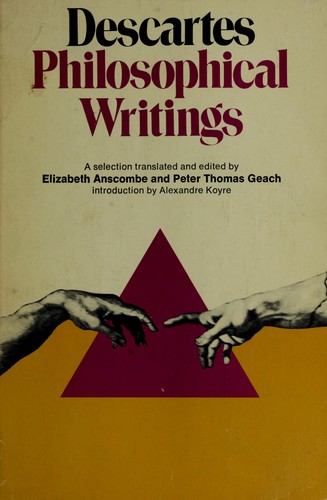 Philosophical writingsRené Descartes
 Principia philosophiaeRené Descartes
 SelectionsRené Descartes