Tractatus logico-philosophicus
≈ From memoryThe limits of my language mean the limits of my world; philosophy is not a way of discovering new truths, but a way of clarifying the logical structure of what we already say.
In one sentence
The meaning of a proposition is its method of representation, and because language can only represent the logical structure of the world, anything that cannot be expressed logically (ethics, aesthetics, religion) is "unsayable."
Why read this (and for who)
This is arguably the most difficult and influential work of 20th-century philosophy. It is for the thinker who wants to understand the architecture of thought. It solves the problem of "philosophical confusion"—the tendency to treat metaphysical problems as if they were empirical problems. After reading this, you will be able to identify when a philosophical statement is actually a "pseudo-proposition" (a grammatical confusion) rather than a meaningful claim about reality.
The big idea
Wittgenstein argues that the purpose of language is to "picture" reality. A sentence is not a vehicle for a hidden "inner" meaning; it is a logical map of a possible state of affairs. Just as a map of a city is not the city itself but shows the relations between streets, a proposition is a logical arrangement of "names" (terms) that represent objects in the world.
The central thesis is that the "logic" of our language is the "logic" of the world. If a sentence cannot be broken down into a logical structure that represents a possible state of affairs, then that sentence is literally nonsense. Therefore, most traditional philosophical problems—questions about the "soul," "the absolute," or "the meaning of life"—are not problems to be solved; they are instances of language being pushed beyond its limits. We are trying to say things that cannot be said.
The Tractatus concludes that because our language is bound by the rules of logic, our world is bound by the limits of our language. To see the world clearly, we must see the limits of our language.
Key ideas
The Picture Theory of Language
- What it is — A proposition is a "logical picture" of a fact. Just as a painting represents a scene, a sentence represents a possible configuration of the world.
- Why it matters — It shifts the focus from what we say to how the words relate to each other. If a sentence doesn't "picture" a possible state of affairs, it has no meaning.
- In the book — Wittgenstein uses the analogy of a "logical picture" to explain that the meaning of a word is its use in a proposition.
The Logical Atomism of "Names"
- What it is — The basic building blocks of language are "names" (terms) that refer to objects in the world. These names are the "atoms" of our propositions.
- Why it matters — It establishes that the world is composed of facts, and facts are composed of states of affairs, which are composed of objects. To understand the world, we must understand the logical structure of these objects.
- In the book — He argues that "the world is the totality of facts, not of things."
The Limits of Language
- What it is — There are things that can be shown but not said. Because language is a logical structure, it cannot express things that are non-logical (like the "mystical" or the "ethical").
- Why it matters — This is the "silent" part of the book. It suggests that the most important things in life (the meaning of life, the "Good") are outside the reach of logic and therefore cannot be articulated in propositions.
- In the book — He distinguishes between "saying" (logical representation) and "showing" (the limits of what can be said).
The Logical Form of the World
- What it is — The "logical form" is the scaffolding of our world. It is not a thing in the world, but the way the world is structured.
- Why it matters — It implies that we cannot "step outside" of logic to see the world. We can only see the world through the lens of logical structure.
- In the book — He argues that "the logical form of the world is the logical form of the propositions."
The Ethics of Silence
- What it is — Since ethics and aesthetics cannot be expressed in logical propositions, they are "mystical." They are lived, not spoken.
- Why it matters — It provides a radical boundary for philosophy. It tells us that the most profound human experiences are precisely those that cannot be captured by a coherent logical argument.
- In the book — He concludes that "Whereof one cannot speak, thereof one must be silent."
Frameworks & tools
The Logical Analysis of Propositions
To determine if a philosophical statement is meaningful, apply this diagnostic:
- Identify the Terms: What are the "names" or objects being used in the sentence?
- Identify the Relations: How are these terms related to one another?
- Test for "Picturing": Does this arrangement of terms represent a possible state of affairs in the world?
- Determine Meaning: If it does, the meaning is the method of its representation. If it does not (e.g., "The square root of justice is blue"), the statement is "senseless" (unsinnig).
The Boundary of the "Sayable"
A checklist for identifying the limits of language:
- Is it a Fact? (Does it describe a state of affairs?) $\rightarrow$ Sayable.
- Is it a Logical Truth? (Is it true by definition, like "A=A"?) $\rightarrow$ Sayable.
- Is it a Mystical Experience? (Is it a feeling, a value, or a "showing"?) $\rightarrow$ Unsayable.
- Is it a Pseudo-Proposition? (Is it a grammatical confusion where words are used outside their logical limits?) $\rightarrow$ Nonsense.
Memorable examples & stories
The Picture of the World
Wittgenstein uses the analogy of a picture to explain how a proposition functions. A picture of a house shows the relation of the walls to the roof. Similarly, a proposition about a house shows the relation of the objects within it. Lesson: Language is a map of relations, not a container for hidden essences.
The "Mystical"
Wittgenstein refers to the "mystical" as that which cannot be expressed in words. He uses this to describe the experience of "the meaning of life." Because this experience is not a "fact" in the world, it cannot be "pictured" by a proposition. Lesson: The most important things in life are often the ones we cannot talk about.
The Limits of the World
He argues that "The limits of my language mean the limits of my world." If you cannot name a concept or describe a relation, that concept does not exist within your "world" of experience. Lesson: Our reality is bounded by our ability to speak about it.
Key quotes
"The meaning of a proposition is its method of representation." Why it matters: This defines the "Picture Theory"—meaning is not a ghost in the machine; it is the logical structure of the sentence.
"The limits of my language mean the limits of my world." Why it matters: This is the foundational claim of the book—that our reality is constrained by our linguistic capacity.
"Whereof one cannot speak, thereof one must be silent." Why it matters: This is the ultimate boundary. It warns us against trying to use language to describe things that are fundamentally beyond the reach of logic.
"The world is the totality of facts, not of things." Why it matters: It forces us to see the world as a web of relations and events, rather than a collection of isolated objects.
How to apply it
This week
- Identify a "Pseudo-Problem": Find a philosophical or personal question you've been obsessing over. Ask: "Is this a fact I can describe, or am I trying to say something that cannot be said?"
- Analyze a Sentence: Take a complex sentence from a news article or book. Try to strip away the "fluff" to see what logical relations it is trying to "picture."
Ongoing
- The Principle of Silence: When you find yourself trying to explain a feeling or a "mystical" experience (like "the feeling of love" or "the essence of beauty"), recognize that you are hitting the limits of language. Stop trying to "solve" it with logic.
- Logical Clarity: Before arguing a point, ensure your terms are clearly defined as "names" for specific states of affairs. Avoid using words as vague placeholders for feelings.
Common pitfalls
- Thinking it's a "How-To" guide for logic: It isn't. It's a critique of how we misuse language. It's not about learning a new logic; it's about realizing the limits of the logic we already have.
- Taking "Nonsense" as a moral failing: When Wittgenstein says a statement is "senseless," he doesn't mean it's "bad" or "wrong." He means it is literally impossible for the words to do what the speaker intends. It's a structural failure, not a moral one.
- Ignoring the "Mystical": Many readers get so caught up in the logical analysis that they miss the point: Wittgenstein's ultimate goal is to protect the "mystical" from being crushed by bad logic.
Connects to
- "Philosophical Investigations" (Wittgenstein): The sequel. Wittgenstein eventually rejects the "Picture Theory" of the Tractatus in favor of "Language Games."
- "Language, Truth, and Logic" (A.J. Ayer): A classic logical positivist response that took Wittgenstein's ideas to their extreme logical conclusion.
- "The Structure of Scientific Revolutions" (Thomas Kuhn): While not a direct philosophical peer, Kuhn's work on "paradigms" shares the idea that the "world" we see is constrained by the "framework" (language/logic) we use to observe it.
If you remember only three things
- The Picture Theory: A proposition is a logical map of a possible state of affairs.
- The Limits of Language: Our world is defined by what we can say; what we cannot say is outside our world.
- The Mystical: The most important things (ethics, aesthetics, religion) are "unsayable" and must be lived, not analyzed.
Internalize it
- Reflection questions
- In what areas of my life am I trying to "speak" about things that are actually "unsayable"?
- How does my current vocabulary limit my ability to perceive certain parts of my reality?
- Can I identify a "pseudo-proposition" I've used recently to justify a feeling or a belief?
- Flashcards
- Q: What is the "Picture Theory" of language?
- A: The theory that a proposition is a logical "picture" of a possible state of affairs in the world.
- Q: What does Wittgenstein mean by "the limits of my language mean the limits of my world"?
- A: That our experience of reality is bounded by the logical structures of the language we use to describe it.
- Q: What is the "Mystical"?
- A: Those aspects of life (like ethics or the meaning of life) that cannot be expressed in logical propositions.
- Q: What is a "pseudo-proposition"?
- A: A statement that uses words outside of their logical limits, making it literally nonsensical.
- Q: What is the "Logical Form" of the world?
- A: The underlying structural rules of reality that correspond to the logical rules of our language.
Fidelity note
Confidence: High. The Tractatus is notoriously difficult because of its unique numbering system and dense, often paradoxical phrasing. This summary captures the core "Grammar" of the book—the Picture Theory, the limits of language, and the distinction between saying and showing. However, because the Tractatus is so dense, some of the specific nuances of his "logical atomism" (how names relate to objects) can be lost in a summary. Readers should be aware that Wittgenstein's later work (the Philosophical Investigations) completely overturns many of the technical mechanics of the Tractatus, though the "mystical" remains a recurring theme.
More from Ludwig Wittgenstein
 Bemerkungen über die FarbenLudwig WittgensteinBemerkungen über die FarbenLudwig Wittgenstein
 Lectures, Cambridge, 1932-1935Ludwig Wittgenstein
 Letters to Russell, Keynes, and MooreLudwig Wittgenstein
 Notebooks, 1914-1916Ludwig Wittgenstein
 On certainty =Ludwig Wittgenstein
 Philosophical InvestigationsLudwig Wittgenstein
 Philosophische BemerkungenLudwig Wittgenstein
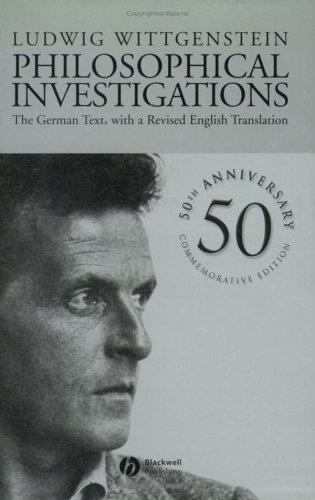 Philosophische UntersuchungenLudwig Wittgenstein
 Remarks on the Philosophy of Psychology, Volume 1 (Remarks on the Philosophy of Psychology)Ludwig Wittgenstein