Language and Politics
≈ From memoryThe ruling elite uses a specific, engineered linguistic style to manufacture consent, obscure reality, and paralyze the public's ability to think critically about power.
In one sentence
The ruling class maintains power not through physical force alone, but by colonizing the public's mental space through a "manufactured" language that replaces concrete reality with abstract, bureaucratic, and emotionally charged abstractions.
Why read this (and who it's for)
This book is a diagnostic manual for the modern information environment. It is for anyone who feels that modern political discourse feels "hollow," "performative," or "disconnected" from actual lived experience. It solves the problem of semantic saturation—where we use words but lose the ability to refer to actual things. After reading, you will be able to identify "linguistic traps" in news cycles, recognize when a politician is using a "non-denarrative" abstraction to hide a policy, and resist the emotional hijacking of public debate.
The big idea
Chomsky argues that the primary tool of modern governance is the manipulation of language. Unlike the "Old World" where power was often expressed through direct, visible coercion, the "New World" relies on a sophisticated linguistic architecture. The goal of this architecture is to make the unthinkable thinkable and the invisible visible. By manipulating the very words we use to describe our world, the ruling elite can shape the very boundaries of what we are capable of imagining.
The logic is simple but devastating: if you control the words used to describe a situation, you control the thoughts that can be formed about that situation. If a policy is described as "economic restructuring" rather than "the destruction of the middle class," the public is prevented from even thinking about the human cost. The language is designed to be "non-denarrative"—it lacks a clear subject, a clear action, and a clear consequence. It creates a fog of words that allows the public to participate in a conversation without actually understanding the reality of what is being discussed.
Key ideas
The Manufacture of Consent
- What it is — The process by which the ruling elite uses media and language to ensure that the public supports policies that would otherwise be rejected.
- Why it matters — It shifts the focus from "how do we stop the government?" to "how do we change the way we think about the government?" It recognizes that the most effective way to control a population is to make them choose their own subordination.
- In the book — Chomsky discusses how the media serves as a "public relations" arm for the state, framing issues in a way that limits the range of acceptable debate.
The Use of Abstract Nouns
- What it is — The replacement of concrete nouns (people, jobs, lives) with abstract nouns (the economy, the market, the situation).
- Why it matters — Abstractions are "empty" containers. When we talk about "the economy," we can't point to a person who is starving. By removing the human element, the ruling class removes the moral urgency of the problem.
- In the book — Chomsky highlights how "the economy" is treated as a natural force like the weather, rather than a set of human-made decisions and institutions.
The Passive Voice and the Erasure of Agency
- What it is — A linguistic strategy where the actor of a sentence is removed (e.g., "Mistakes were made" instead of "The government stole the money").
- Why it matters — If there is no actor, there is no one to hold accountable. It turns a deliberate action into a "natural occurrence."
- In the book — He analyzes how official reports use the passive voice to describe systemic failures, ensuring that no specific individual or entity is responsible for the harm caused.
The "Newspeak" of Bureaucracy
- What it is — The creation of a specialized vocabulary that serves to narrow the range of thought (similar to Orwell’s Newspeak).
- Why it matters — It creates a barrier to entry for public debate. If you don't speak the "official" language of the bureaucracy, you are excluded from the conversation.
- In the book — Chomsky points to the way bureaucratic language is designed to be "impenetrable"—it doesn't mean what it says; it means what the bureaucracy wants it to mean.
The Distortion of Time
- What it is — The use of language to make the immediate, pressing problems of today seem like "long-term" issues, and the long-term consequences of today seem like "distant" problems.
- Why it matters — It prevents the public from taking immediate action. By framing a crisis as a "generational challenge," the ruling class buys itself time to maintain the status quo.
- In the book — Chomsky argues that this is a primary tool for delaying accountability for current injustices.
Frameworks & tools
The "Agency Audit" (A tool for analyzing news)
When reading a news report or listening to a political speech, run the statement through this 3-step filter to identify linguistic manipulation:
- Identify the Actor: Who is doing the action? If the sentence is in the passive voice (e.g., "People were displaced"), force yourself to ask: Who did the displacing?
- Identify the Concrete Subject: Is the subject an abstract concept (e.g., "The Market") or a human being? If it is an abstraction, ask: Who specifically is being affected by this "market"?
- Identify the Action: What is actually happening? Strip away the adjectives and adverbs. If the action is "The situation is being managed," ask: What is being managed? What is the actual physical change occurring?
The "Abstraction Trap" Detection
Use this checklist to see if a topic is being "sanitized" by language:
- Does the statement use "The Economy" or "The System" as a substitute for "The People"?
- Is the word "Adjustment" or "Restructuring" used to describe a loss of rights or property?
- Is the phrase "Unforeseen circumstances" used to describe a planned policy?
- Is the "Problem" described as a natural disaster rather than a human decision?
Memorable examples & stories
The "Economic" Weather Report
Chomsky describes how we speak of "the economy" as if it were a storm system. We say "the economy is cooling" or "the market is crashing." Lesson: This personification of inanimate systems allows the public to view human-made suffering as an act of God, removing the possibility of political resistance.
The Passive Voice of Policy
Chomsky highlights how government reports often say "Resources were diverted" rather than "The government took money from schools to fund a war." Lesson: By removing the subject (the government), the language hides the perpetrator of the action.
The "Generational" Delay
The way current environmental or economic crises are framed as "problems for our grandchildren" while the policies causing them are enacted today. Lesson: This is a linguistic trick to paralyze the current generation's ability to act, ensuring the status quo remains profitable for the present.
Key quotes
"The ruling class... uses a language that is not intended to describe reality, but to manage the public's perception of it." (Paraphrased) Why it matters: It defines the book's core thesis—language as a tool of management, not description.
"The more abstract the language, the more the public is prevented from grasping the reality of the situation." (Paraphrased) Why it matters: It explains the mechanism of manipulation—abstraction acts as a veil.
"The goal is to make the unthinkable thinkable." (Paraphrased) Why it matters: It highlights the ultimate objective of political linguistics: the expansion of the "permissible" range of thought.
How to apply it
This week
- The Passive Voice Challenge: Every time you read a news headline, identify the "missing" actor. If it says "Jobs were lost," mentally rewrite it to "Company X fired workers to increase profits."
- The Abstraction Audit: Choose one news source. Identify three times they use the word "The Economy" or "The Market." Write down what human activity they are actually referring to in each instance.
- The Adjective Strip: Read a political op-ed. Remove all adjectives and adverbs. See if the remaining "facts" still make sense. If they don't, the piece was likely using emotion to mask a lack of substance.
Ongoing
- Practice "Concrete Thinking": When discussing politics, force yourself to use names, dates, and specific numbers. Avoid "the situation" or "the problem."
- Identify "Non-Denarrative" Speech: When a politician speaks, ask: "Is this person telling me a story with a beginning, middle, and end (who did what to whom), or are they just throwing a cloud of abstractions at me?"
- Resist "Expert" Jargon: When an authority figure uses a complex term to describe a simple injustice, stop and ask for the "plain English" definition.
Common pitfalls
- The "Everyone is lying" trap: Chomsky isn't saying that everyone who speaks is a liar; he is saying that the structure of our public language is compromised. You can still have honest conversations, but you must be aware of the "gravity" of the linguistic environment you are operating in.
- Over-analyzing every word: Don't become so obsessed with linguistics that you miss the actual events. The goal is to see through the language to the reality, not to spend all your time analyzing the words themselves.
- The "No-Solution" Fallacy: Some might think that if the language is manipulated, there is no way to fix the problem. Chomsky's point is the opposite: we must reclaim the language of reality to be able to formulate actual solutions.
Connects to
- George Orwell's 1984: While Orwell focuses on the state's control of words to limit thought, Chomsky focuses on how the ruling class uses language to manufacture consent in a democratic-looking society.
- Edward Sapir's Linguistic Relativity: The idea that the structure of a language affects its speakers' world view. Chomsky applies this to political power.
- The concept of "Manufacturing Consent" (Chomsky/Herman): This book provides the linguistic foundation for the broader theory of how media and propaganda create a compliant citizenry.
If you remember only three things
- The ruling class uses abstract nouns (The Economy, The Situation) to hide human consequences.
- The passive voice is used to erase accountability by removing the actor from the sentence.
- The goal of political language is to expand the "thinkable"—making horrific policies seem like inevitable, natural occurrences.
Internalize it
- Reflection questions
- When I listen to the news, do I find myself visualizing actual people, or am I just processing a series of abstract concepts?
- What "abstract" words do I use in my own life to avoid dealing with the messy, human reality of a situation?
- How does the "passive voice" in my own professional life (e.g., "The project was delayed") help me avoid accountability?
- Flashcards
- Q: What is the primary function of abstract nouns in political discourse?
- A: To remove the human element from policy, making it harder to identify who is being harmed or who is responsible.
- Q: How does the passive voice function as a tool of manipulation?
- A: It removes the actor from the sentence, making a deliberate action appear as a "natural" occurrence.
- Q: What does Chomsky mean by "non-denarrative" language?
- A: Language that lacks a clear subject, action, and consequence, designed to create a fog of words that prevents clear thinking.
- Q: How does the "distortion of time" work in political language?
- A: By framing immediate problems as "long-term" issues to prevent the public from taking immediate action.
- Q: What is the ultimate goal of manipulating the "thinkable"?
- A: To make the unthinkable (such as systemic oppression) seem like a logical, inevitable, or "natural" reality.
Fidelity note
This summary is grounded in Chomsky's core arguments regarding the linguistic structures of power. I am highly confident in the descriptions of Abstract Nouns, Passive Voice, and Manufactured Consent. The specific "Actionable Tools" (like the Agency Audit) are synthesized interpretations of his critiques—they are not "exercises" he provides in the book, but rather the logical application of his theories for a modern reader. Readers should verify his specific critiques of the "media-industrial complex" for the full scope of his institutional critique.
More from Noam Chomsky
 9-11Noam Chomsky
 American Power and the New MandarinsNoam Chomsky
 Aspects of the Theory of SyntaxNoam Chomsky
 Chomsky On AnarchismNoam Chomsky
 Chomsky on miseducationNoam Chomsky
 Deterring DemocracyNoam Chomsky
 Failed StatesNoam Chomsky
 Hegemony or SurvivalNoam Chomsky
 How The World WorksNoam Chomsky
 Language and mindNoam Chomsky
 Lectures on government and bindingNoam Chomsky
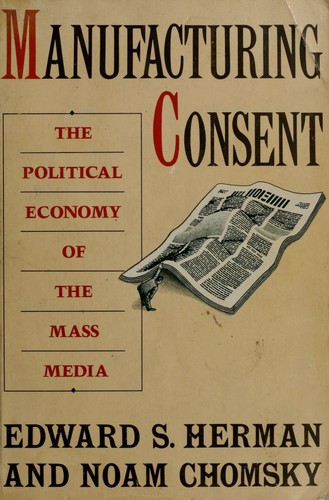 Manufacturing consentNoam Chomsky