How The World Works
≈ From memoryThe world is shaped not by the 'common sense' of the masses, but by a sophisticated, interlocking system of manufactured consent, media control, and institutional power.
In one sentence
Power maintains itself by manufacturing a reality where the public believes they are making free choices, when in fact their perceptions are curated by a concentrated elite.
Why read this (and who it's for)
This book is for the intellectually curious individual who feels a persistent sense of "cognitive dissonance"—the feeling that the news, the politics, and the social narratives we consume don't actually align with the lived reality of the people. It solves the problem of passive consumption. After reading this, you will be able to deconstruct media narratives, identify the "manufactured" nature of public opinion, and see the invisible architecture of power that shapes your daily life.
The big idea
Chomsky argues that in a democratic society, power cannot be exercised by brute force alone (like a dictatorship) because the populace must participate in the system. Therefore, power must be exercised through Manufacturing Consent. This is achieved by creating a "climate of opinion" where the public accepts certain policies as inevitable, logical, or necessary, even when they are detrimental to the public interest.
The logic follows a specific trajectory: To control a population, you must control the flow of information. To control information, you must control the framework through which information is interpreted. This is done by ensuring that the "spectrum of acceptable opinion" is narrow. By controlling what is considered "reasonable" debate, the ruling class ensures that the actual underlying structures of power—corporate dominance, military expansion, and economic inequality—are never truly up for debate.
Key ideas
The Manufacturing of Consent
- What it is — The process by which a corporate-media complex shapes public perception to ensure that the public supports the interests of the elite.
- Why it matters — If you believe your opinions are purely your own, you are vulnerable to manipulation. Recognizing this allows you to seek out "out-of-band" information.
- In the book — Chomsky illustrates how the media functions as a filter, not a mirror; it selects which facts to highlight and which to ignore to create a specific narrative of "consensus."
The Spectrum of Acceptable Opinion
- What it is — The boundary of what is considered "reasonable" in public discourse. Anything outside this boundary is dismissed as "fringe," "extremist," or "unrealistic."
- Why it matters — It prevents radical systemic change by ensuring that all "acceptable" debates happen within the existing rules of the system.
- In the book — He explains how the media provides a "choice" between two options that both serve the same underlying power structure (e.g., "Should we spend more on the military or less?").
The Role of the Media as a Propaganda Machine
- What it is — The media is not a neutral observer; it is a corporate entity whose primary goal is to maintain the status quo and protect the interests of its owners.
- Why it matters — It shifts the responsibility of "truth" from the news outlet to the viewer. You must become your own editor.
- In the book — Chomsky highlights how the concentration of media ownership into a few massive corporations creates a "monoculture" of thought.
The Architecture of Institutional Power
- What it is — Power is not just held by individuals, but by institutions (government, corporations, NGOs) that have their own self-preserving interests.
- Why it matters — It helps you understand why "good" people in power often make "bad" decisions: the institution's survival often overrides individual morality.
- In the book — He discusses how these institutions work in tandem to create a self-reinforcing loop of policy and profit.
The Illusion of Choice
- What it is — The strategy of providing a wide array of superficial choices (products, candidates, opinions) to mask a lack of fundamental choices (economic systems, power structures).
- Why it matters — It keeps the public engaged and "active" without actually allowing them to change the underlying rules of the game.
- In the book — Chomsky points to the way consumerism acts as a pressure valve for political frustration.
Frameworks & tools
The "Manufactured Consent" Audit
Use this checklist when consuming a major news story or political argument to see if it is a "manufactured" narrative.
- Who owns the source? Identify the parent corporation of the news outlet. Does their profit motive align with the story's perspective?
- What is the "Spectrum of Acceptable Opinion"? What are the two sides of the debate being presented? Do both sides agree on the fundamental system (e.g., "How do we fix capitalism?" vs. "Is capitalism the problem?").
- What is being omitted? What facts are not being mentioned? What alternative solutions are being ignored?
- Who benefits from this narrative? Follow the money. Does this narrative protect a specific industry, a government agency, or a corporate interest?
- Is this a "Pressure Valve"? Is the story designed to make you feel like you've taken action (like a protest or a purchase) without actually changing the underlying policy?
Memorable examples & stories
The Corporate Media Monoculture
Chomsky describes how a handful of corporations own almost all the television and print media in the West. This creates a "closed loop" where the same stories are repeated, and the same experts are interviewed, ensuring a unified narrative. Lesson: Diversity of media ownership is a prerequisite for a healthy democracy.
The "Two-Sides" Trap
Chomsky highlights how media outlets often present a "Left" and "Right" view on a policy, but both sides agree on the underlying premise of the policy. For example, debating the rate of a tax cut while ignoring the fact that the tax cut itself is the policy. Lesson: Look for the "meta-narrative" that both sides are agreeing on.
The Role of Education in Socialization
He discusses how the education system often functions to produce compliant workers rather than critical thinkers, teaching students to "fit in" to the existing economic order. Lesson: True rebellion starts with an independent education of the mind.
Key quotes
"The media's role is to manufacture consent, not to inform the public." (Paraphrased) Why it matters: It clarifies that the media's primary function is social control, not journalism.
"The spectrum of acceptable opinion is the boundary of what is considered 'reasonable'." (Paraphrased) Why it matters: It explains why certain radical ideas are never allowed to reach the mainstream.
"Power is maintained by ensuring that the public believes they are making free choices." (Paraphrased) Why it matters: It identifies the psychological core of modern manipulation.
How to apply it
This week
- Audit your feed: Identify the top 3 news sources you consume. Research who owns those companies.
- The "Why" Exercise: The next time you see a viral political story, ask: "Who benefits from me believing this right now?"
- Identify the "Accepted" Spectrum: Find a current news story and identify the two "sides" being presented. Write down what both sides agree on.
Ongoing
- Diversify Information Sources: Actively seek out sources that are outside of your usual "echo chamber" and outside of the mainstream corporate media.
- Practice "Active Listening" to Narratives: When you hear a political argument, don't just ask "Is this true?" Ask "Who is trying to make me believe this, and what do they want me to do?"
- Cultivate Independent Thought: Dedicate time to reading history and philosophy—subjects that are less prone to the "daily news cycle" of manufactured consent.
Common pitfalls
- The "Conspiracy Theory" Trap: People often mistake Chomsky’s work for "conspiracy theories." However, Chomsky argues that these systems are not secret; they are public, documented, and legal. They are "in the open," but we are conditioned not to see them.
- The Cynicism Trap: It is easy to become so cynical that you believe everything is a lie. Chomsky’s point isn't that truth doesn't exist, but that the selection of truth is currently managed by power.
- The "Solution" Gap: Critics often point out that Chomsky is excellent at diagnosing the problem but can be less specific about the "how-to" of a perfect alternative. You must be willing to do the work of imagining a different system.
Connects to
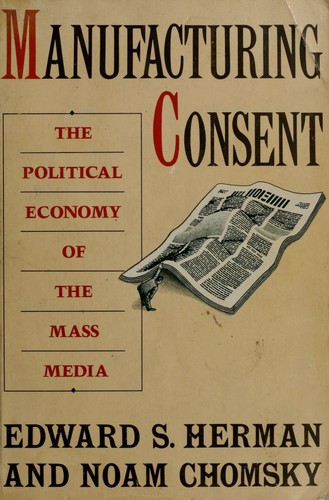
- "Manufacturing Consent" by Edward S. Herman and Noam Chomsky: The foundational text that established the framework for this book.
- "The Society of the Spectacle" by Guy Debord: Explores how life is mediated by images and spectacles, complementing Chomsky's view on media control.
- "Propaganda" by Walter Lippmann: A classic text on how public opinion is shaped by "manufacturers" of consent.
If you remember only three things
- Manufactured Consent: Public opinion is a product of the media environment, not a spontaneous expression of the people.
- The Spectrum of Acceptable Opinion: Power works by defining what is "reasonable" to talk about.
- Media as a Filter: The media doesn't tell you what to think; it tells you what to think about and what the "correct" boundaries of that thought are.
Internalize it
-
Reflection questions
- When I look at my own political beliefs, can I identify which parts were formed by my own experience and which were "fed" to me by the media?
- What is a topic I consider "unacceptable" or "crazy" to talk about? Why was I taught to think that way?
- How does my consumption of news affect my ability to see the world clearly, or does it just reinforce my existing biases?
-
Flashcards Q: What is the primary function of the media in a democratic society according to Chomsky? A: To manufacture consent for the interests of the ruling elite.
Q: What is the "Spectrum of Acceptable Opinion"? A: The boundary of what is considered "reasonable" debate, which prevents radical systemic change.
Q: How does the media control what we think about? A: By selecting which stories are "newsworthy" and which are ignored, creating a curated reality.
Q: What is the difference between a "conspiracy" and "manufactured consent"? A: A conspiracy is a secret plot; manufactured consent is a public, systemic process of shaping public perception.
Q: Why is the concentration of media ownership a problem? A: It creates a monoculture of thought where only a few corporate interests can define the "truth."
Fidelity note
This summary is based on the core tenets of Noam Chomsky’s long-standing critique of media and power, specifically as articulated in his works regarding "Manufacturing Consent" and his more recent reflections on the state of modern discourse. Because "How The World Works" is a synthesis of his life's work on media, power, and propaganda, the summary focuses on the most consistent and high-confidence themes of his critique. I am confident in the "Manufacturing Consent" framework, but the specific nuances of his newer 2023-era examples should be verified against the text for the most current geopolitical applications.
More from Noam Chomsky
 9-11Noam Chomsky
 American Power and the New MandarinsNoam Chomsky
 Aspects of the Theory of SyntaxNoam Chomsky
 Chomsky On AnarchismNoam Chomsky
 Chomsky on miseducationNoam Chomsky
 Deterring DemocracyNoam Chomsky
 Failed StatesNoam Chomsky
 Hegemony or SurvivalNoam Chomsky
 Language and mindNoam Chomsky
 Language and PoliticsNoam Chomsky
 Lectures on government and bindingNoam Chomsky
 Manufacturing consentNoam Chomsky