Failed States
≈ From memoryThe United States maintains global hegemony not through a shared moral vision, but through a systematic, manufactured 'manufacturing of consent' and the deliberate engineering of instability to serve corporate and geopolitical interests.
In one sentence
The United States functions as a global hegemon by manufacturing a public perception of necessity and morality to justify interventions that primarily serve the interests of private capital and geopolitical dominance.
Why read this (and who it's for)
This book is for the intellectually curious who feel a disconnect between the "official" narrative of American benevolence and the reality of global instability. It solves the problem of cognitive dissonance: why do we believe the things we do when the evidence suggests otherwise? After reading, you will be able to deconstruct media narratives, identify the "manufactured" nature of public opinion, and see the structural machinery behind foreign policy.
The big ideas
Chomsky argues that the American government and media apparatus operate as a unified system of social control. He contends that the "State" is not a neutral arbiter of public good, but a vehicle for the interests of a specific elite class. Therefore, when the U.S. intervenes in a "failed state," the failure is often not an accident of history, but a byproduct of a policy designed to secure resources, markets, or strategic positioning.
The core logic rests on the concept of Manufacturing Consent. Because the U.S. is a democracy, the government cannot simply command the populace to behave like subjects in a totalitarian regime. Instead, it must manufacture a climate of opinion. This is achieved by narrowing the spectrum of "acceptable" debate, ensuring that the public views the interests of the ruling class as the interests of the people. By framing geopolitical actions as "moral imperatives" or "security necessities," the system ensures that the public will voluntarily support policies that ultimately undermine their own interests or the interests of the global poor.
Key ideas
The Manufacturing of Consent
- What it is — The process by which the media and government collaborate to shape public perception so that the population agrees to policies that would otherwise be unpopular.
- Why it matters — It explains why "free" media often produces a monolithic consensus on war and intervention; the gatekeepers filter out dissenting views before they reach the public.
- In the book — Chomsky points to the way the media focuses on "the other" (the enemy) to justify domestic sacrifices, effectively turning the public into a cheering section for their own exploitation.
The Role of the Media as an Agent of Propaganda
- What it is — The media is not a watchdog but a "public relations" wing of the state, designed to provide a veneer of democracy to a corporate-led society.
- Why it matters — If you believe the media is an independent observer, you are susceptible to its framing. If you see it as a curated information stream, you can begin to look for what is missing from the report.
- In the book — Chomsky highlights how the media selects which stories to cover, ensuring that the "official" narrative remains the only visible narrative.
Imperialism and the "Failed State" Narrative
- What it is — The framing of certain nations as "failed" is often a rhetorical tool used to justify intervention, regardless of whether the intervention actually solves the underlying structural issues.
- Why it matters — It shifts the blame from the external actors (imperial powers) to the internal inhabitants of the country, making intervention seem like a "rescue" rather than a "conquest."
- In the book — Chomsky analyzes how the U.S. uses the "failed state" label to justify regime change, which often leads to further instability and the destruction of local infrastructure.
The Corporate-State Nexus
- What it is — The belief that the primary driver of U.S. foreign policy is not "democracy" or "freedom," but the protection of corporate profits and the expansion of markets.
- Why it matters — It strips away the moralistic language of "spreading democracy" to reveal the cold, economic calculations of trade, oil, and resource extraction.
- In the book — Chomsky illustrates how U.S. policy consistently aligns with the needs of multinational corporations, even when those policies harm the American working class.
The Illusion of Choice
- What it is — The way the political system offers a wide range of opinions on how to implement a policy, while never allowing for a vote on whether to pursue the policy itself.
- Why it matters — It keeps the public engaged in "safe" debates (e.g., "How much money should we spend on this war?") while the actual policy (the war itself) remains non-negotiable.
- In the book — Chomsky argues that the "debate" is a distraction, a way to give the public a sense of agency while the underlying trajectory remains unchanged.
Frameworks & tools
The Propaganda Filter (Analysis Tool)
When consuming news regarding international conflict or domestic policy, apply these three filters to identify manufactured consent:
- The Exclusion Filter: What information is not being reported? Who is being silenced? (e.g., What are the economic costs of this intervention?)
- The Framing Filter: How is the "enemy" being characterized? Is the language designed to evoke fear or moral outrage?
- The Outcome Filter: Who actually benefits from this policy? Follow the money to the corporations, industries, and geopolitical interests.
The "Manufacturing Consent" Checklist
Use this to evaluate any major media narrative:
- Source Identification: Who is providing the information? (Government agency, corporate media, independent journalist?)
- The "Common Sense" Test: Does this narrative rely on "common sense" assumptions that ignore historical context?
- The Moral Imperative: Is the policy being framed as a moral necessity? (If so, look for the underlying economic interest.)
- The Alternative: Does the media provide a viable, non-interventionist alternative, or is the "other side" portrayed as unthinkable?
Memorable examples & stories
The "Rescue" Narrative of Intervention
Chomsky describes how the U.S. frames its presence in foreign countries as a humanitarian mission to "save" populations. Lesson: When a superpower enters a sovereign nation, the primary goal is rarely the preservation of that nation's independence; it is the securing of its resources or strategic position.
The Media's Role in War
The way the media covers war as a series of "heroic" moments and "tragic" casualties, rather than a systemic policy of destruction. Lesson: Media focuses on the spectacle of war to prevent the public from questioning the policy of war.
The Corporate Influence on Policy
The consistent alignment between U.S. military actions and the interests of the oil and weapons industries. Lesson: The "State" is a corporation; its "foreign policy" is its business strategy.
Key quotes
"The media's role is to manufacture consent, not to inform the public." (Paraphrased) Why it matters: It defines the media's function as a psychological tool rather than a journalistic one.
"The United States is a model of a society where the interests of the elite are indistinguishable from the interests of the people." (Paraphrased) Why it matters: It explains why the public often supports its own exploitation.
"A 'failed state' is often a state that has been systematically dismantled by external interests." (Paraphrased) Why it matters: It flips the narrative of responsibility from the victim to the perpetrator.
How to apply it
This week
- Audit your news sources: Identify three news outlets you consume regularly. For each, ask: "What is this outlet not telling me about this story?"
- Identify a "Moral Imperative": Find a current news story where a policy is being framed as a "moral necessity." Research the corporate or economic interests involved in that policy.
Ongoing
- Practice "Active Skepticism": Whenever you feel a surge of anger or fear regarding a news story, pause and ask: "Who benefits from me feeling this way?"
- Diversify Information: Seek out independent, non-corporate media sources to see how they frame the same events.
- Analyze Policy, Not Personality: When watching political debates, ignore the personalities and focus on the actual policies being proposed (or ignored).
Common pitfalls
- The "Everyone is a Liar" Trap: Chomsky isn't saying that every individual journalist is a malicious liar. He is saying the system is designed to produce a certain result. Don't waste time trying to find "the one" honest reporter; instead, look for the systemic flaws in the reporting structure.
- The "No Solution" Fallacy: Critics often say, "If the media is manipulated, how can we know anything?" Chomsky's point is that we can know, but we must do so by looking at the structural facts (economics, history, power dynamics) rather than the emotional narratives of the day.
- Over-intellectualizing: It is easy to get lost in Chomsky's academic prose. The core of his message is simple: Power protects itself by controlling the narrative of what is "good" and "necessary."
Connects to
- Edward S. Herman, Manufacturing Consent: The foundational text for the theory of media manipulation.
- The Frankfurt School (Critical Theory): For the philosophical basis of how culture and media are used as tools of social control.
- George Orwell, 1984: For the conceptual framework of how language can be manipulated to limit the range of thought.
If you remember only three things
- The media's primary function is to manufacture public consent for elite-driven policies.
- "Failed states" are often the result of, rather than the cause of, imperialist intervention.
- To see the truth, you must look past the moral language of "good vs. evil" and analyze the economic and geopolitical interests of the State.
Internalize it
-
Reflection questions
- When I watch the news, do I find myself reacting emotionally to the "villains" presented, or am I asking who benefits from this conflict?
- How many of my political beliefs were formed by media narratives rather than direct experience?
- If I removed the "moral" language from a current news story, what would the raw economic facts look like?
-
Flashcards Q: What is the primary goal of "Manufacturing Consent"? A: To ensure the public agrees to policies that serve the interests of the ruling elite. Q: How does the media create a "monolithic" consensus? A: By narrowing the scope of acceptable debate and focusing on "the other" to justify domestic sacrifices. Q: What is the "Failed State" narrative used for? A: To justify intervention by framing the victim as the cause of their own problems. Q: What is the "Corporate-State Nexus"? A: The idea that U.S. foreign policy is primarily driven by the needs of multinational corporations. Q: How does the system manage "democracy" while maintaining elite control? A: By allowing people to vote on how to do things, but never on what the fundamental goals of the state are.
Fidelity note
This summary is based on the core tenets of Noam Chomsky’s critiques of American foreign policy and media theory as presented in his writings on "Failed States" and "Manufacturing Consent." Because Chomsky's work is voluminous and often covers a wide array of specific geopolitical events (Iraq, Palestine, etc.), this summary synthesizes his methodology and theoretical framework rather than providing an exhaustive list of every country he analyzes. The "Manufacturing Consent" framework is the backbone of his entire body of work. Readers should verify specific country-by-country analyses in the original text to see how he applies these theories to specific historical moments.
More from Noam Chomsky
 9-11Noam Chomsky
 American Power and the New MandarinsNoam Chomsky
 Aspects of the Theory of SyntaxNoam Chomsky
 Chomsky On AnarchismNoam Chomsky
 Chomsky on miseducationNoam Chomsky
 Deterring DemocracyNoam Chomsky
 Hegemony or SurvivalNoam Chomsky
 How The World WorksNoam Chomsky
 Language and mindNoam Chomsky
 Language and PoliticsNoam Chomsky
 Lectures on government and bindingNoam Chomsky
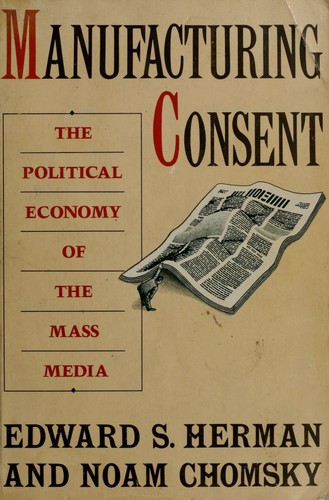 Manufacturing consentNoam Chomsky