Deterring Democracy
≈ From memoryDemocracy is being systematically dismantled not by a single coup, but by a sophisticated, multi-pronged strategy of manufacturing consent and institutional capture to ensure the public remains passive while the elite maintain absolute control.
In one sentence
The erosion of democracy is a deliberate project of "manufacturing consent," where the state and corporate interests collaborate to colonize the public's mind, ensuring that the people voluntarily surrender their freedoms to a managed, technocratic elite.
Why read this (and who it's for)
This book is for the intellectually curious individual who feels a sense of "cultural malaise"—the feeling that despite having more information than ever before, the public seems more polarized, less capable of independent thought, and more susceptible to emotional manipulation.
It solves the problem of passive observation. Most people see the symptoms of a decaying democracy (polarization, media bias, corporate dominance) but fail to see the mechanisms of the disease. After reading this, you will be able to identify the specific rhetorical and structural tools used to manufacture public opinion and develop a "mental firewall" against the constant stream of engineered narratives.
The big idea
Chomsky argues that in a society where the state cannot simply ban opposition (due to the presence of free speech and elections), it must instead manage the perception of reality. This is the "Manufacturing of Consent." The goal is to create a situation where the public accepts policies that are fundamentally contrary to their own interests—such as perpetual war, extreme inequality, and the erosion of civil liberties—because they believe these policies were their own ideas.
The logic is based on the Control of Information. Democracy requires an informed citizenry to function. If you can control the flow of information, you can control the boundaries of what is considered "acceptable" thought. By saturizing the public sphere with "manufactured" news, the state ensures that the public remains preoccupied with trivialities or manufactured enemies, preventing them from ever looking at the structural foundations of power.
Ultimately, Chomsky posits that the "deterrence" of democracy is a structural necessity for a corporate-state alliance. To maintain a system of private property and concentrated wealth, the state must ensure that the masses remain "docile." This is achieved not through the "boot on the neck" (totalitarianism), but through the "management of the mind" (media saturation and psychological manipulation).
Key ideas
The Manufacturing of Consent
- What it is — The process by which the media and government work together to create a "common sense" that serves elite interests. It is the art of making the public agree to things they would otherwise oppose.
- Why it matters — If you believe your opinions are entirely your own, you are vulnerable to manipulation. Recognizing this process allows you to see the "invisible" hand of propaganda.
- In the book — Chomsky explains how the media acts as a "filter" rather than a mirror; it doesn't just report what is happening, it selects what is permissible to think about.
The Role of the Media as a "Gatekeeper"
- What it is — The media does not provide a neutral platform for all ideas; it acts as a gatekeeper that determines which ideas are "newsworthy" and which are ignored.
- Why it matters — By controlling the "agenda," the media can make certain topics (like systemic inequality) invisible while making others (like celebrity scandals) omnipresent.
- In the book — Chomsky highlights how the media focuses on "the spectacle"—the visual and emotional—to bypass the reader's critical thinking faculties.
The Corporate-State Alliance
- What it is — The symbiotic relationship between large corporations and the government, where the state protects private property and corporate interests in exchange for the corporate funding of the state's infrastructure.
- Why it matters — This explains why "democracy" often feels like a sham: the laws are designed to favor the entities that fund the system, not the people who live in it.
- In the book — He discusses how corporate interests are baked into the very structure of our legal and economic systems, making "free markets" a tool for concentration of power.
The Management of Fear
- What it is — The deliberate use of fear (terrorism, crime, "the other") to justify the expansion of state surveillance and the curtailing of civil liberties.
- Why it matters — Fear shuts down the analytical brain. When people are afraid, they are more willing to trade their rights for a sense of security, which the state then uses to consolidate power.
- In the book — Chomsky points to how the "war on terror" or other existential threats are used to manufacture a climate of emergency that justifies permanent emergency measures.
The Erosion of Independent Thought
- What it is — The systematic narrowing of the "public square" so that only certain types of dissent are allowed, and only if they don't challenge the core structure of the system.
- Why it matters — It creates a "false" democracy where people can vote on the style of management but not on the substance of the system itself.
- In the book — He argues that the media encourages a "false consciousness" where people identify with the very institutions that oppress them.
Frameworks & tools
The "Filter" Analysis (How to spot Manufactured Consent)
When consuming any news story or political argument, run it through this three-step filter to see if it is a "manufactured" narrative:
- The Source Check: Who owns the outlet? Is the information being presented as a "fact" or as a "perspective"? Does the outlet rely on "official" sources (government/corporate) as the sole authority?
- The Agenda Check: What is not being said? If a story about a corporate disaster is being told, is the systemic cause (the laws that allowed it) being ignored in favor of the "human interest" story (the individual victims)?
- The Emotional Trigger: Is the story designed to make you feel fear or outrage? If the primary goal of the piece is to provoke an emotional reaction rather than provide a nuanced understanding of a complex system, it is likely a tool of manipulation.
The "Power Structure" Map
To understand any social issue, map it out using this hierarchy:
- The Core Interest: Who benefits financially or politically from this policy?
- The Gatekeepers: Who is allowed to speak on this topic? (Who is excluded?)
- The Distraction: What "moral" or "cultural" debate is being used to keep the public from looking at the Core Interest?
Memorable examples & stories
The "Spectacle" of Television
Chomsky describes how television news is designed to be "consumable" rather than "educational." By prioritizing images over information, the media turns the public into passive spectators of their own lives. Lesson: If you are being entertained by the news, you are being manipulated.
The "Terrorist" Label
Chomsky discusses how the definition of "terrorism" is often expanded to include any political action that threatens the status quo, while state-sponsored violence is rarely labeled as such. Lesson: Language is a weapon of the state to define what is "legal" and what is "criminal."
The Corporate Takeover of Education
He highlights how the "professionalization" of the news and the education system ensures that the public learns how to work within the system, rather than how to think critically about the system itself. Lesson: The system doesn't want you to be a revolutionary; it wants you to be a productive, compliant unit.
Key quotes
"The media's role is to manufacture consent, not to inform." (Paraphrased) Why it matters: It shifts the definition of media from a public service to a psychological tool.
"The government's primary role is to protect the interests of the corporate elite." (Paraphrased) Why it matters: It identifies the true beneficiary of the current political structure.
"Fear is the most effective tool for the management of a population." (Paraphrased) Why it matters: It explains why the most alarming news is often the most manipulated.
How to apply it
This week
- The "Source" Audit: Choose one major news source you consume daily. Research who owns that company and what their primary revenue streams are.
- The "Silence" Test: When reading a news story, ask: "What is the one thing this article doesn't want me to ask?" Write down three questions that the article avoids answering.
- Emotional Fasting: For 24 hours, avoid all "breaking news" alerts. Observe how your anxiety levels change when you aren't being fed a constant stream of manufactured crises.
Ongoing
- Verify the "Who": Before reacting to a political scandal, ask: "Who benefits from me being angry about this right now?"
- Diversify Information: Actively seek out sources that are not beholden to corporate advertisers (independent journals, non-profit reports, academic papers).
- Practice "Systemic Thinking": Whenever you see a problem (e.g., a housing shortage), stop at the "individual" level (the person without a home) and immediately look for the "systemic" level (the laws and corporate interests that created the shortage).
Common pitfalls
- The "Conspiracy Theory" Trap: People often mistake Chomsky's work for conspiracy theories. He is not arguing that "secret cabals" meet in basements; he is arguing that the system is designed to produce these results. It is not a secret; it is a public, documented, and legal process.
- The "Apathy" Trap: After realizing how much of our world is manipulated, it is easy to become cynical and give up. Chomsky’s point is the opposite: once you see the mechanism, you can begin to resist it by fostering independent communities and alternative information networks.
- The "False Equivalence" Trap: Do not assume that because a media outlet is "biased," it is always lying. Sometimes, the most dangerous manipulation is not a lie, but a "truth" that is presented without its necessary context.
Connects to
- "Manufacturing Consent" by Edward S. Herman and Noam Chomsky: The foundational text that provides the academic framework for the ideas in Deterring Democracy.
- "The Society of the Spectacle" by Guy Debord: Explores how modern society is mediated by images, providing a philosophical backdrop to Chomsky's media critique.
- "Propaganda" by Walter Lippmann: A classic text on how public opinion is managed, which serves as a precursor to Chomsky's modern analysis.
If you remember only three things
- Manufacturing Consent: The media's job is to make you agree with the status quo by controlling what you see and what you think is possible.
- Corporate-State Symbiosis: The government and corporations are not separate entities; they are a unified machine designed to protect private property and concentrate power.
- The Management of Fear: Fear is a tool used to bypass your critical thinking and make you more compliant with the erosion of your own rights.
Internalize it
-
Reflection questions
-
When I feel a sudden surge of anger or fear regarding a news story, what specific "spectacle" is being shown to me to trigger that emotion?
-
In what ways has my own education taught me to be a "good worker" rather than a "critical thinker"?
-
If I were to remove all the "manufactured" distractions of the news, what are the three most pressing systemic problems in my community?
-
Flashcards Q: What is the primary goal of "Manufacturing Consent"? A: To ensure the public agrees to policies that serve elite interests by controlling the flow and framing of information. Q: How does the "Spectacle" function in media? A: It prioritizes visual and emotional impact over deep, systemic information, turning the public into passive observers. Q: What is the relationship between the state and corporations in Chomsky's view? A: A symbiotic alliance where the state protects corporate interests and the corporations fund the state's infrastructure. Q: Why is fear a central tool in "Deterring Democracy"? A: Fear shuts down the analytical brain, making people more willing to trade their freedoms for a sense of security. Q: What is the difference between a "conspiracy theory" and Chomsky's analysis? A: Chomsky's analysis is based on observable, systemic structures and legal frameworks, not hidden, secret plots.
Fidelity note
This summary is grounded in Chomsky's core arguments regarding media, corporate power, and the erosion of democratic institutions as presented in his body of work, specifically Deterring Democracy. Because Chomsky's work is often dense and relies on a vast web of historical references, this summary prioritizes the mechanisms of manipulation over a comprehensive list of every historical example he cites. Readers should verify specific historical dates and specific legislative acts in the original text to ensure full context.
More from Noam Chomsky
 9-11Noam Chomsky
 American Power and the New MandarinsNoam Chomsky
 Aspects of the Theory of SyntaxNoam Chomsky
 Chomsky On AnarchismNoam Chomsky
 Chomsky on miseducationNoam Chomsky
 Failed StatesNoam Chomsky
 Hegemony or SurvivalNoam Chomsky
 How The World WorksNoam Chomsky
 Language and mindNoam Chomsky
 Language and PoliticsNoam Chomsky
 Lectures on government and bindingNoam Chomsky
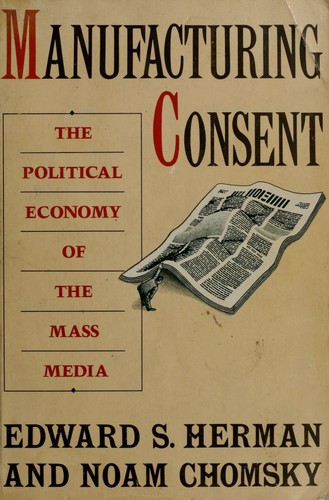 Manufacturing consentNoam Chomsky