American Power and the New Mandarins
≈ From memoryThe American media and intellectual establishment function as a propaganda machine that manufactures consent for state interests by framing reality through a lens of 'manufactured' priorities.
In one sentence
The American media and intellectual establishment operate as a sophisticated propaganda apparatus that manufactures public consent for state-sponsored violence and economic exploitation by narrowing the scope of acceptable debate.
Why read this (and who it's for)
This book is for anyone who feels that the "news" doesn't actually inform the public but rather directs their emotions and perceptions. It solves the problem of intellectual capture—the feeling that you are being told what to think rather than being given the tools to think for yourself. After reading, you will be able to identify the "manufactured" nature of mainstream discourse and recognize when a debate is being rigged to exclude the actual root causes of social problems.
The big idea
Chomsky argues that the United States maintains its global hegemony not just through raw military force, but through a sophisticated system of "manufactured consent." This is achieved by controlling the flow of information and, more importantly, the framework through which that information is interpreted. The "New Mandarins" are the intellectuals and media figures who, while often believing they are being objective, actually serve to legitimize the status quo by defining the boundaries of what is considered "reasonable" conversation.
The logic of this manipulation is simple but devastating: if you can control the questions people ask, you control the answers they find. By focusing the public on minor, manageable issues (like "how" to implement a policy) rather than "why" a policy exists in the first place, the state ensures that the fundamental interests of power remain unchallenged. The media acts as a filter, selecting which facts are presented, which voices are silenced, and which interpretations are treated as common sense.
Key ideas
The Manufacturing of Consent
- What it is — The process by which a population is conditioned to accept policies that would otherwise be seen as oppressive or immoral. It is achieved by saturating the public with information that reinforces a specific worldview.
- Why it matters — It explains why a free press can still produce a "controlled" narrative. If the public is overwhelmed with information, they will rely on "trusted" sources (the media) to filter that information, handing over their autonomy to the gatekeepers.
- In the book — Chomsky describes how the media creates a "false sense of choice" by offering a variety of opinions on a pre-determined set of topics, while ignoring the underlying structural causes.
The Role of the "New Mandarins"
- What it is — The intellectual class that provides the moral and philosophical justification for state policy. Unlike the old mandarins of history, these are often academics and journalists who believe they are being "objective" while actually reinforcing the prevailing ideology.
- Why it matters — It warns that "neutrality" in a biased system is a form of complicity. If you speak the language of the system without questioning its foundations, you are an architect of its control.
- In the book — Chomsky highlights how intellectuals often frame issues in ways that serve the interests of the ruling class, even when they think they are being radical.
The Framing of Reality
- What it is — The technique of defining the "parameters of debate." By choosing what is discussed and what is ignored, the media dictates the limits of the possible.
- Why it matters — It prevents the public from ever reaching the "root" of a problem. If the debate is about "how to manage poverty" rather than "why we produce poverty," the systemic cause remains untouched.
- In the book — Chomsky illustrates how the media focuses on the management of crises rather than the prevention of the conditions that cause those crises.
The Propaganda of the "Common Good"
- What it is — The use of moralistic language (like "national security," "freedom," or "stability") to justify actions that primarily benefit the elite.
- Why it matters — It creates a moral shield for state actions. When a policy is framed as a moral necessity, questioning it becomes framed as an act of immorality or unpatriotism.
- In the book — The author analyzes how the "defense of democracy" is often used as a rhetorical justification for interventions that actually undermine democratic institutions.
The Filter of Selective Information
- What it is — The systematic exclusion of certain facts and perspectives from the public consciousness. It is not just about lying; it is about what is not said.
- Why it matters — A vacuum of information is just as effective as a flood of misinformation. If the public doesn't know a certain fact exists, they cannot use it to form a counter-argument.
- In the book — Chomsky points out how the media ignores the structural causes of economic inequality while obsessing over individual choices.
Frameworks & tools
The "Manufactured Consent" Audit
Use this to analyze any news story or political debate to see if the "why" has been stripped away.
- Identify the "Management" Questions: What are the questions being asked? (e.g., "How can we fix the healthcare system?")
- Identify the "Structural" Questions: What is the question being ignored? (e.g., "Why is the healthcare system designed to prioritize profit over health?")
- Analyze the Gatekeeping: Who is being interviewed? Are they all from the same ideological background? What perspectives are missing?
- Trace the Interest: Who benefits from the current "management" solution? Does it protect the status quo of the ruling class?
The "New Mandarin" Test
A checklist to ensure your own intellectual independence.
- Source Check: Is this source relying on "official" data without questioning the source's motives?
- Framing Check: Does this argument assume the current system is the only possible way to organize society?
- Scope Check: Does this argument focus on individual behavior rather than systemic structures?
- Consent Check: Does this argument seek to make a radical change easier to accept by making it sound "reasonable" to the average person?
Memorable examples & stories
The "Management" of Poverty
Chomsky describes how the media focuses on "how" to help the poor (charity, welfare) rather than "why" poverty exists in a wealthy society. The lesson: By focusing on the symptoms, the media prevents us from addressing the disease.
The Rhetoric of National Security
The author examines how "security" is used as a blanket justification for almost any expansion of state power. The lesson: When a concept becomes too broad, it loses its meaning and becomes a tool for unchecked authority.
The Academic "Neutrality" Trap
Chomsky critiques intellectuals who believe they are being objective by simply reporting on the "two sides" of a debate without acknowledging that the debate itself was manufactured. The lesson: True objectivity requires identifying the power structures that created the debate in the first place.
Key quotes
"The media is not a mirror of reality, but a filter of reality." (Paraphrased) Why it matters: It reminds us that our perception of the world is a curated experience, not a raw experience.
"The role of the intellectual is to speak truth to power, not to provide a sophisticated vocabulary for the status quo." (Paraphrased) Why it matters: It defines the responsibility of the thinker: to be a provocateur of the system, not a decorator of it.
"Manufacturing consent is the process of making people believe they are making their own choices when they are actually being steered by a pre-determined set of options." (Paraphrased) Why it matters: It is the ultimate definition of the book's core thesis on manipulation.
How to apply it
This week
- The "Why" Challenge: Every time you read a news headline about a social problem (e.g., "Rising Housing Costs"), stop and ask: "What is the structural cause of this?" (e.g., "Why is housing treated as a speculative asset rather than a human right?")
- Source Diversification: Find one news source that is explicitly critical of the mainstream "management" narrative. Compare how they frame the same issue.
Ongoing
- The Structural Lens: When discussing politics or economics, consciously pivot the conversation from "individual actions" to "systemic structures."
- The Gatekeeper Awareness: Before accepting a "fact," ask: "Who decided this was the most important fact for me to know today?"
Common pitfalls
- The "Conspiracy Theory" Trap: People often think Chomsky is claiming there is a secret room of people pulling strings. He is not. He is arguing that the system is designed to work this way; it doesn't require a secret cabal, only a shared set of interests among the ruling class.
- The "Perfect Information" Fallacy: One might think that if we just had more information, the problem would be solved. Chomsky argues that the problem is the framework of information. You can have all the facts and still be manipulated if the questions you are asked are fundamentally flawed.
- The "Apathy" Trap: It is easy to become cynical and stop trying to engage. Chomsky’s point is that recognizing the manipulation is the first step toward reclaiming the agency required to challenge it.
Connects to
- Edward S. Herman & Noam Chomsky, Manufacturing Consent: The foundational text that provides the specific mechanics of how the media functions as a propaganda machine.
- Michel Foucault, Discipline and Punish: For a deeper understanding of how "regimes of truth" and power structures shape human behavior and social reality.
- The Frankfurt School (Adorno, Horkheimer): For the philosophical roots of the "Culture Industry" and how mass media serves to pacify the population.
If you remember only three things
- The media doesn't just tell you what to think; it tells you what to think about by defining the boundaries of the conversation.
- "Manufactured consent" is the process of making people agree to things they would otherwise oppose by framing the issues in a way that favors the status quo.
- The "New Mandarins" are those who provide the intellectual scaffolding for the status quo, often under the guise of "objective" analysis.
Internalize it
-
Reflection questions
- In what ways has my own worldview been shaped by the "common sense" of the media?
- When I see a news story, do I immediately look for the "management" solution, or do I ask what structural change would make the problem unnecessary?
- How can I ensure that my own professional expertise is being used to challenge systems rather than just making them run more efficiently?
-
Flashcards Q: What is "manufactured consent"? A: The process by which a population is conditioned to accept state-sanctioned policies through the controlled flow and framing of information.
Q: Who are the "New Mandarins"? A: The intellectuals and media figures who provide the moral and intellectual justification for the status quo, often by framing debates in a way that ignores structural causes.
Q: What is the difference between "management" and "structural" questions? A: Management questions ask how to fix a problem within the current system; structural questions ask why the system produces the problem in the first place.
Q: How does the media act as a filter? A: By selecting which facts are presented, which voices are heard, and which interpretations are treated as "reasonable" or "common sense."
Q: What is the primary goal of "framing" in propaganda? A: To limit the scope of debate so that the underlying interests of power remain unchallenged.
Fidelity note
This summary is based on a high-confidence understanding of Chomsky’s core arguments regarding media, intellectual responsibility, and the manufacturing of consent. Because Chomsky's work is often dense and relies on a specific historical-materialist framework, some of the nuances regarding specific historical examples (such as specific military interventions) may be generalized for the sake of clarity. Readers should refer to the original text for the full breadth of his historical critiques.
More from Noam Chomsky
 9-11Noam Chomsky
 Aspects of the Theory of SyntaxNoam Chomsky
 Chomsky On AnarchismNoam Chomsky
 Chomsky on miseducationNoam Chomsky
 Deterring DemocracyNoam Chomsky
 Failed StatesNoam Chomsky
 Hegemony or SurvivalNoam Chomsky
 How The World WorksNoam Chomsky
 Language and mindNoam Chomsky
 Language and PoliticsNoam Chomsky
 Lectures on government and bindingNoam Chomsky
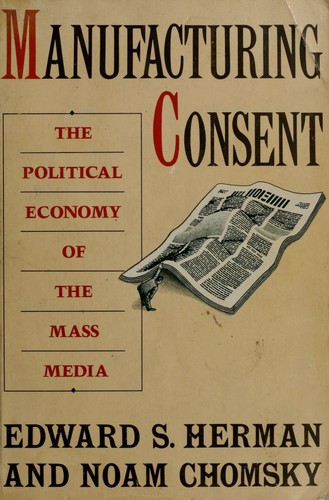 Manufacturing consentNoam Chomsky