What do you say after you say hello
≈ From memoryHuman interaction is a series of psychological games played by different 'ego states' to manage internal discomfort and external social demands.
In one sentence
Human behavior is not a unified expression of the self, but a complex interplay of distinct "ego states" (Parent, Adult, Child) that often engage in repetitive, unconscious "games" to avoid intimacy or manage anxiety.
Why read this (and who it's for)
This book is the foundational text for Transactional Analysis (TA). It solves the mystery of why we say one thing but mean another, and why we repeat the same self-defeating behaviors in relationships. It is for anyone who feels "stuck" in social patterns—the person who constantly finds themselves in the same types of arguments, the person who feels they are "performing" rather than connecting, or the therapist/leader trying to understand the hidden scripts of human interaction. After reading, you will be able to identify the "game" being played in a conversation and choose to step out of the script into a more authentic "Adult" interaction.
The big_idea
Berne argues that our personalities are not monolithic. Instead, we inhabit three distinct psychological positions: the Parent (the internalized voices of authority and care), the Adult (the data-processing, rational center), and the Child (the emotional, spontaneous, and reactive center). Most of our daily interactions are not "Adult-to-Adult" exchanges of information; they are "Games" where we unconsciously inhabit these roles to achieve a specific psychological payoff, often at the expense of genuine connection.
The logic of the book follows a revolutionary path: to change your life, you must recognize that your "personality" is often a collection of scripts. When you say "hello," the conversation that follows is rarely a neutral exchange of facts. It is a dance of roles. By identifying which "part" of you is speaking and which "part" of the other person you are addressing, you can break the cycle of repetitive, dysfunctional social scripts.
Key ideas
The Three Ego States
What it is: The Parent is the internalized rules and values of others; the Child is our spontaneous feelings and reactions; the Adult is the "here and now" processor of information. Why it matters: Recognizing these allows you to see that "you" are not your anger (Child) or your criticism (Parent)—you are the observer who can choose which state to lead from. In the book: Berne describes how a person might react to a simple request with an over-the-top emotional outburst (Child) or a cold, bureaucratic refusal (Parent), illustrating that the "Adult" was bypassed.
The Transactional Analysis of Communication
What it is: Every social interaction is a "transaction." A transaction has a stimulus, a response, and a specific "stroke" (unit of recognition). Why it matters: It shifts the focus from what was said to how the message was structured. It reveals whether a conversation is complementary (flowing smoothly) or crossed (causing conflict). In the book: Berne illustrates "Complementary Transactions" where two people stay in their roles (e.g., Parent-Child) and "Crossed Transactions" where one person switches roles unexpectedly, causing the "game" to break or escalate.
Social Games
What it is: "Games" are repetitive, unconscious sequences of interactions that have a hidden agenda, usually ending in a "payoff" like victory, sympathy, or a "win" that feels hollow. Why it matters: Identifying the game allows you to stop being a character in someone else's script. It reveals that we often choose "losing" situations because they provide a familiar emotional relief. In the book: Berne describes the "Kick Me" game, where a person behaves in a way that invites criticism, then feels justified in their self-pity once the criticism arrives.
The "Stroke"
What it is: A "stroke" is any unit of recognition—a smile, a frown, a nod, or a harsh word. Humans have a biological need to be "stroked" to survive socially. Why it matters: If we don't receive positive strokes, we will seek negative ones (criticism) just to be noticed. It explains why we often accept "bad" attention over no attention at all. In the book: Berne explains that a "negative stroke" (like being scolded) is still a stroke because it acknowledges our existence.
The Script
What it is: The "Script" is the unconscious life plan we develop in childhood based on the messages we received from our primary caregivers. Why it matters: Your script determines your "destiny"—the roles you play, the people you choose, and the limitations you place on your own success. In the book: Berne explores how a child who is told they are "useless" may develop a script where they are destined to fail, and they will unconsciously sabotage their own success to remain consistent with that internal narrative.
Frameworks & tools
The Transactional Analysis Map
To analyze any interaction, identify the Position of the participants:
- Identify the Stimulus: What was said or done?
- Identify the Response: How did the other person react?
- Determine the Ego State:
- Parent: Is this a rule, a command, or a protective instinct?
- Adult: Is this a request for information, a fact, or a logical observation?
- Child: Is this an emotional reaction, a plea, or a spontaneous feeling?
- Categorize the Transaction:
- Complementary: A $\rightarrow$ B $\rightarrow$ A (e.g., "Can I have the salt?" "Here you go.")
- Crossed: A $\rightarrow$ B, but B responds from a different ego state (e.g., "Can I have the salt?" "Why are you always so demanding?")
- Ultimatum: A $\rightarrow$ B, but B ignores the message and responds to a different ego state (e.g., "Can I have the salt?" "You're always so messy.")
The Game Detection Checklist
When you feel a familiar "sting" of frustration or guilt in a conversation, ask:
- What is the "Payoff"? (Am I trying to prove I'm right? Am I trying to get them to apologize? Am I trying to feel like a victim?)
- What is the Script? (Does this remind me of a recurring theme from my past?)
- Who is the Actor? (Which part of me is speaking? My Parent? My Child?)
- How can I "Break the Script"? (How can I respond from the Adult state—the "here and now"?)
Memorable examples & stories
The "Kick Me" Game
A person behaves in a way that invites others to criticize them. Once the criticism comes, they feel a sense of "victory" or relief because it confirms their internal belief that they are flawed. Lesson: We often seek out the very things we fear to confirm our internal scripts.
The "Why Don't You" Game
One person asks "Why don't you...?" (e.g., "Why don't you ever help out?"). The other person responds with a list of reasons why they can't. The game ends when the first person says, "Well, that's your problem," and the second person feels a sense of "winning" by being the one who is "right." Lesson: The goal isn't a solution; the goal is the emotional payoff of the argument.
The "Yes, But..." Game
One person proposes a solution, and the other responds with "Yes, but..." followed by a reason why it won't work. This continues until the first person gives up. Lesson: This is a way to keep the other person in a position of dependency while avoiding any actual change.
Key quotes
"The transaction is the unit of social intercourse." Why it matters: It forces us to look at the mechanics of communication rather than just the content.
"People are not who they say they are; they are what they do in the moment of transaction." (Paraphrased) Why it matters: It emphasizes that behavior is a manifestation of ego states, not a fixed personality.
"The game is played to get a certain psychological result." (Paraphrased) Why it matters: It helps identify the hidden motives behind seemingly irrational behavior.
How to apply it
This week
- The "Who is Speaking?" Audit: During three conversations today, pause and ask yourself: "Which part of me is talking right now? Is it my Parent (judging), my Child (reacting), or my Adult (observing)?"
- Identify the "Crossed" Transaction: The next time you get into an argument, stop and identify the exact moment the conversation "crossed." What was the stimulus? What was the unexpected response?
- The Stroke Count: Notice how many "strokes" (acknowledgments) you give others today. Try to give three intentional, positive strokes to people you usually ignore.
Ongoing
- Practice Adult-to-Adult Communication: When someone makes a demand or a criticism, consciously respond with a request for information or a statement of fact. (e.g., Instead of "Why are you always late?" try "What happened that delayed you?")
- Script Awareness: When you feel a recurring emotion (like "Why does this always happen to me?"), ask: "What script is this following?"
Common pitfalls
- Over-analyzing: It is easy to become so obsessed with "identifying the game" that you stop actually connecting with the person. The goal is to move out of the game, not to become a spectator of it.
- The "Judgment" Trap: It is easy to use the "Parent" ego state to judge others for their "Games." If you find yourself thinking, "Wow, they are playing the Kick Me game," you are still acting as a Parent. The goal is to observe without judgment.
- The "Adult" Fallacy: The Adult is not a robot. It is a state of being grounded in the "here and now." It still feels emotions; it just processes them without being hijacked by the Child or Parent.
Connects to
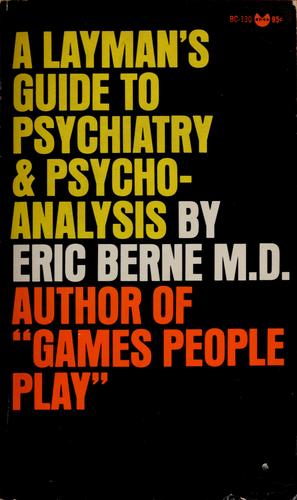
- "Games People Play" by Eric Berne: The more famous, accessible follow-up that focuses heavily on the specific types of games.
- "The Body Keeps the Score" by Bessel van der Kolk: For understanding how childhood trauma (the Script) is physically and psychologically encoded in the brain.
- "Emotional Intelligence" by Daniel Goleck: For a complementary look at self-regulation and social awareness.
If you remember only three things
- Ego States: We have three "selves" (Parent, Adult, Child) and we switch between them constantly.
- Games: We often engage in repetitive, self-defeating social patterns to manage internal anxiety or avoid intimacy.
- The Adult: The goal of healthy communication is "Adult-to-Adult" interaction—grounded in the here-and-now, facts, and mutual respect.
Internalize it
Reflection questions
- In what recurring argument do I find myself playing the same role every time? What is the "payoff" I get from that argument?
- When I am angry, can I identify which part of me is "speaking"? Is it a Parent's judgment or a Child's hurt?
- How much of my daily communication is "Crossed" (reacting to a hidden meaning) versus "Complementary" (exchanging information)?
Flashcards
Q: What are the three Ego States? A: Parent, Adult, and Child.
Q: What is a "Crossed Transaction"? A: A transaction where the response comes from a different ego state than the one addressed (e.g., a question about a fact is met with an emotional accusation).
Q: What is a "Stroke"? A: Any unit of recognition, whether positive or negative.
Q: What is the "Kick Me" game? A: A game where a person behaves to invite criticism so they can feel "right" in their self-pity.
Q: What is the "Script"? A: The unconscious life plan developed in childhood that dictates our expectations and limitations.
Q: What is the "Adult" ego state? A: The part of the personality that handles information, perceives the "here and now," and responds to reality.
Fidelity note
This summary is based on the core principles of Transactional Analysis (TA) as established by Eric Berne in his foundational work, specifically the concepts of Ego States, Transactions, and Games. Because Berne's work is a foundational psychological theory, the "Games" described are standard TA concepts. I am highly confident in the definitions of Parent, Adult, and Child, and the mechanics of Complementary/Crossed transactions. The specific "Games" (like Kick Me) are standard examples in his literature. Readers should consult Games People Play for a more exhaustive list of specific social games.