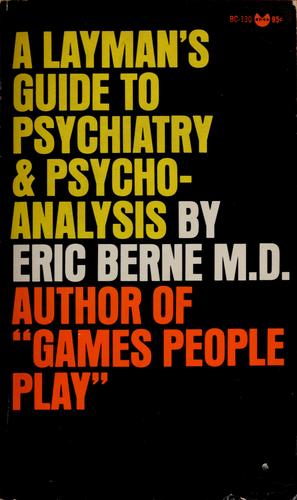
Transactional analysis in psychotherapy
≈ From memoryHuman interaction is a structured game of social roles where we switch between different 'ego states' to navigate our needs, relationships, and internal conflicts.
In one sentence
Transactional Analysis (TA) is a theory of personality and social interaction that views human behavior as a series of "transactions" between different internal psychological states, allowing us to map, understand, and ultimately change our relational patterns.
Why read this (and who it's for)
Most people struggle with "Why did they say that?" or "Why do I keep reacting this way?" Berne provides a literal map of the human social landscape. This book is for therapists, counselors, and anyone interested in interpersonal dynamics who wants a structured, non-mystical way to understand human behavior. After reading, you will be able to identify the "scripts" people are following, recognize when you are being manipulated by a "game," and consciously choose which "ego state" to inhabit in different social contexts.
The big idea
Berne argues that we do not interact as a single, unified "Self." Instead, we interact from distinct psychological positions—or Ego States—that were formed in childhood. When we communicate, we are essentially "switching" between these states. Transactional Analysis posits that social interaction is a transaction: a unit of exchange where one person sends a message and another receives it.
The core logic is that most of our social lives are "scripts" we wrote for ourselves as children. If we understand the structure of these transactions, we can see when a conversation is "natural" (healthy and direct) and when it is "crossed" (conflicting) or a "game" (designed to produce a specific, often negative, emotional result). By identifying these patterns, we can move from being reactive puppets of our past to conscious actors in our present.
Key ideas
The Ego States (Parent, Adult, Child)
What it is: The three states of personality: the Parent (internalized voices of authority/care), the Adult (the data-processing, logical center), and the Child (the emotional, spontaneous, and creative center). Why it matters: It allows you to de-identify from your reactions. Instead of saying "I am angry," you can say, "My Child ego state is reacting to this." This creates the space needed for objective observation. In the book: Berne describes how a person might have a "Nurturing Parent" who is very attentive to others' needs, but a "Natural Child" that is impulsive and lacks self-control.
Transactions
What it is: The smallest unit of social intercourse. A transaction occurs when one person's message is received by another. Why it matters: It shifts the focus from "What is wrong with that person?" to "What is the structure of this exchange?" It helps you see that communication is a loop of stimulus and response. In the book: Berne illustrates "Complementary Transactions" (where the response stays in the same ego state, like a balanced conversation) versus "Crossed Transactions" (where the response comes from a different ego state, causing a breakdown in communication).
The Script
What it is: A life plan created in childhood (usually before age 7) based on the messages we received from our primary caregivers. Why it matters: Your script is the "blueprint" for your life. It determines your goals, your limitations, and your "destiny." Recognizing your script is the first step toward "Autonomy"—the ability to choose your own path. In the book: Berne explains how a child might hear "You are only capable of doing X," and internalize it as a script that prevents them from ever attempting Y.
Games
What it is: A "Game" is a series of transactions that seem natural but are actually designed to produce a "payoff"—usually a specific, unpleasant feeling (like winning, losing, or being right) that reinforces a negative script. Why it matters: It reveals why we often sabotage our own success or repeat self-destructive patterns in relationships. In the book: Berne describes "The Kick Me" game, where a person behaves in a way that invites criticism, then feels a sense of "winning" when they receive it, confirming their script that they are unlovable.
The Stroke
What it is: A "Stroke" is a unit of recognition. It is any amount of recognition (positive or negative) that acknowledges another's existence. Why it matters: Humans have a biological need for strokes. If we don't get "positive" strokes (praise, smiles), we will settle for "negative" strokes (criticism, yelling) just to feel seen. In the book: Berne explains how a child who is ignored by parents may become "attention-seeking" by acting out, because a negative stroke is better than no stroke at all.
Frameworks & tools
The Ego State Analysis (Identifying the "Who")
Use this to analyze any interaction that feels "off" or confusing.
- Identify the Initiator: What ego state did the person speak from? (e.g., Were they being demanding like a Parent? Logical like an Adult? Emotional like a Child?)
- Identify the Response: Did the other person respond from the same state? (e.g., If I asked a logical question and they gave me an emotional outburst, the transaction was "crossed.")
- Identify the Pattern: Is this a one-time occurrence, or do we consistently "cross" in this specific way?
The Game Analysis (Identifying the "Why")
Use this when a conversation feels circular or leads to a "bad" feeling.
- The Setup: What was the initial "innocent" question or comment?
- The Hook: How did the other person respond to pull the conversation into a specific direction?
- The Payoff: What was the final "feeling" at the end? (e.g., "I'm so incompetent," "They're so mean," "I'm so much better than them.")
- The Script Connection: How does this payoff reinforce a belief the person holds about themselves?
Memorable examples & stories
The "Kick Me" Game
A person constantly puts themselves in situations where they will be criticized. They then use that criticism to justify their internal belief that they are a failure. Lesson: We often seek out "proof" of our own negative self-beliefs.
The "Yes, But..." Game
One person asks for help or advice, and the other provides it. The first person immediately finds a reason why that advice won't work. Lesson: The goal isn't the solution; the goal is to prove that the other person is unhelpful and the first person is helpless.
The "Poor Thing" Game
A person complains about a problem, and the other person offers sympathy. The first person then complains even more, seeking to deepen the sympathy. Lesson: The "payoff" is the feeling of being a victim, which reinforces a script of helplessness.
Key quotes
"The transaction is the unit of social intercourse." Why it matters: It forces us to look at the mechanics of communication rather than just the content.
"A game is a series of transactions... that leads to a 'payoff' which reinforces a script." (Paraphrased) Why it matters: It explains why we repeat self-destructive behaviors.
"The stroke is the unit of recognition." (Paraphrased) Why it matters: It explains our desperate need for attention, even if that attention is negative.
How to apply it
This week
- Identify your "Parent" voice: Notice when you have an internal monologue that is critical, demanding, or over-protective. Label it: "That's my Internal Parent speaking."
- Observe "Crossed Transactions": In one conversation today, notice the exact moment a conversation "went sideways." What ego state did the other person switch into?
- Stroke Inventory: Give three people a "positive stroke" today (a genuine compliment, a thank you, or a smile) with no expectation of a response.
Ongoing
- The Adult Check-in: Before reacting to a frustrating email or comment, pause and ask: "What is the Adult response here? What are the facts?"
- Game Awareness: When you feel a familiar "bad" feeling after a conversation (e.g., "I'm so stupid"), stop and ask: "What game was I just playing? What was the payoff?"
Common pitfalls
- Over-analyzing: It is easy to become so obsessed with "identifying" ego states that you stop actually connecting with the person. The goal is awareness, not clinical labeling.
- The "Script" Trap: Do not assume your script is fixed. The point of TA is to realize that while the script was written in childhood, you have the power to rewrite it now.
- Misinterpreting "Child": People often think the "Child" ego state is "immature." In TA, the Child is also the seat of creativity, play, and spontaneous joy. It is a vital part of a healthy human.
Connects to
- "Games People Play" by Eric Berne: The foundational text that introduces the specific "Games" mentioned in this book.
- "The Body Keeps the Score" by Bessel van der Kolk: While Berne focuses on the social script, Van der Kolk focuses on the biological impact of trauma, providing a complementary view on how our past shapes our present.
- Internal Family Systems (IFS): A modern therapeutic model that shares similarities with Ego States (Parts) but focuses more on the internal "parts" of the self rather than the transactional nature of social interaction.
If you remember only three things
- Ego States: We communicate from three places: Parent (rules/care), Adult (logic/data), and Child (emotion/spontaneity).
- Transactions: Communication is a transaction. When we "cross" (respond from a different ego state than expected), communication breaks down.
- Games: We often play out repetitive social "games" to confirm old, painful beliefs about ourselves (our "Scripts").
Internalize it
Reflection questions
- In what ways do I "cross" transactions with my partner or coworkers? What ego state am I reacting from?
- What is a recurring "Game" I play in my relationships? What is the "payoff" I get from it?
- If I were to stop following my current "Script," what would I be afraid of losing?
Flashcards Q: What are the three Ego States? A: Parent, Adult, and Child. Q: What is a "Crossed Transaction"? A: A transaction where the response comes from a different ego state than the one expected by the initiator. Q: What is a "Stroke"? A: The unit of recognition; any acknowledgment of another's existence. Q: What is a "Script"? A: A life plan created in childhood that dictates our beliefs and behaviors. Q: What is the "Payoff" in a Game? A: The specific feeling (usually negative) that reinforces a person's internal script. Q: What is the "Adult" ego state responsible for? A: Data processing, objective reality, and logical communication.
Fidelity note
I have a high level of confidence in the core concepts of Transactional Analysis (Ego States, Transactions, Scripts, Games, and Strokes) as they are the pillars of Berne's work. However, because this book is a dense psychological text, some of the specific nuances of "Games" (the specific names and rules of various games) are summarized for clarity. Readers should refer to Berne's other works for the full catalog of social games.