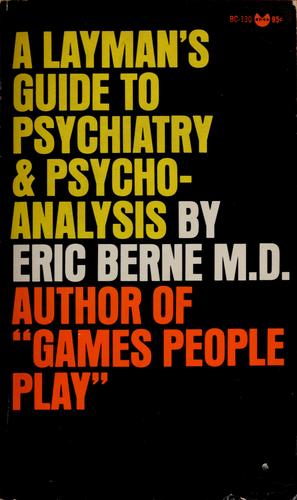
Intuition and ego states
≈ From memoryHuman personality is a collection of distinct 'ego states'—Child, Parent, and Adult—and psychological health depends on the ability to move fluidly between them while maintaining a grounded 'Adult' awareness.
In one sentence
Human behavior is not a monolithic personality but a series of switching "ego states" (Parent, Adult, Child) that interact with one another, and therapy aims to restore the "Adult" ego state's ability to mediate between the others.
Why read this (and who it's for)
This book is the foundational blueprint for Transactional Analysis (TA). It solves the problem of "why do I act in ways that don't feel like 'me'?" It explains why we sometimes snap at people we love, why we feel like a helpless child in certain situations, and why we can be overly critical of ourselves.
This is for:
- Therapists and counselors seeking a structural model of the human psyche.
- Leaders and communicators who want to understand the "games" people play in social interactions.
- Individuals who want to understand their own emotional reactivity and develop a more integrated sense of self.
After reading, you will be able to identify which "part" of you is speaking in any given moment and recognize when you are being "hooked" into a repetitive, unproductive social script.
The big idea
Berne argues that the human personality is not a single, unified "Self." Instead, it is a collection of different "ego states"—internalized modes of thinking, feeling, and behaving. He posits that we all possess three primary states: the Parent (the internalized voices of authority and care), the Adult (the data-processing, realistic part of the personality), and the Child (the emotional, spontaneous, and reactive part).
The core of the book's logic is that psychological dysfunction occurs when these states become "frozen" or when we lose access to the Adult state. When we are stuck in a Parent state, we are judgmental and controlling; when stuck in a Child state, we are impulsive or dependent. The goal of understanding these states is to develop "Awareness"—the ability to observe these internal shifts in real-time and choose a response from the Adult state rather than reacting from a hijacked ego state.
Key ideas
The Parent Ego State
- What it is — The internalized rules, values, and behaviors of our caregivers and authority figures. It can be "nurturing" (protective, caring) or "critical" (judgmental, demanding).
- Why it matters — If you identify too strongly with the Critical Parent, you become your own harshest critic; if you identify with the Nurturing Parent, you may become over-protective or enabling.
- In the book — Berne describes how a person might "act out" a Parent state by lecturing others on what they should do, even when the other person hasn't asked for advice.
The Adult Ego State
- What it is — The "here and now" part of the personality. It is the part that gathers information, evaluates reality, and makes decisions based on facts rather than emotions or ingrained habits.
- Why it matters — The Adult is the only state capable of objective communication. It is the "mediator" that prevents the Child and Parent from colliding destructively.
- In the book — Berne highlights the Adult's role in "transactional analysis"—the ability to communicate clearly without hidden agendas or emotional "hooks."
The Child Ego State
- What it is — The repository of our childhood emotions, creativity, and reactions. It includes the "Free Child" (spontaneous, playful) and the "Adapted Child" (compliant, fearful, or rebellious).
- Why it matters — We need the Child for joy and spontaneity, but an unmanaged Child state leads to emotional outbursts or chronic dependency on others.
- In the book — Berne illustrates how a person might "regress" into a Child state when feeling threatened, reacting with a tantrum or withdrawal rather than a logical response.
The Transactional Model
- What it is — The study of how ego states interact. A "transaction" is a unit of social intercourse (a conversation, a look, a gesture).
- Why it matters — Most social interactions are "complementary" (Person A's Parent speaks to Person B's Child). Problems arise in "crossed" transactions, where the expected ego state is not met, leading to conflict.
- In the book — Berne explains how a simple "How are you?" can be a Child-to-Adult request for information, but if the other person responds with a Parent-to-Child lecture, the transaction "crosses."
The Concept of "Games"
- What it is — A "Game" is a repetitive social interaction where the goal is not communication, but a specific emotional payoff (usually a "payoff" of feeling justified in a negative belief).
- Why it matters — Recognizing games allows you to stop participating in them. Games usually involve a "hook" where one person tries to provoke a specific reaction from another.
- In the book — Berne discusses how people often play games to prove that "people can't be trusted" or "I'm not capable," even when they know the conclusion is false.
Frameworks & tools
The Ego State Identification Framework
Use this to audit your internal dialogue and social interactions.
- Identify the Trigger: What just happened? (e.g., "My coworker ignored my email.")
- Identify the Reaction: What was my immediate internal thought or feeling? (e.g., "They think they're better than me!")
- Label the Ego State:
- Parent: Is this a "should" or a "must"? Is it judgmental?
- Child: Is this a feeling of hurt, fear, or a desire to lash out?
- Adult: Is this a statement of fact? (e.g., "They haven't replied yet; I don't know why.")
- The Adult Intervention: Ask yourself: "What does the Adult need to do here?" (e.g., "I will send a follow-up email in two hours.")
The Transactional Analysis Map
To understand social dynamics, map out who is "talking" to whom:
- Complementary: Parent $\rightarrow$ Child / Child $\rightarrow$ Parent / Adult $\rightarrow$ Adult. (The conversation flows smoothly).
- Crossed: Parent $\rightarrow$ Adult / Adult $\rightarrow$ Child / Child $\rightarrow$ Parent. (The conversation hits a wall; this is where arguments start).
- The Goal: Aim for Adult-to-Adult transactions for clarity and cooperation.
Memorable examples & stories
The "Why Don't You" Parent
Berne describes a person who constantly gives unsolicited advice. They aren't trying to be helpful; they are inhabiting a "Critical Parent" state that feels superior by pointing out others' flaws. Lesson: Authority is often a mask for a rigid, internalized rule-set.
The "Victim" Game
A person constantly complains about their problems but refuses any actual solutions. They are playing a game to maintain a specific "Child" identity of helplessness. Lesson: Sometimes we choose our problems because they provide a familiar emotional script.
The "Hook" of the Child
Berne describes how a person can be "hooked" into a reaction. If someone insults you and you get angry, you have allowed them to pull you out of your Adult state and into your Child state. Lesson: Emotional reactivity is a choice of ego state.
Key quotes
"The Parent is the internalized voice of authority." (Paraphrased) Why it matters: It explains why we often hear voices in our heads that aren't our own.
"The Adult is the only part of the personality that can truly communicate." (Paraphrased) Why it matters: It defines the goal of healthy communication.
"Games are played to achieve a psychological payoff, often at the expense of genuine connection." (Paraphrased) Why it matters: It reveals the hidden motives behind our most repetitive social conflicts.
How to apply it
This week
- The "Who is Speaking?" Audit: Three times a day, stop and ask: "Which ego state am I in right now?" Just notice it without judgment.
- Identify one "Parent" rule: Write down one rule you live by (e.g., "I must never make a mistake"). Ask: "Whose voice is this? Is it mine, or my parents'?"
- The Adult Response: The next time you feel annoyed by a coworker, wait 10 seconds before responding. Ask: "What is the factual, Adult response here?"
Ongoing
- Practice Adult-to-Adult Communication: In meetings, try to state facts and needs clearly without using "shoulds" (Parent) or "I can't" (Child).
- Observe the "Games": When a recurring argument happens with a friend or partner, stop and ask: "What game are we playing right now? What is the 'payoff' we are seeking?"
Common pitfalls
- Over-analyzing: It is easy to become a "spectator" of your own life. The goal isn't just to label the Child state; it's to use the Adult state to manage it.
- The "Perfect" Adult: People often think the Adult state is a robot. It isn't. The Adult state still feels emotions; it just processes them through the lens of reality rather than reacting impulsively.
- The "Game" Trap: Don't use this knowledge to "win" games. The goal is to stop playing the games entirely.
Connects to
- "Games People Play" by Eric Berne: The direct sequel/companion that explores the specific social scripts.
- "The Body Keeps the Score" by Bessel van der Kolk: For a biological/trauma-informed look at why some people get "stuck" in Child states (trauma).
- "Emotional Intelligence" by Daniel Goleck: For a modern framework on self-regulation that complements Berne's structural approach.
If you remember only three things
- You have three internal "personalities": Parent, Adult, and Child.
- Most psychological distress comes from being "stuck" in Parent or Child states.
- The "Adult" state is your tool for freedom; it is the part of you that sees the truth of the present moment.
Internalize it
-
Reflection questions
- When I feel a sudden surge of anger, which ego state is currently "driving" the car?
- What "Parent" voices do I hear in my head when I fail at a task? Whose voice is it?
- In my most frequent argument with my partner/colleague, what "Game" are we playing?
- How can I invite more "Free Child" (creativity/play) into my life without losing the "Adult" structure?
-
Flashcards Q: What is the primary function of the Adult ego state? A: To gather information, evaluate reality, and communicate in the "here and now." Q: What is the difference between the Nurturing and Critical Parent? A: Nurturing Parent provides care and protection; Critical Parent judges and demands. Q: What is a "Crossed Transaction"? A: A communication where the response from one person does not match the ego state expected by the other (e.g., an Adult asking a question gets a Parent's lecture). Q: What is a "Game" in Transactional Analysis? A: A repetitive social interaction with a hidden psychological payoff, often reinforcing a negative belief about oneself or others. Q: What is the "Adapted Child"? A: The part of the personality that learned to behave in ways that were safe or rewarded by authority figures during childhood.
Fidelity note
I have a high-confidence understanding of Berne's Ego State theory (Parent, Adult, Child) and the foundational concepts of Transactional Analysis. However, because "Intuition and Ego States" is a specific clinical text, some of the specific clinical case studies may be summarized here as representative of Berne's broader work rather than a 1:1 exhaustive list of every patient story in the book. The core definitions of the three states and the concept of "Games" are the bedrock of the book and are represented with high fidelity.