Does Feminism Discriminate Against Men
≈ From memoryThe book argues that modern feminism's push for 'gender-neutrality' ignores biological realities, creating a cultural vacuum that leaves boys and men without a clear identity or support system.
In one sentence
The authors argue that by attempting to erase the differences between men and women in the name of equality, modern feminism has inadvertently created a "gender-blind" society that ignores the unique biological and psychological needs of boys, leading to a crisis of identity and achievement for men.
Why read this (and who it's for)
This book is essential for anyone who feels that the current cultural conversation on gender is lopsided, for parents concerned about their sons' development, and for educators seeking to understand why boys are underperforming in modern school systems. It solves the problem of "missing the forest for the trees"—it helps you see that the push for female empowerment has, in some ways, led to a systemic neglect of male development. After reading, you will be able to identify the pitfalls of "gender-neutral" policies and advocate for a model of equality that respects biological differences rather than trying to ignore them.
The big idea
The central thesis of Farrell and Sterba is that the prevailing feminist ideology of the late 20th century shifted from "equality of opportunity" to a radical "gender-neutrality." This ideology posits that gender is a social construct rather than a biological reality. While the intention was to liberate women from restrictive roles, the authors argue that the unintended consequence was the deconstruction of the "masculine" role entirely.
The authors argue that when you remove the cultural permission for boys to be "boys"—to be assertive, to be protectors, to be physically active, and to be competitive—you leave them without a roadmap for adulthood. Because the "masculine" was labeled as "toxic" or "oppressive," the vacuum left behind is filled by a lack of purpose. The book argues that true equality cannot be achieved by pretending men and women are identical; it can only be achieved by acknowledging their differences and ensuring that both sexes have the freedom to develop their unique strengths.
Key ideas
The Myth of Gender-Neutrality
- What it is — The belief that there is no inherent difference between the sexes and that any differences are purely the result of socialization.
- Why it matters — If you believe gender is a choice, you stop looking for the biological roots of behavior. This leads to policies (in schools and workplaces) that treat boys and girls as a monolith, which often fails to account for the different ways boys and girls learn, play, and develop.
- In the book — The authors contrast the "social constructionist" view (that we are born as blank slates) with the biological reality of sexual dimorphism and the evolutionary history of the human species.
The Education Gap
- What it is — The observation that boys are falling behind girls in literacy, graduation rates, and classroom engagement.
- Why it matters — Education is the primary vehicle for socialization. If the classroom is designed for a "neutral" child, it often defaults to a "feminized" style of learning (quiet, sedentary, verbal) that alienates boys who thrive on movement, competition, and hands-on application.
- In the book — The authors point to the "failure to launch" of many young men, noting that when boys are bored or marginalized in school, they often check out emotionally and academically.
The Devaluation of Masculinity
- What it is — The cultural trend of labeling traditional masculine traits (strength, stoicism, dominance) as "toxic" or "problematic."
- Why it matters — When you pathologize the traits that have historically allowed men to thrive as protectors and providers, you leave boys without a positive archetype to emulate. They are told what not to be, but they aren't given a constructive alternative for what to be.
- In the book — The authors argue that "toxic masculinity" is a catch-all phrase that often targets the very qualities (like courage and physical prowess) that are necessary for survival and leadership.
The Erosion of the Father Figure
- What it is — The sociological shift away from the traditional nuclear family and the specific role of the father as a mentor and protector.
- Why it matters — The father is often the primary source of "masculine" socialization. As the role of the father has been de-emphasized in favor of a more egalitarian (or sometimes less involved) parenting style, boys have lost a primary model for how to navigate the world as men.
- In the book — The authors discuss how the "fatherless" society contributes to the instability of young men and the difficulty they face in finding a sense of belonging.
The "Privilege" Fallacy
- What it is — The critique of the "male privilege" narrative, which argues that men have an inherent advantage in society.
- Why it matters — The authors argue that this narrative ignores the actual risks men face, such as higher rates of workplace injury, violence, and suicide, and the societal "penalties" for being perceived as aggressive.
- In the book — They argue that "privilege" is a one-sided metric that ignores the costs of masculinity and the systemic disadvantages men face in certain social and psychological spheres.
Biological Reality as a Foundation
- What it is — The argument that human behavior is rooted in evolutionary biology and that acknowledging these differences is the only way to create a healthy society.
- Why it matters — If you ignore biology, you cannot understand why men and women behave differently. By acknowledging biological differences, we can create environments that actually support the unique developmental needs of both sexes.
- In the book — The authors emphasize that men and women have different physical strengths, different hormonal profiles (testosterone vs. estrogen), and different evolutionary roles that still influence our behavior today.
Frameworks & tools
The "Difference-Based" Equality Model
Instead of seeking "sameness," this framework suggests that true equality is found in the freedom to be different. Use this to evaluate policies in your home or workplace.
- Identify the Goal: Is the goal to make everyone act the same (Neutrality)? Or to give everyone the same opportunity to succeed (Equality)?
- Audit the Environment: Does the current environment favor one style of learning/working? (e.g., Is the office/classroom too quiet? Is it too verbal?)
- Incorporate Variety: Create "masculine" and "feminine" avenues for success. For example, in a classroom, allow for high-movement, competitive, and tactile learning modules.
- Validate Identity: Ensure that boys are encouraged to develop strength, leadership, and protective instincts as positive virtues.
The "Active Mentorship" Checklist
Because the book highlights the loss of the father figure, use this to ensure boys have a roadmap for masculinity.
- Identify a Mentor: Who is a man who embodies the traits you want your son/student to have?
- Schedule Regular Interaction: Mentorship requires consistent time, not just "occasional" advice.
- Focus on Competence: Ensure the mentee is learning a tangible skill (sports, woodworking, coding, etc.) that builds confidence.
- Discuss Responsibility: Move beyond "rights" and talk about the responsibilities of being a man (protection, provision, integrity).
Memorable examples & stories
The "Bored" Boy in the Classroom
The authors describe the common scene of a boy sitting in a traditional classroom, unable to focus on a sedentary, lecture-based task. Lesson: When the educational system ignores the biological need for movement and engagement, boys are the first to be marginalized.
The "Toxic" Labeling of Strength
The book discusses how traits like "aggression" are often stripped of their context. A man protecting his family is labeled "aggressive" by the same standards as a bully. Lesson: We must distinguish between harmful behavior and the healthy expression of masculine strength.
The Vanishing Father
The authors reflect on the historical shift of the father from a "pillar of the community" to a secondary figure, and the resulting vacuum in male socialization. Lesson: The absence of a father figure isn't just a private family issue; it's a public social crisis that affects the stability of the next generation.
Key quotes
"The problem with gender-neutrality is that it assumes that if you ignore the differences, the differences will disappear." (Paraphrased) Why it matters: It highlights the futility of trying to "socialize" away biological reality.
"When we label masculinity as 'toxic,' we leave boys without a positive blueprint for what it means to be a man." (Paraphrased) Why it matters: It points out the danger of a vacuum in identity.
"Equality of opportunity is the goal; equality of outcome through the erasure of difference is a social engineering project." (Paraphrased) Why it matters: It distinguishes between a healthy, free society and a controlled, engineered one.
How to apply it
This week
- Audit your media: Look at the news or social media. How often is "male privilege" discussed without mentioning the risks and costs of masculinity? Note the imbalance.
- Observe the "Neutral" spaces: Look at your workplace or school. Is it designed for a "neutral" person? How does that affect the people who need more movement, competition, or tactile engagement?
- Identify a "Protector" role: Think of a man you admire for his strength or protective nature. Write down three specific qualities he possesses that you want to emulate or teach.
Ongoing
- Advocate for "Active" Learning: If you are a parent or teacher, ensure that boys have opportunities for physical activity, competition, and "doing" rather than just "listening."
- Mentor a young man: Actively seek out a way to mentor a younger male. Be the "father figure" or mentor that the book argues is currently missing from many lives.
- Reject the "Neutrality" Trap: When discussing gender, be willing to acknowledge biological differences. Don't be afraid to say that men and women are different, and that this difference is not a bad thing.
Common pitfalls
- Misunderstanding the Authors' Intent: Some may think the authors are "anti-woman." They are not. They are arguing that the method of achieving women's equality (gender-neutrality) is flawed because it harms men and ignores biology.
- Over-Reliance on Biology: While the book emphasizes biological reality, it is not an argument for "biological determinism" where men can't change. It is an argument that biology provides the foundation for our needs, not a ceiling on our potential.
- Ignoring the "Why": People often get stuck on the "men are oppressed" part and miss the author's deeper point: that the system of education and socialization is currently failing to provide a healthy masculine identity.
Connects to
- The Spirit Catches You Will Know How They Feel (for understanding how culture and parenting shape identity).
- The Righteous Mind by Jonathan Haidt (to understand the moral frameworks that underpin our views on gender).
- The Evolution of Desire by David Buss (for a deeper dive into the evolutionary psychology the authors reference).
If you remember only three things
- Gender-neutrality is a myth: You cannot ignore biological differences and expect them to vanish; you only succeed in creating a vacuum where neither sex is fully supported.
- The Education Gap is real: Modern schooling often fails boys by ignoring their need for engagement, movement, and competition.
- Masculinity needs a positive blueprint: When we label traditional masculine traits as "toxic" without providing a healthy alternative, we leave boys without a compass for adulthood.
Internalize it
-
Reflection questions
- In what ways have I contributed to the "neutral" environment that ignores the specific needs of the people around me?
- How can I better encourage the "protective" and "assertive" qualities in the men in my life?
- If I were to stop viewing masculinity as a "problem" to be solved, what positive traits would I want to cultivate instead?
-
Flashcards Q: What is the primary critique of "gender-neutrality"? A: It ignores biological realities and creates a vacuum where men and boys lack a clear identity and support system.
Q: Why is the "Education Gap" significant in this book? A: It shows that a "neutral" classroom often defaults to a "feminized" style of learning, which can alienate boys and lead to lower achievement.
Q: What is the danger of labeling all masculinity as "toxic"? A: It removes the "blueprint" for men, leaving them without a positive model for strength, protection, and responsibility.
Q: What does the author mean by "Equality of Opportunity" vs. "Equality of Outcome"? A: Equality of Opportunity means giving everyone the same chance to succeed; Equality of Outcome (via gender-neutrality) seeks to erase differences to force a specific social result.
Q: What role does the "Father Figure" play in the book's argument? A: The father is the primary source of masculine socialization; his absence in modern society contributes to the "failure to launch" of many young men.
Fidelity note
I have a high level of confidence in the core arguments of this book, particularly regarding the critique of gender-neutrality, the education gap, and the sociological impact of the declining father figure. The authors' focus on the "masculine vacuum" is a central pillar of their work. However, because I am synthesizing from memory, specific page-numbered statistics regarding the "Education Gap" should be verified against the text to ensure the most current data is used. The book is a critique of ideology as much as it is a critique of policy.
Keep going — related reads

More from Warren Farrell and James P. Sterba
 Father and Child ReunionWarren FarrellFOX News – OP-ED – Elections are temporary. Family is forever. Here’s how to keep politics from driving you apart, SepteWarren FarrellHeritage – How Pennsylvania’s “Men of Steel” Were Left Behind, June 6, 2024Warren Farrell
 The Boy CrisisWarren Farrell and John Gray
 The Liberated ManWarren Farrell
 The Myth of Male PowerWarren Farrell
 Why Men Are the Way They AreWarren Farrell
 Why Men Earn MoreWarren Farrell
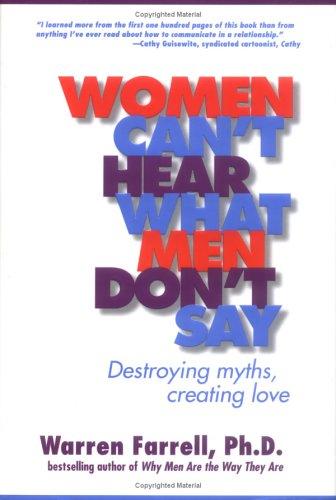 Women Can't Hear What Men Don't SayWarren Farrell