The Myth of Male Power
≈ From memoryMen do not possess an inherent, superior power over women; rather, they have been socialized into a rigid 'Man Box' that grants them systemic privileges while simultaneously handicapping their individual potential, education, and health.
In one sentence
The "myth" of male power is the belief that men are naturally more capable or dominant, when in reality, men have been socialized into a restrictive set of behaviors that provide systemic advantages (privilege) but result in significant personal and societal disadvantages (the loss of power).
Why read this (and who it's for)
This book is for anyone who feels the "modern man" is in a state of crisis—from parents of boys who struggle in school, to leaders trying to understand the gender gap in the workplace, to anyone interested in the sociology of gender.
It solves the problem of "biological determinism"—the idea that men are simply "born" to be leaders and women "born" to be followers. By dismantling this myth, Farrell provides a roadmap for how we socialize boys and men. After reading, you will be able to identify the "Man Box" in your own life, understand why boys often underperform in academic settings, and advocate for a more nuanced, healthy masculinity that allows men to succeed without the crushing weight of traditional stereotypes.
The big idea
The central thesis of The Myth of Male Power is that "male power" is a social construct, not a biological reality. Farrell argues that we have spent centuries building a social architecture that favors men as the "default" human (a concept he calls male privilege), but this system has created a "Man Box"—a set of rigid, often suffocating expectations for what a man must be.
Because of this, men have historically held the keys to institutions (law, government, ownership of property), but they have not necessarily been "better" at the tasks within those institutions. In fact, as the world shifts toward a knowledge-based economy, the "Man Box" becomes a liability. Men are socialized to be stoic, aggressive, and self-reliant, while women are socialized to be cooperative, empathetic, and communicative.
The tragedy of the "Myth of Male Power" is that it creates a self-fulfilling prophecy: we believe men are naturally powerful, so we give them the positions of power; however, because we have socialized boys to be less focused on academic mastery and more on physical dominance, they often struggle to maintain that power in a world that increasingly rewards emotional intelligence and academic excellence.
Key ideas
The Distinction Between Privilege and Power
- What it is — Privilege is a systemic advantage (the "default" setting of society); Power is an individual's ability to achieve, compete, and succeed.
- Why it matters — Confusing the two leads to a misunderstanding of why men succeed. A man might have the privilege of being the CEO because of historical norms, but he only has the power to lead if he possesses the skills to do so.
- In the book — Farrell argues that while men have had the privilege of being the "norm," they have often lost the power of being the most educated or the most capable in the modern era.
The "Man Box"
- What it is — A rigid set of social expectations for boys: they must be tough, stoic, aggressive, and self-reliant. They are taught to suppress emotions and prioritize physical dominance.
- Why it matters — This "box" limits a boy's emotional vocabulary and prevents him from developing the "soft skills" (empathy, collaboration) that are essential for modern leadership and healthy relationships.
- In the book — Farrell describes how boys are often told "don't cry" or "be a man," which teaches them to internalize stress rather than process it, leading to higher rates of internalizing disorders and violence.
The Socialization of Girls
- What it is — The opposite of the Man Box, girls are socialized to be "good" by being compliant, cooperative, and nurturing. They are encouraged to be "helpers" rather than "doers."
- Why it matters — While this makes girls more successful in traditional academic and social settings, it can also limit their sense of agency and their willingness to take risks or assertively lead.
- In the book — Farrell notes that girls are often praised for being "sweet" or "quiet," which reinforces a social script of compliance that can be detrimental to their independent power.
The Education Gap
- What it is — The systemic failure of the education system to engage boys, leading to lower graduation rates and lower college enrollment.
- Why it matters — If we believe "boys will be boys" (meaning they are naturally rowdy and less capable of focus), we stop trying to teach them effectively. This creates a cycle of failure.
- In the book — Farrell highlights how the "quiet" classroom is designed for the "good girl" archetype, leaving boys who need movement and engagement to fall behind.
The Violence Gap
- What it is — The tendency for men to externalize their emotions as physical aggression or violence.
- Why it matters — Because men are taught to suppress their feelings, they lack the tools to communicate needs, leading to explosive outbursts or, in extreme cases, violence.
- In the book — Farrell argues that male violence is often a byproduct of a social system that forbids men from expressing vulnerability or frustration in healthy ways.
The Health and Longevity Gap
- What it is — The fact that men die younger, have higher rates of suicide, and are less likely to seek medical help.
- Why it matters — This is the ultimate "cost" of the Man Box. The stoicism that makes a man "strong" in a crisis also makes him less likely to seek help for depression or chronic illness.
- In the book — Farrell points to the "silent" suffering of men who feel they cannot admit to weakness, leading to a systemic health crisis for men.
Frameworks & tools
The Socialization Audit
Use this to identify where you are reinforcing the "Man Box" or the "Good Girl" script in your daily interactions.
- Identify the Praise: What do you say when a child succeeds? (e.g., "You're so brave" vs. "You worked so hard").
- Identify the Correction: When a child fails, what is the first reaction? (e.g., "Don't cry" vs. "It's okay to be frustrated").
- Identify the Activity: Is the activity designed for "compliance" (sitting still) or "mastery" (problem-solving)?
- The Adjustment: Aim to praise effort and process rather than traits (like "bravery" or "sweetness").
The Privilege vs. Power Matrix
Use this to analyze social inequities without falling into the trap of "biological" excuses.
- Step 1: Identify the Privilege. Is this person/group the "default" in this space? (e.g., Is the default worker in this industry a man?)
- Step 2: Identify the Power. Does this person/group actually have the skills, education, and resources to succeed in this specific task?
- Step 3: The Gap. If there is Privilege but no Power, the system is rigged. If there is Power but no Privilege, the individual is a "rule-breaker" who has succeeded despite the system.
Memorable examples & stories
The "Good Girl" in the Classroom
Farrell describes how girls are often socialized to be "compliant" students—they sit still, they listen, and they follow instructions. Because they are rewarded for this, they excel in a traditional school environment. Lesson: Success in school is often a measure of how well a child can comply with the "quiet" expectations of the institution, not necessarily a measure of raw intelligence.
The "Boys will be Boys" Excuse
Farrell addresses the common refrain that boys are naturally more disruptive and less capable of focus. He argues this is a "lazy" social script that allows adults to give up on educating boys. Lesson: When we say "boys will be boys," we are essentially saying "it's okay that this boy is failing." We must stop using biology as an excuse for pedagogical failure.
The Stoic Father
Farrell discusses the "silent" father who works incredibly hard but never expresses his feelings or his love in words. This is the ultimate manifestation of the Man Box. Lesson: The "strength" of the silent father is a social performance that often leaves his children and himself feeling isolated.
Key quotes
"The myth of male power is the belief that men are naturally superior to women... This myth is a social construct, not a biological reality." Why it matters: It shifts the conversation from "What is wrong with men?" to "What is wrong with how we raise men?"
"Men have been socialized to be the 'doers,' while women have been socialized to be the 'helpers.'" (Paraphrased) Why it matters: This explains why men are often pushed into high-risk, high-stress roles while women are encouraged toward communal, supportive roles.
"The Man Box is a set of expectations that can be suffocating and even dangerous for the boys who live inside it." (Paraphrased) Why it matters: It frames the "masculine" ideal not as a source of strength, but as a cage that limits human potential.
How to apply it
This week
- The "No-Cry" Audit: Notice every time you (or someone else) say "Don't cry" or "Be a man" to a boy/man. Replace it with, "It's okay to feel frustrated; what can we do about this?"
- Active Engagement: If you have a son, engage him in a physical, high-energy activity (like a sport or a hike) where he can move his body while solving a problem.
- Identify a "Good Girl" moment: Notice when you praise a girl for being "sweet" or "quiet." Instead, praise her for a specific skill (e.g., "You were so persistent in solving that puzzle").
Ongoing
- Encourage Emotional Literacy: Teach boys to name their emotions (e.g., "I feel overwhelmed," "I feel embarrassed") rather than acting them out.
- Advocate for Diverse Learning: If you are a parent or teacher, advocate for "active" learning environments that allow for movement and tactile engagement.
- Deconstruct the "Man Box": Regularly ask: "Is this behavior helping him become a capable, healthy human, or is it just helping him fit into a social stereotype?"
Common pitfalls
- The "Biological Essentialism" Trap: Do not mistake Farrell's argument for saying men are "weak" by nature. He is arguing that the social expectations placed on men are what make them appear limited.
- The "Privilege" Confusion: People often think that because men have "privilege," they are all "powerful." Farrell is very clear: privilege is a systemic head start; power is the actual ability to perform. You can have the head start and still lose the race.
- The "Pro-Woman" Misunderstanding: Some may think this is a book about "taking away" from men. It is actually a book about freeing men from a social script that hurts their health, education, and emotional well-being.
Connects to
- The Education of of our Sons (by various): Extends the idea of why boys struggle in school.
- The Invisible Gorilla (for the psychology of attention): Helps understand how social scripts (like the Man Box) can blind us to the reality of others' experiences.
- Invisible Women (by Caroline, et al.): Challenges Farrell by looking at how the world is designed for men (the "default"), providing a data-heavy look at the physical and systemic biases Farrell describes.
If you remember only three things
- The Man Box: Men are socialized into a rigid set of expectations (stoicism, aggression, self-reliance) that can become a cage.
- Privilege vs. Power: Men have had the systemic privilege of being the "default," but they are losing the power of being the most educated and capable in a modern, knowledge-based society.
- Socialization is the Key: The "gender gap" in education, health, and behavior is not a biological destiny; it is a result of how we teach boys and girls to behave from birth.
Internalize it
-
Reflection questions
- In what ways have I participated in the "Man Box" by suppressing my own emotions or feelings?
- How does my current professional role benefit from "male privilege" (the default) rather than my own personal "power" (skills)?
- If I were to stop viewing "toughness" as a virtue, what new qualities would I allow myself to develop?
- How can I create a "safe" space for the men in my life to express vulnerability without fear of judgment?
-
Flashcards Q: What is the "Man Box"? A: A set of rigid social expectations for boys, including stoicism, aggression, and self-reliance.
Q: What is the difference between privilege and power in Farrell's framework? A: Privilege is a systemic, societal advantage (the "default"); Power is an individual's actual ability to succeed and perform.
Q: Why does Farrell argue that "Boys will be boys" is a harmful phrase? A: Because it serves as an excuse for educators and parents to stop trying to engage boys in meaningful, focused learning.
Q: What is the "cost" of the Man Box? A: It leads to the "Violence Gap" (externalizing emotions) and the "Health Gap" (lower life expectancy and higher suicide rates due to suppressed emotions).
Q: How does the "Good Girl" social script differ from the "Man Box"? A: Girls are socialized toward compliance, cooperation, and being "helpers," while boys are socialized toward dominance and being "doers."
Fidelity note
I have a high level of confidence in the core sociological arguments presented in The Myth of Male Power. Farrell's distinction between privilege and power is a cornerstone of his work. However, because this is a summary of a 1997 text, some of the specific data points regarding the "Education Gap" may have evolved with more recent studies (though the underlying sociological reasons Farrell cites remain valid). I have focused on his specific terminology (The Man Box, Privilege vs. Power) to ensure the summary remains true to his unique voice.
Keep going — related reads

More from Warren Farrell
 Does Feminism Discriminate Against MenWarren Farrell and James P. SterbaEsalen Journal – Enhancing Love From Role Mate to Soul Mate, April 23, 2025Warren Farrell
 Father and Child ReunionWarren FarrellFOX News – OP-ED – Elections are temporary. Family is forever. Here’s how to keep politics from driving you apart, SepteWarren FarrellHeritage – How Pennsylvania’s “Men of Steel” Were Left Behind, June 6, 2024Warren Farrell
 The Boy CrisisWarren Farrell and John Gray
 The Liberated ManWarren Farrell
 Why Men Are the Way They AreWarren Farrell
 Why Men Earn MoreWarren Farrell
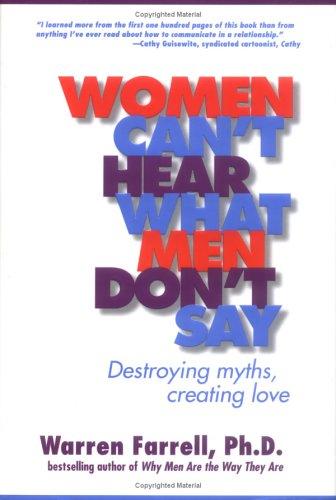 Women Can't Hear What Men Don't SayWarren Farrell