The Liberated Man
≈ From memoryTrue liberation for men requires more than the dismantling of patriarchal roles; it requires the construction of a new, purposeful masculine identity rooted in responsibility, brotherhood, and competence.
In one sentence
The feminist revolution successfully liberated women from the constraints of traditional domesticity, but it left men in a "cultural vacuum" where their traditional roles were dismantled without a viable, healthy replacement for their identity and purpose.
Why read this (and who it's for)
This book is for men who feel a sense of aimlessness, "quiet desperation," or a lack of identity in the modern world. It addresses the "crisis of masculinity" not as a political grievance, but as a psychological and sociological reality. By reading this, you will move from a state of reactive frustration to a proactive understanding of how to build a masculine life based on responsibility, competence, and brotherhood. You will learn to identify the specific cultural forces that have eroded male self-esteem and gain a blueprint for reclaiming a sense of agency.
The big idea
Warren Farrell argues that the "liberation" of women was a necessary historical milestone, but it was incomplete because it did not provide a roadmap for the "liberated man." For centuries, masculinity was defined by external roles: the provider, the protector, the patriarch. When these roles were dismantled by the feminist revolution, men were left with a "privilege" of choice that often manifested as a vacuum of purpose.
The central thesis is that masculinity is not a set of behaviors to be discarded, but a psychological need for purpose and responsibility. Farrell argues that men are fundamentally "relational" beings who require a specific type of community (brotherhood) and a specific type of challenge (mastery over the physical and spiritual world) to thrive. Without these, men become "atrophied." The book argues that we must move from a "permission-based" masculinity (what am I allowed to do?) to a "purpose-based" masculinity (what am I capable of doing for others?).
Key ideas
The Vacuum of Purpose
- What it is — The removal of traditional patriarchal roles (provider, protector) without the immediate replacement of a new, culturally-sanctioned masculine identity.
- Why it matters — When a man’s identity is tied to his utility to others, the removal of that utility without a replacement causes a psychological collapse. It leads to "anomie"—a sense of rootlessness.
- In the book — Farrell describes how men often struggle with "the burden of choice." In a world where you can be anything, the lack of a clear "should" can lead to paralysis and a loss of self-worth.
The Feminization of Boys
- What it is — The systemic shift in early childhood education and parenting that prioritizes "soft" skills (verbal communication, emotional expression) over "hard" skills (physical competence, risk-taking, and spatial awareness).
- Why it matters — Boys need "rough and tumble" play to develop resilience, physical coordination, and the ability to navigate conflict. When this is suppressed, boys grow into men who are less capable of handling the stresses of the physical and social world.
- In the book — Farrell points to the decline of "rough and tumble" play in schools and the increasing emphasis on "compliance" over "competence" in early childhood development.
Side-by-Side Bonding
- What it is — The unique way men bond through shared activity and "doing" rather than "talking."
- Why it matters — While women often bond "face-to-face" (sharing feelings and experiences), men bond "side-by-side" (working toward a common goal). Without side-by-side activities, men lose their primary source of community.
- In the book — Farrell highlights the importance of the "locker room" or the "hunting trip"—spaces where men can be vulnerable and honest because they are engaged in a shared task.
The Responsibility Framework
- What it is — The idea that masculinity is fundamentally tied to the capacity to carry weight—to be responsible for the safety, well-being, and growth of others.
- Why it matters — If masculinity is defined by "power over" others, it is oppressive. If it is defined by "responsibility for" others, it is a noble, stabilizing force.
- In the book — Farrell argues that a man’s sense of self-worth is inextricably linked to his ability to be relied upon. A man who is not needed by anyone eventually feels like he doesn't exist.
The Crisis of Authority
- What it is — The erosion of the father as a moral and authoritative figure in the home, replaced by a "friend" model of parenting.
- Why it matters — Without a father figure to model "liberated masculinity"—a man who is both capable and loving—boys lack a blueprint for how to navigate the world as men.
- In the book — Farrell discusses how the "democratization" of the family has often left boys without a clear guide on how to handle strength, authority, and responsibility.
The Need for Male-Specific Spaces
- What it is — The necessity of environments where men can discuss their unique struggles without the "policing" of the feminine gaze or the pressure of performance.
- Why it matters — Men often feel they must perform "strength" even in private. They need "safe" spaces to admit fear, failure, and inadequacy to their peers.
- In the book — Farrell argues for the preservation of male-only spaces not as a means of exclusion, but as a means of psychological preservation.
Frameworks & tools
The "Side-by-Side" Connection Model
To build brotherhood and community, stop trying to "talk" your way into friendship. Instead, use this framework to build bonds:
- Identify a Shared Goal: Choose a physical or technical task (hiking, woodworking, a sport, a fitness goal).
- Establish Regularity: Schedule a recurring time to engage in this activity.
- The "Doing" Phase: Engage in the activity for 60–90 minutes. The conversation should be secondary to the task.
- The "Debrief": Use the end of the activity to discuss the "hard" stuff—life, struggles, and goals. This is where the true bonding occurs.
The Responsibility Audit
Use this to identify where your "masculine muscles" are atrophying. Ask yourself:
- Who is depending on me? (Identify the people who rely on your skills, presence, or protection.)
- What is my "Hard" Skill? (Identify one physical or technical skill you are currently mastering.)
- What is my "Soft" Skill? (Identify one area of emotional intelligence or communication you are developing.)
- The Balance: Ensure you are not just "doing" (skills) without "caring" (relationships), and not just "feeling" (emotions) without "acting" (responsibilities).
Memorable examples & stories
The "Rough and Tumble" Observation
Farrell describes how children who engage in physical, "messy" play develop a different type of confidence than those who are kept in sanitized, sedentary environments. Lesson: Physical competence is a prerequisite for psychological confidence.
The Locker Room Analogy
Farrell uses the locker room as a metaphor for a space where men can be "unfiltered." It is a place where the "performance" of masculinity can be dropped, allowing for genuine camaraderie. Lesson: Men need a sanctuary where they can be honest about their struggles without judgment.
The "Provider" Archetype
Farrell discusses the historical role of the man as the "gatekeeper" of the home. While the method of providing has changed (from manual labor to intellectual/emotional labor), the need to provide remains. Lesson: A man who provides nothing to his family or community will eventually feel like a ghost.
Key quotes
"The problem is not that men are inherently oppressive; the problem is that they have been stripped of their purpose without being given a new one." (Paraphrased) Why it matters: It shifts the conversation from "fixing" men to "equipping" men.
"Masculinity is not a set of permissions; it is a set of responsibilities." (Paraphrased) Why it matters: It defines the difference between a "free" man and a "liberated" man.
"Men are relational beings who need to be needed." (Paraphrased) Why it matters: It highlights the psychological necessity of being useful to a community.
How to apply it
This week
- Identify a "Side-by-Side" Activity: Reach out to one male friend. Don't ask to "grab coffee to talk." Ask to "go for a hike," "hit the gym," or "work on [Project X] together."
- Audit your "Hard" Skills: Identify one physical or technical skill you have neglected (e.g., basic repairs, a sport, a craft). Spend 30 minutes practicing it.
- The "Who Needs Me?" List: Write down three people who rely on you. What is one thing you can do this week to make their lives easier or safer?
Ongoing
- The Brotherhood Rule: Make it a point to have at least one "Side-by-Side" interaction per week with a peer.
- The Responsibility Principle: Before making a decision, ask: "Does this action increase my responsibility to my family, my community, or my own growth?"
- The Competence Habit: Regularly seek out "hard" challenges. Whether it's a physical fitness goal or a difficult new skill, ensure you are regularly testing your limits.
Common pitfalls
- Confusing "Liberation" with "License": A common mistake is thinking that being a "liberated man" means you can do whatever you want without discipline. Farrell argues the opposite: true liberation is the freedom to pursue a meaningful, disciplined life of responsibility.
- The "Victim" Trap: It is easy to fall into a narrative of "men are oppressed by the system." While Farrell acknowledges systemic issues, he warns that focusing solely on victimhood prevents men from taking the agency required to build a new identity.
- The "Soft" Trap: Some might interpret his critique of "feminized" education as a rejection of emotional intelligence. Farrell isn't arguing against being "nice" or "expressive"; he is arguing against the replacement of competence with mere expression.
Connects to
- "The Problem with Equality" by Warren Farrell: Provides the broader sociological context of how "sameness" can be a trap for both men and women.
- "The Way of Men" by Ryan Holiday: Explores the archetypal and philosophical side of masculinity that Farrell touches on regarding purpose and virtue.
- "Wild at Heart" by John Eldreditch Chase: Offers a more spiritual/emotional exploration of the "masculine" need for adventure and brotherhood.
If you remember only three things
- Purpose over Permission: Masculinity is defined by what you do for others, not by what you are allowed to do.
- Side-by-Side Bonding: Men bond best through shared activity and "doing." Seek out brotherhood in action.
- The Responsibility Framework: A man's self-worth is tied to his ability to be relied upon. Find people who need you, and be the man they can count on.
Internalize it
-
Reflection questions
- In what areas of my life have I allowed my "masculine muscles" to atrophy?
- Who is currently depending on me, and am I meeting those needs with competence?
- When was the last time I engaged in a "side-by-side" activity with a friend? How did it feel compared to a "face-to-face" conversation?
- If I lost my current job/role tomorrow, what would be my "North Star" for purpose?
-
Flashcards Q: What is the primary difference between "permission-based" and "purpose-based" masculinity? A: Permission-based asks "What am I allowed to do?" while purpose-based asks "What am I capable of doing for others?"
Q: How do men typically bond compared to women, according to Farrell? A: Men typically bond "side-by-side" through shared activities, while women often bond "face-to-face" through conversation.
Q: What is the "Feminization of Boys" referring to? A: The shift toward prioritizing "soft" skills (verbal/emotional) over "hard" skills (physical/competence) in early childhood development.
Q: What is the "Vacuum of Purpose"? A: The psychological state of men who have had their traditional roles removed without a viable, culturally-sanctioned replacement.
Q: What is the "Responsibility Framework"? A: The idea that masculinity is defined by the capacity to carry weight and be responsible for the safety and growth of others.
Fidelity note
I have a high-confidence understanding of Warren Farrell's core arguments regarding the "crisis of masculinity" and the "feminization of boys." His work is distinct because it focuses on the psychological and sociological costs of the feminist revolution on men's identity. I am confident in the "Side-by-Side" and "Responsibility" frameworks as they are central to his advocacy. However, because Farrell's work is extensive, specific nuances regarding his critiques of specific educational policies may be generalized in this summary. Readers should verify specific policy critiques in the text if they are looking for a deep dive into school board-level changes.
Keep going — related reads


More from Warren Farrell
 Does Feminism Discriminate Against MenWarren Farrell and James P. SterbaEsalen Journal – Enhancing Love From Role Mate to Soul Mate, April 23, 2025Warren Farrell
 Father and Child ReunionWarren FarrellFOX News – OP-ED – Elections are temporary. Family is forever. Here’s how to keep politics from driving you apart, SepteWarren FarrellHeritage – How Pennsylvania’s “Men of Steel” Were Left Behind, June 6, 2024Warren Farrell
 The Boy CrisisWarren Farrell and John Gray
 The Myth of Male PowerWarren Farrell
 Why Men Are the Way They AreWarren Farrell
 Why Men Earn MoreWarren Farrell
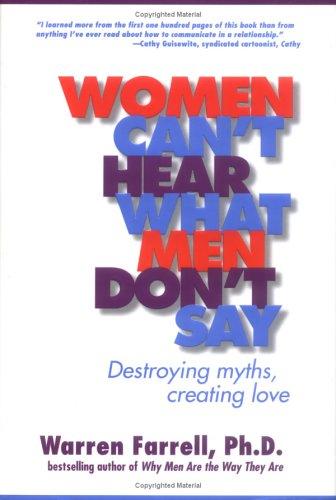 Women Can't Hear What Men Don't SayWarren Farrell