Why Men Earn More
≈ From memoryThe gender pay gap is primarily driven by the 'motherhood penalty' and the 'fatherhood premium,' reflecting a societal structure where men are socialized as providers and women as caregivers.
In one sentence
The gender pay gap is not primarily a result of systemic discrimination or a lack of ability, but rather a byproduct of different life choices and social roles—specifically the way motherhood penalizes women's careers while fatherhood often enhances men's earning potential.
Why read this (and who it's for)
This book is for anyone who feels frustrated by the "why" of the gender pay gap but finds the standard explanations (bias, lack of ambition, "the glass ceiling") insufficient or incomplete. It provides a sociological and psychological framework to understand the mechanics of the gap.
After reading this, you will be able to:
- Identify the structural differences between how men and women navigate career trajectories.
- Explain the "Motherhood Penalty" vs. "Fatherhood Premium" to others.
- Recognize how social expectations (not just individual choices) shape economic outcomes.
- Analyze career paths through the lens of "Opportunity Cost" rather than just "Potential."
The big idea
Warren Farrell argues that to understand why men earn more, we must look at the structural incentives of the nuclear family and the socialization of our children. He posits that the gap is not a "problem" to be solved by simply removing bias; it is a reflection of a society that still views men as the primary breadwinners and women as the primary caregivers.
The logic follows a clear path: Society rewards men for being "providers." Because men are socialized to be assertive and competitive, they are more likely to pursue high-risk, high-reward roles. Conversely, women are often socialized toward cooperation and nurturing. When women enter the workforce, they often choose roles that offer more flexibility or "soft" environments, which historically pay less.
Crucially, Farrell highlights that the "gap" widens significantly once children enter the picture. The "Motherhood Penalty" refers to the loss of wages and career momentum women experience when they take time off or reduce hours to care for children. The "Fatherhood Premium" is the opposite: men with children are often perceived as more stable, responsible, and committed to their careers, leading to higher pay and faster promotions.
Key ideas
The Motherhood Penalty
- What it is — The systemic reduction in earnings and career advancement that women experience when they become mothers. This includes the "opt-out" (leaving the workforce), the "opt-out-lite" (reducing hours), and the "interruption" (taking leaves of absence).
- Why it matters — It means the gap isn't just about who gets hired, but how careers are sustained. A woman might be just as capable as a man, but the structural requirement to provide childcare creates a "friction" that her male peers do not face.
- In the book — Farrell points to the data showing that women’s earnings often plateau or drop significantly after the first child, while men’s earnings often continue to climb.
The Fatherhood Premium
- What it is — The phenomenon where men who have children are often rewarded with higher pay and more responsibility than men without children.
- Why it matters — This creates a "double whammy" for women. While mothers are penalized for their caregiving roles, fathers are rewarded for theirs. This reinforces the idea that the "provider" role is the ultimate metric of success in the professional world.
- In the book — Farrell notes that employers often view a father as a "safe bet"—someone who is now motivated to work harder to provide for his family—whereas a mother is viewed as a potential liability for "distraction" by her children.
The Choice of Flexibility
- What it is — The tendency for women to choose careers that offer more "work-life balance," which often correlates with lower pay ceilings.
- Why it matters — It shifts the conversation from "discrimination" to "opportunity cost." If a woman chooses a job that allows her to be home for dinner, she is making a trade-off. Farrell argues we must acknowledge that these choices are often made in response to a society that doesn't provide enough support for working mothers.
- In the book — He discusses how women are more likely to choose "pink-collar" jobs or roles in education and social services—fields that are vital but systematically undervalued in the marketplace.
Risk-Taking and Leadership
- What it is — The psychological and social tendency for men to seek out high-risk, high-reward positions (like management or entrepreneurship) while women often opt for roles with more stability and less "exposure."
- Why it matters — Leadership roles are where the highest pay resides. If men are socialized to be "risk-takers" and women are socialized to be "risk-aversive," the pay gap will persist even if every other variable is equal.
- In the book — Farrell argues that men are more willing to work 80-hour weeks and take on "impossible" projects because they are socialized to believe that is what a "successful man" does.
The Socialization of Roles
- What it is — The invisible "programming" that begins in childhood, where boys are encouraged to be assertive, competitive, and independent, while girls are encouraged to be empathetic, cooperative, and communal.
- Why it matters — This is the root cause. If you change the way we raise children, you eventually change the types of careers they pursue and the way they negotiate for pay.
- In the book — Farrell explains how even small differences in how parents speak to children (e.g., praising a boy for "doing it himself" and a girl for "being a good helper") compound over decades into massive economic disparities.
Frameworks & tools
The "Motherhood/Fatherhood" Analysis Framework
Use this to analyze any workplace inequality. Instead of asking "Is this person being discriminated against?", ask:
- The Time Audit: Does this role require a "presence" that is incompatible with primary caregiving?
- The Penalty/Premium Check: Is the person being rewarded for their role as a provider (Fatherhood Premium) or penalized for their role as a caregiver (Motherhood Penalty)?
- The Flexibility Trade-off: Is the lower pay a result of a "choice" for flexibility? If so, what is the actual cost of that flexibility?
The Socialization Audit
To understand why certain roles are filled by certain genders, look at the "Socialization Pipeline":
- Early Childhood: What traits are being praised? (Assertiveness vs. Cooperation)
- Adolescence: What types of "risk" are encouraged? (Competitive sports/leadership vs. Collaborative arts/service)
- Adulthood: How do these traits translate to the workplace? (Management/Sales vs. Support/Nurturing)
Memorable examples & stories
The "Safe Bet" Father
Farrell describes how employers often view a man with a mortgage and children as a "stable" employee who won't quit on a whim. This creates a paradox where the very thing that makes a man a "provider" makes him more employable in a corporate sense. Lesson: The "provider" role is a social construct that has massive economic payoffs for men.
The "Opt-Out" Data
The book highlights the sheer volume of women who leave the workforce entirely or significantly reduce their hours during the first three years of a child's life. This isn't a "lack of ambition"; it's a response to a lack of affordable, high-quality childcare and a workplace culture that isn't designed for parents. Lesson: The gap is often a "gap in participation" before it is a "gap in pay."
The "Pink-Collar" Trap
Farrell discusses how women are often funneled into "helping" professions (teaching, nursing, social work). While these are essential to society, they are often treated as "vocations" rather than "careers," leading to lower pay and less influence. Lesson: Society's valuation of "caring" work is lower than its valuation of "producing" work.
Key quotes
"The gender pay gap is not a result of women being less capable; it is a result of the different roles we ask women to play in society." (Paraphrased) Why it matters: It shifts the focus from individual ability to societal structure.
"Men are socialized to be providers; women are socialized to be caregivers. The economy rewards the former." (Paraphrased) Why it matters: It identifies the specific economic engine driving the disparity.
"The 'Motherhood Penalty' is one of the most significant drivers of the wealth gap between men and women." (Paraphrased) Why it matters: It pinpoints the exact moment the gap widens.
How to apply it
This week
- Audit your "Risk" profile: Look at your current career path. Are you avoiding a high-reward opportunity because of a "risk-aversion" you learned in childhood?
- Observe the "Fatherhood Premium": Notice how colleagues with children are treated. Are they given more autonomy? Are they seen as more "serious"?
- Analyze your "Flexibility" costs: If you have ever taken a lower-paying job for "balance," calculate what that balance actually cost you in terms of long-term trajectory.
Ongoing
- The "Provider" Awareness: When evaluating leadership, look for "provider" traits (the ability to take responsibility and manage risk) rather than just "technical" skills.
- Advocate for "Care-Compatible" Infrastructure: Instead of asking for "special treatment," advocate for systems (like flexible hours or childcare support) that allow for the "Motherhood/Fatherhood" reality to coexist with professional success.
- Challenge Socialization: When mentoring others, identify the "socialized" reasons they might be hesitant to pursue certain roles (e.g., "I'm not a 'type' of person who does X") and challenge those as social constructs, not inherent traits.
Common pitfalls
- The "Glass Ceiling" Fallacy: Many readers assume the book ignores the "Glass Ceiling." Farrell doesn't ignore it, but he argues that the "ceiling" is often a result of the "floor" (the socialized roles and the Motherhood Penalty) rather than a standalone conspiracy of biased managers.
- Ignoring the "Choice" Element: A common critique is that "choice" is an illusion. Farrell acknowledges that choices are constrained by social pressure, but he insists that we cannot understand the data without acknowledging that women do choose different paths.
- Over-simplifying "Bias": Some readers might think this book says bias doesn't exist. Farrell argues that while bias exists, it is a secondary factor compared to the massive structural shifts caused by motherhood and fatherhood.
Connects to
- "Invisible Women" by Caroline Criado-Poitia: Provides a data-heavy look at how the world (and the economy) is designed for men, complementing Farrell's psychological/sociological view.
- "The Status Game" by David Rieff: Explores how social status and "roles" (like being a provider) drive human behavior, which explains the "why" behind the socialized roles Farrell describes.
- "Lean In" by Sheryl Sandberg: Offers a different perspective, focusing on how women can navigate the existing system, whereas Farrell focuses on why the system is built the way it is.
If you remember only three things
- The Motherhood Penalty (loss of earnings for women) and the Fatherhood Premium (gain for men) are the primary drivers of the pay gap.
- The gap is a result of socialized roles: Men are raised to be providers; women are raised to be caregivers.
- Opportunity Cost is key: Many women choose roles that offer more flexibility, which historically correlates with lower pay.
Internalize it
-
Reflection questions
- In what ways has my own upbringing influenced the types of "risks" I am willing to take in my career?
- If I were to remove the "caregiving" responsibilities from my life tomorrow, what career path would I take? How does that compare to my current path?
- How can I advocate for a workplace that rewards "care" and "flexibility" without devaluing the "provider" roles that drive the economy?
-
Flashcards Q: What is the "Motherhood Penalty"? A: The reduction in earnings and career advancement women experience due to the demands of caregiving.
Q: What is the "Fatherhood Premium"? A: The tendency for men with children to be perceived as more stable and rewarded with higher pay/responsibility.
Q: According to Farrell, what is the root cause of gendered career paths? A: Socialization—the way boys and girls are encouraged to behave and what roles they are expected to fill.
Q: Why does "Flexibility" often lead to lower pay? A: Because roles that offer high flexibility are often "pink-collar" or support roles that the market values less than "producing" roles.
Q: How does Farrell view the "Risk-Taking" difference? A: He argues men are socialized to take higher risks (leadership, entrepreneurship) while women are socialized toward cooperation and stability.
Fidelity note
I have a high level of confidence in the core arguments of this summary, specifically the Motherhood Penalty, Fatherhood Premium, and the role of socialized expectations. Farrell is a well-known proponent of these specific sociological views. However, because Farrell's work often cites specific labor statistics that can change year-to-year, I have focused on the mechanisms (the "why") rather than specific, static percentages. Readers should verify specific data points (like the exact percentage of the gap) in the current edition of the book.
Keep going — related reads

More from Warren Farrell
 Does Feminism Discriminate Against MenWarren Farrell and James P. SterbaEsalen Journal – Enhancing Love From Role Mate to Soul Mate, April 23, 2025Warren Farrell
 Father and Child ReunionWarren FarrellFOX News – OP-ED – Elections are temporary. Family is forever. Here’s how to keep politics from driving you apart, SepteWarren FarrellHeritage – How Pennsylvania’s “Men of Steel” Were Left Behind, June 6, 2024Warren Farrell
 The Boy CrisisWarren Farrell and John Gray
 The Liberated ManWarren Farrell
 The Myth of Male PowerWarren Farrell
 Why Men Are the Way They AreWarren Farrell
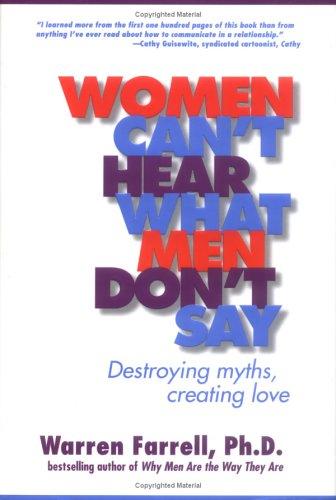 Women Can't Hear What Men Don't SayWarren Farrell