The Passions of the Soul
≈ From memoryPassions are bodily reactions triggered by the imagination, but they can be mastered through the sovereign power of the will and the guidance of reason.
In one sentence
Human beings are not slaves to their emotions; rather, passions are physiological responses to sensory input that can be governed, moderated, and mastered by the conscious will.
Why read this (and who it's for)
This book is the foundational text for modern psychology and the "mastery of self." It solves the problem of emotional volatility: Why do I feel things I don't want to feel? It is for anyone who feels overwhelmed by their impulses, for the seeker of emotional intelligence, and for the philosopher of the mind. After reading this, you will be able to deconstruct an emotional outburst into its mechanical components (sensory input, bodily reaction, and mental interpretation) and develop a strategy to intervene in that process.
The big ideas
Descartes argues that the "passions" (emotions like fear, anger, and desire) are not "spirit" or "soul" events; they are purely physical, bodily reactions. They occur when the imagination (the "fancy") perceives a danger or a pleasure and triggers a physiological response in the body—such as a racing heart or a tingle of excitement. However, while we do not choose the initial feeling, we possess the unique human capacity to choose our response to that feeling.
The central logic is a triumph of Dualism. Because the mind (the thinking thing) is distinct from the body (the extended thing), the mind can observe the body's reactions as if they were external events. This creates a "gap" between stimulus and response. By identifying the specific sensory inputs that trigger our passions, we can train our reason to override the body's reflexive reactions. The goal is not to kill the passions—which are useful for survival—but to ensure that the "pilot" (Reason) always steers the ship of the body.
Key ideas
The Passions as Bodily Reactions
Passions are not "emotions" in a vacuum; they are the body's response to the imagination. When you see a predator, your heart races; that is a passion. Why it matters: It strips the "mystique" from emotions. If an emotion is a physical reaction, it can be analyzed, measured, and managed like any other biological process. In the book: Descartes explains how the "imagination" (the faculty of mental representation) acts as the bridge between the external world and the internal bodily response.
The Role of the Imagination
The imagination is the faculty that allows us to represent things that are not present (like a memory of a fire or a fear of a future event). It is the primary driver of the passions. Why it matters: It explains why we can be terrified by a thought alone. The imagination "tricks" the body into reacting to a non-existent threat. In the book: Descartes describes how the imagination can be both a source of great pleasure (art, dreams) and a source of great distress (fear, anxiety).
The Sovereignty of the Will
While the passions are involuntary, the "will" is the seat of human freedom. The will is the power to say "no" to a bodily impulse. Why it matters: It establishes the human dignity of choice. You are not a puppet of your hormones; you are a commander of your reactions. In the book: Descartes argues that while we cannot always control the feeling of anger, we can control the action that follows the feeling.
The Necessity of Reason
Reason is the "governor" of the passions. It is the faculty that evaluates the reality of a situation and decides which passions are useful and which are harmful. Why it matters: It moves the goalpost from "feeling good" to "thinking clearly." A good life is one where reason directs the passions toward virtuous ends. In the book: Descartes emphasizes that the passions are useful for survival (fear keeps us from danger), but they must be subordinated to the intellect.
The Distinction between Feeling and Acting
Descartes makes a sharp distinction between the passion (the internal state) and the action (the external behavior). Why it matters: It allows for a "calm" observation of one's own feelings. You can feel fear without running away; you can feel anger without striking out. In the book: He argues that the mastery of the passions lies in the ability to experience the feeling without letting it dictate the behavior.
Frameworks & tools
The Anatomy of a Passion (The Analysis Model)
To master a passion, Descartes suggests breaking it down into its constituent parts. Use this when you feel an overwhelming emotional spike.
- Identify the Stimulus: What did I just see, hear, or imagine? (The external input).
- Identify the Imagination: What story is my mind telling about this? (The internal representation).
- Identify the Physical Reaction: What is my body doing? (Heart rate, sweating, tension).
- Identify the Impulse: What does the passion want me to do? (The automatic action).
- Apply the Will: Choose a response based on Reason, not the Impulse.
The Rule of Governance
A checklist for maintaining emotional sovereignty:
- Observation: Acknowledge the passion without judgment (e.g., "I feel fear right now").
- Evaluation: Ask, "Is this reaction proportionate to the reality of the situation?"
- Decision: Choose the action that aligns with your long-term goals, regardless of the immediate feeling.
Memorable examples & stories
The Predator and the Prey
Descartes uses the example of a person seeing a wild animal. The fear is a necessary biological response to ensure survival. Lesson: Passions are not "bad"; they are tools for survival that must be calibrated by the mind.
The Artist's Imagination
He discusses how artists use the imagination to create beauty and evoke feelings in others. Lesson: The imagination is a powerful engine; it can be used for creation or for self-destruction.
The "Pilot" Metaphor
While not a story, Descartes uses the consistent metaphor of the soul as a pilot and the body/passions as a ship. Lesson: You are the captain; the emotions are the winds. You don't control the wind, but you control the sails.
Key quotes
"The passions are the motions of the body... they are produced by the imagination." Why it matters: It grounds psychology in physiology.
"The will is the power of the soul to choose... it is the most perfect of all human faculties." Why it matters: It asserts that our greatest strength is our ability to choose.
"We must not be slaves to our passions, but we must use them as tools for our benefit." (Paraphrased) Why it matters: It advocates for a pragmatic, rather than ascetic, approach to emotion.
How to apply it
This week
- The "Naming" Exercise: Every time you feel a strong emotion (anger, anxiety, excitement), stop and say out loud: "I am experiencing [Emotion] because my imagination has perceived [Stimulus]."
- The 5-Second Gap: When you feel an impulse to react (e.g., sending a snarky text, eating a junk food), force a 5-second pause. Observe the physical sensation in your body before acting.
Ongoing
- The Reason Audit: At the end of each day, identify one moment where you let a passion dictate your actions. Ask: "What would a 'Reason-led' response have looked like?"
- Imagination Training: Practice visualizing difficult situations (public speaking, difficult conversations) to "pre-train" your body's reactions, while consciously choosing to remain calm during the visualization.
Common pitfalls
- The "Suppression" Fallacy: Many readers mistake "mastery" for "suppression." Descartes does not want you to crush your feelings; he wants you to acknowledge them as physical events while refusing to let them drive your behavior.
- Over-Intellectualizing: It is easy to think you are "mastering" your passions while actually just ignoring them. True mastery requires a deep awareness of the physical sensations (the racing heart, the heat in the face) without being swept away by them.
- The "Perfect Reason" Trap: Descartes assumes a high level of self-awareness. For a beginner, the "Reason" might feel weak. The goal is to strengthen the muscle of reason through practice, not to expect it to be perfect immediately.
Connects to
- Marcus Aurelius, Meditations: Both emphasize the gap between stimulus and response, though Aurelius focuses on Stoic virtue while Descartes focuses on the mechanics of the mind-body split.
- Daniel Kahneman, Thinking, Fast and Slow: Modern cognitive science's "System 1" (fast, instinctive, emotional) and "System 2" (slow, deliberate, logical) is a direct modern descendant of Descartes' distinction between Passions and Reason.
If you remember only three things
- Passions are physical reactions triggered by the imagination, not "spiritual" commands.
- The "Will" is the unique human ability to choose a response to a feeling.
- Mastery comes from identifying the stimulus, observing the physical reaction, and choosing a reasoned action.
Internalize it
-
Reflection questions
- When was the last time I acted on an impulse? What was the specific "imagined" threat or reward that triggered it?
- How does my body physically react when I am angry? Can I identify the sensation (e.g., tightness in chest) before the thought of "I want to yell" occurs?
- In what areas of my life am I currently a "slave" to a passion (e.g., procrastination, overspending, irritability)?
-
Flashcards Q: What is the source of the passions according to Descartes? A: The imagination (the faculty of mental representation).
Q: What is the difference between a passion and an action? A: A passion is an involuntary bodily reaction; an action is a choice made by the will.
Q: What is the "Pilot" metaphor? A: The soul is the pilot, and the passions are the winds/currents of the body.
Q: Does Descartes believe passions are inherently bad? A: No, they are useful for survival, but they must be governed by Reason.
Q: What is the primary tool for mastering passions? A: The Will (the power to choose).
Fidelity note
This summary is grounded in the core philosophical arguments of Descartes' The Passions of the Soul. I am highly confident in the distinction between the "Imagination" as the driver of passions and the "Will" as the seat of freedom. I am less certain of the specific nuances of his physiological descriptions (as he was a philosopher, not a modern biologist), but the conceptual framework of "Passions as bodily reactions" is the undisputed heart of the work. Readers should verify the specific distinction between "passions" and "affections" if they seek a deeper technical analysis of his terminology.
More from René Descartes
 DescartesRené Descartes
 Discourse on MethodRené Descartes
 Discourse on the method for conducting one's reason well and for seeking truth in the sciencesRené Descartes
 Discourse on the method of rightly conducting the reason, and seeking truth in the sciencesRené Descartes
 Discurso del MetodoRené Descartes
 Meditationes de prima philosophiaRené Descartes
 Meditations and other metaphysical writingsRené Descartes
 Meditations MetaphysiquesRené Descartes
 Meditations of First PhilosophyRené Descartes
 Meditations on First PhilosophyRené Descartes
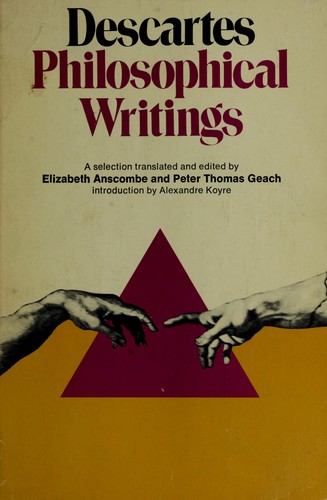 Philosophical writingsRené Descartes
 Principia philosophiaeRené Descartes