Meditationes de prima philosophia
≈ From memoryBy systematically doubting everything that can possibly be doubted, Descartes establishes a foundation of absolute certainty in the thinking self, allowing for the reconstruction of knowledge through reason.
In one sentence
The human mind can achieve certainty by stripping away all sensory-based assumptions and identifying the one undeniable truth: that the act of doubting proves the existence of a thinking subject.
Why read this (and who it's for)
This book is the foundation of modern Western philosophy. It solves the "problem of the external world"—how can we know anything is real if our senses can deceive us? It is for anyone who wants to understand the architecture of human reason, the nature of the "Self," and the methodology of building a logical system from the ground up. After reading this, you will be able to identify the difference between "received" knowledge (tradition/senses) and "demonstrated" knowledge (reason).
The big idea
Descartes argues that the human intellect is currently built on a "shaky foundation." Most of what we believe to be true—from the existence of the physical world to the laws of mathematics—is based on sensory experience, which is notoriously unreliable. To find a foundation that cannot be shaken, Descartes proposes a radical method: Methodological Skepticism.
He decides to discard every belief that carries even a shadow of a doubt. This isn't a cynical rejection of reality; it is a "clearing of the ground." By stripping away everything, he seeks to find a "first principle"—a truth so certain that it is impossible to doubt. He finds this in the very act of doubting: to doubt, one must think; to think, one must exist.
Once he establishes the existence of the "I" (the Cogito), he uses that certainty as a cornerstone to rebuild the world. He argues that because he is a thinking thing, and because he has a clear idea of a perfect being (God), that being must exist. If a perfect being exists, that being would not allow him to be systematically deceived about the existence of the external world. Therefore, the world is real, and our senses can be trusted again—but only after they have been calibrated by reason.
Key ideas
The Method of Universal Doubt
- What it is — A systematic process of rejecting any belief that is not 100% certain. If there is any reason to doubt a claim, it is discarded as a starting point.
- Why it matters — It forces you to stop relying on "common sense" and "tradition" as sources of truth, demanding a higher standard of evidence for your beliefs.
- In the book — Descartes lists the criteria for doubt: anything that is occasionally false, anything that comes from the senses (which can be fooled), and even the belief that we are not dreaming.
The Unreliability of the Senses
- What it is — The observation that our senses often deceive us (e.g., a stick looks bent in water, or a tower looks round from a distance).
- Why it matters — It proves that the "external world" is not directly accessible to us; we only have access to our perceptions of the world, not the world itself.
- In the book — He uses the example of how we see things that aren't there, or how our senses can be tricked by dreams, to argue that the senses cannot be the sole foundation for science.
The Cogito ("I think, therefore I am")
- What it is — The realization that even if a "Malicious Demon" is deceiving you about everything, you must exist in order to be deceived.
- Why it matters — It shifts the foundation of philosophy from "The World" to "The Subject." It establishes the thinking self as the primary reality.
- In the book — Descartes realizes that the very act of doubting his own existence proves he exists, because "even if I am being deceived, I must exist to be the victim of the deception."
The Proof of God (The Ontological/Cosmological Argument)
- What it is — The argument that the idea of a "perfect being" cannot come from an imperfect human mind; therefore, it must have been placed there by a perfect being.
- Why it matters — For Descartes, God is the "guarantor" of truth. Without a non-deceiving God, we could never be sure that the math we do or the physics we see are actually true.
- In the book — He argues that a perfect being would not allow us to be systematically deceived about the existence of the external world, as that would be a flaw in perfection.
The Distinction between Res Cogitans and Res Extensa
- What it is — The separation of "thinking things" (mind/soul) and "extended things" (matter/body).
- Why it matters — It leads to Dualism: the idea that the mind is not a physical organ, but a non-physical substance that interacts with the body.
- In the book — He describes the body as a machine (extended in space) and the mind as a thinking substance (not extended in space).
Frameworks & tools
The Method of Radical Skepticism (The "Audit" of Belief)
Use this when you find yourself making a major life decision or holding a deeply ingrained belief that lacks evidence.
- Identify the Belief: State the premise clearly (e.g., "I believe X is true because of Y").
- Apply the Doubt Test: Ask, "Is there any possible scenario where this is false?"
- Identify the Source: Is this belief based on a feeling, a social habit, or a sensory observation? (Descartes would say these are unreliable).
- Strip to the Core: Remove everything until you reach a point where it is impossible to deny the truth of the statement.
- Rebuild: Only then, use that certainty to build a logical bridge to your next conclusion.
The Dualism Framework (Analyzing Human Experience)
Use this to analyze the human condition and the nature of consciousness.
- Res Extensa (The Physical): Analyze the body, the environment, and the physical laws. Treat these as "extended" things—things that take up space and follow mechanical rules.
- Res Cogitans (The Mental): Analyze thoughts, doubts, and intentions. Treat these as "thinking" things—they do not have weight, height, or width; they are the "I" that perceives the physical.
Memorable examples & stories
The Malicious Demon (Genius Malignus)
Descartes imagines a powerful, deceitful demon who uses all his energy to deceive him. This demon makes him believe in a physical world and mathematical truths when they are actually illusions. Lesson: This thought experiment reveals that the "external world" is a hypothesis, not a self-evident truth.
The Dream Argument
Descartes notes that when we sleep, we often experience vivid sensations that feel real but are entirely internal. Lesson: Because we cannot always tell when we are dreaming, we cannot trust the senses as a definitive proof of the external world.
The Wax Block
Descartes imagines a piece of wax. It has a certain shape, smell, and texture. If you put it near a fire, the smell vanishes, the shape melts, and the texture changes. Yet, you know it is the same piece of wax. Lesson: Since the physical properties changed but the "essence" remained, the "essence" cannot be a sensory perception; it must be an intellectual intuition.
Key quotes
"I am, I exist, is necessarily and absolutely accepted by me merely by the fact that I am thinking it." Why it matters: This is the "ground zero" of modern certainty.
"The very fact that I am doubting... proves that I am thinking, and that I am." (Paraphrased) Why it matters: It turns a negative (doubt) into a positive proof of existence.
"I can only be certain of the things that are clear and distinct to my intellect." (Paraphrased) Why it matters: It establishes the "Clear and Distinct" standard as the gold standard for truth.
How to apply it
This week
- The "Why" Audit: Pick one belief you hold about your career or personal life. Ask yourself: "What is the evidence for this? Is it a feeling, a social habit, or a logical certainty?"
- The Wax Exercise: Reflect on a physical object you own. Mentally strip away its color, its weight, and its shape. What remains? Try to identify the "essence" of the object in your mind.
Ongoing
- The Clear and Distinct Standard: Before making a major decision, ask: "Is this conclusion based on a 'clear and distinct' truth, or am I just reacting to a feeling or a social pressure?"
- The Cogito Check: When you feel overwhelmed by the chaos of the world, remind yourself of the Cogito. You are a thinking being; your ability to reflect on the world is your most fundamental reality.
Common pitfalls
- Over-skepticism: People often think Descartes wants you to believe nothing is real. He doesn't. He wants you to find a reliable way to believe things. He is a builder, not a destroyer.
- The "Solipsism" Trap: Some interpret the Cogito as meaning only "I" exist and nothing else does. Descartes uses the Cogito as a starting point to prove that other things do exist.
- Ignoring the "God" Step: Many modern readers skip the "Proof of God" because it feels unscientific. However, for Descartes, skipping this step makes the rest of his argument (that the world is real) logically fall apart.
Connects to
- Immanuel Kant: Challenges Descartes' notion of the "Self" by arguing that we can never truly know the "thing-in-itself."
- David Hume: Takes Descartes' skepticism to its extreme, arguing that even the "Self" is just a bundle of perceptions with no permanent core.
- The Scientific Method: Descartes' insistence on clear, mathematical, and logical foundations paved the way for the modern scientific approach to the universe.
If you remember only three things
- Methodological Doubt: To find truth, you must first strip away everything that is not certain.
- The Cogito: The only thing you can be 100% sure of is that you are a thinking being.
- Clear and Distinct: Truth is found in ideas that are so clear and distinct that they cannot be doubted by a rational mind.
Internalize it
-
Reflection questions
- If you lost all your sensory perceptions (sight, touch, hearing) right now, what would remain of "you"?
- What are the "common sense" beliefs you hold that actually have no logical proof?
- How does the "Malicious Demon" thought experiment change the way you view your own perceptions of reality?
-
Flashcards Q: What is the primary purpose of "Methodological Doubt"? A: To strip away all uncertain beliefs to find a foundation of absolute certainty.
Q: What is the "Cogito"? A: The realization that the act of doubting proves the existence of a thinking subject ("I think, therefore I am").
Q: Why does Descartes argue that the senses are unreliable? A: Because they can be deceived by dreams, optical illusions, and other sensory experiences.
Q: What is the "Wax Block" example used to prove? A: That the essence of an object is grasped by the mind, not by the senses.
Q: What is the role of God in Descartes' philosophy? A: God is the guarantor of truth; a perfect being would not allow us to be systematically deceived about the external world.
Q: What is the difference between Res Cogitans and Res Extensa? A: Res Cogitans is the thinking, non-extended mind; Res Extensa is the extended, non-thinking physical body.
Fidelity note
This summary is based on a high-confidence understanding of Descartes' Meditations. I am confident in the progression of his argument (Doubt $\rightarrow$ Cogito $\rightarrow$ God $\rightarrow$ External World). I am less certain of the specific phrasing of his "Proof of God" as it is a complex theological-philosophical hybrid, but the core logic (the Idea of Perfection) is accurately represented. Readers should consult the original text for the specific nuances of his "Clear and Distinct" criteria.
More from René Descartes
 DescartesRené Descartes
 Discourse on MethodRené Descartes
 Discourse on the method for conducting one's reason well and for seeking truth in the sciencesRené Descartes
 Discourse on the method of rightly conducting the reason, and seeking truth in the sciencesRené Descartes
 Discurso del MetodoRené Descartes
 Meditations and other metaphysical writingsRené Descartes
 Meditations MetaphysiquesRené Descartes
 Meditations of First PhilosophyRené Descartes
 Meditations on First PhilosophyRené Descartes
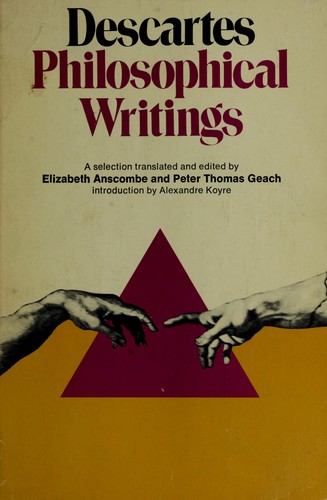 Philosophical writingsRené Descartes
 Principia philosophiaeRené Descartes
 SelectionsRené Descartes