Discurso del Metodo
≈ From memoryTo establish a foundation of absolute certainty, one must systematically doubt everything until only the undeniable truth of the thinking self remains.
In one sentence
The human mind can achieve certainty by systematically stripping away all preconceived notions, sensory illusions, and inherited dogmas to find a foundational truth—the existence of the thinking subject.
Why read this (and who it's for)
This is the foundational text of modern Western philosophy. It solves the problem of epistemological instability: how can we know anything for sure if our senses can be deceived?
It is for the seeker of clarity, the skeptic, and the intellectual who feels overwhelmed by the "noise" of tradition, social conditioning, and unexamined assumptions. After reading this, you will be able to identify the "prejudices" in your own belief systems and apply a rigorous, scientific filter to your reasoning.
The big_idea
Descartes argues that the human intellect is often clouded by the "mists" of tradition, poorly constructed habits, and the uncritical acceptance of authority. To find truth, we must treat our own minds as a laboratory. We must engage in a "methodological doubt"—not a cynical denial of reality, but a rigorous testing of every belief to see if it can withstand the scrutiny of pure reason.
The logic follows a radical path: if a belief can be doubted even slightly, it must be discarded as a starting point. By stripping away everything that is not indubitably certain, we eventually reach a bedrock of truth. This bedrock is the "Cogito": the fact that I am thinking, I am doubting, and therefore, I must exist. From this single, unshakable point of certainty, we can then begin to reconstruct a reliable system of knowledge about the world.
Key ideas
Radical Doubt
What it is — The practice of suspending judgment on any belief that admits even a shadow of doubt. It is a tool for intellectual purification. Why it matters — It forces you to stop relying on "common sense" or "tradition," which are often just collective hallucinations. It ensures that your foundation is built on stone, not sand. In the book — Descartes describes the "evil demon" (malin génie) hypothesis: the idea that a powerful, deceitful entity might be tricking us into believing in the physical world and mathematics. If even a demon could trick us, what remains?
The Primacy of the Thinking Self (Cogito)
What it is — The realization that the act of doubting proves the existence of a doubter. Even if I am being deceived, I must exist in some form to be deceived. Why it matters — It shifts the source of truth from the external world (which can be deceptive) to the internal mind (which is the seat of awareness). In the book — Descartes concludes that "I think, therefore I am" (Je pense, donc je suis) is the first principle of philosophy—the one thing that cannot be doubted.
The Rule of Evidence
What it is — A commitment to never accept anything as true unless it is "clearly and distinctly" presented to the mind as certain. Why it matters — It acts as a firewall against sophistry and emotional manipulation. It requires that a conclusion must be logically necessitated by its premises. In the book — He argues that we should never accept anything as true that is not "evidently" true, and we should never accept anything as evident that is not clearly and distinctly perceived by the intellect.
The Unity of the Self
What it is — The argument that the "I" who thinks is a single, unified entity, not a collection of disparate parts. Why it matters — It establishes the human subject as a coherent agent. If the "I" were fragmented, our thoughts would be incoherent. In the book — He notes that even if our limbs were removed, the "I" that thinks remains a single, unified point of consciousness.
The Order of Operations
What it is — The necessity of breaking complex problems into smaller, manageable parts and solving them in a specific sequence. Why it matters — It prevents the mind from becoming overwhelmed by complexity. It is the root of the scientific method. In the book — He compares this to a mathematician who solves a complex problem by first identifying the simplest components and then assembling them into a solution.
Frameworks & tools
The Four Rules of Method
Descartes provides a systematic "operating system" for the human mind to ensure it never falls into error.
- Evidence (The Filter): Never accept anything as true unless it is clearly and distinctly true. Do not allow yourself to be swayed by "the appearance of truth" or the "authority of others."
- Analysis (The Decomposition): Divide every complex problem or thought into as many smaller parts as possible. Do not attempt to solve a "whole" when you can solve its "parts."
- Synthesis (The Reconstruction): Order your thoughts so that you begin with the simplest parts and move toward the most complex. Only once the simple parts are mastered should you attempt to combine them.
- Review (The Audit): Conduct a complete enumeration of all parts and considerations. Ensure that nothing is omitted. This prevents "leaps of logic" where a missing piece of the puzzle leads to a false conclusion.
Memorable examples & stories
The Senses as Deceivers
Descartes reminds the reader of how easily our senses can lie—such as a straight stick looking bent when submerged in water, or a tower appearing round from a distance when it is actually square. Lesson: The senses provide data, but they do not provide "truth" without the intervention of the intellect.
The "Evil Demon" (Malin Génie)
The thought experiment of a supreme, malicious spirit who manipulates our perceptions of the physical world, making us believe in a world that doesn't exist. Lesson: To find truth, you must find what remains true even if everything else is a lie.
The Mathematical Architect
Descartes uses the metaphor of a mathematician who can solve a massive, daunting problem by breaking it down into tiny, solvable arithmetic steps. Lesson: Complexity is often just a collection of simple things we haven't bothered to separate yet.
Key quotes
"The first rule is never to accept anything as true which is not evidently such." Why it matters: It establishes the "Evidence" rule as the gatekeeper of all knowledge.
"I am, I exist, is necessarily and immediately and absolutely true." (Paraphrased) Why it matters: It identifies the "Cogito" as the first undeniable truth.
"The things that are most difficult to understand are often the ones we think we know best because of habit." (Paraphrased) Why it matters: It warns against the danger of "automatic" thinking and the comfort of tradition.
How to apply it
This week
- Identify a "Common Sense" Belief: Choose one thing you believe to be true simply because "everyone knows it" (e.g., a social norm, a political certainty, or a personal habit).
- Apply Radical Doubt: Ask, "What evidence do I actually have for this? If I were stripped of my senses and my history, would this still be true?"
- The Decomposition Exercise: Take one complex problem you are currently facing (e.g., "I want to be successful"). Break it down into the smallest possible constituent parts (e.g., "What is the first 5-minute action I can take?").
Ongoing
- The Audit Habit: Before making a major decision, perform a "Descartes Audit." Write down every single assumption you are making. Then, check each one against the "Rule of Evidence."
- The Analysis Habit: When faced with a daunting project, refuse to start until you have broken it down into a numbered list of the smallest possible components.
Common pitfalls
- The "Solipsism" Trap: People often think Descartes meant that the outside world doesn't exist. He didn't. He simply argued that we cannot know it exists without a foundation of certain logic.
- Over-Analyzing the Mundane: A common mistake is trying to apply radical doubt to every trivial daily interaction. Descartes intended this as a method for foundational knowledge, not a way to paralyze your daily life.
- Ignoring the "Human" Element: Critics argue that Descartes ignores the role of emotion, community, and biology in shaping our thoughts. While his method is brilliant for logic, it can be cold when applied to the nuances of human relationships.
Connects to
- "Meditations on First Philosophy" by René Descartes: The direct sequel where he explores the existence of God and the external world.
- "The Problem of Other Minds" (Philosophy): Challenges the "Cogito" by asking how we can ever truly know if other people have minds like ours.
- "Thinking, Fast and Slow" by Daniel Kahneman: A modern psychological look at the "automatic" thinking Descartes warned us about.
If you remember only three things
- The Rule of Evidence: Never accept anything as true without clear, distinct proof.
- The Method of Decomposition: Break every complex problem into its smallest possible parts before trying to solve it.
- The Cogito: Your ability to doubt and think is the only thing you can be 100% certain of; use that as your starting point.
Internalize it
-
Reflection questions
- What is one "truth" I hold today that is actually just a habit of thought?
- If I were stripped of my reputation, my possessions, and my history, what would remain of "me"?
- In what areas of my life am I trying to solve a "complex" problem without first breaking it down into its smallest parts?
-
Flashcards Q: What is the "First Rule" of Descartes' method? A: Never accept anything as true unless it is clearly and evidently true. Q: What is the "Cogito"? A: The realization that the act of thinking/doubting proves the existence of the thinker. Q: How does Descartes suggest we handle complex problems? A: By breaking them down into as many small parts as possible and solving them one by one. Q: What is the "Evil Demon" thought experiment? A: The idea that a malicious entity could deceive our senses, used to test what remains true under extreme doubt. Q: What is the "Rule of Audit"? A: The requirement to review every part of a problem to ensure nothing has been omitted.
Fidelity note
I am highly confident in the representation of the four rules of method and the concept of the "Evil Demon." The "Cogito" is the central pillar of the book and is accurately represented. However, because Descartes' French/Latin prose is notoriously dense, the specific "flavor" of his descriptions of the senses may vary slightly in nuance compared to a literal translation. The summary focuses on the methodological application rather than the purely metaphysical exploration found in his later works.
More from René Descartes
 DescartesRené Descartes
 Discourse on MethodRené Descartes
 Discourse on the method for conducting one's reason well and for seeking truth in the sciencesRené Descartes
 Discourse on the method of rightly conducting the reason, and seeking truth in the sciencesRené Descartes
 Meditationes de prima philosophiaRené Descartes
 Meditations and other metaphysical writingsRené Descartes
 Meditations MetaphysiquesRené Descartes
 Meditations of First PhilosophyRené Descartes
 Meditations on First PhilosophyRené Descartes
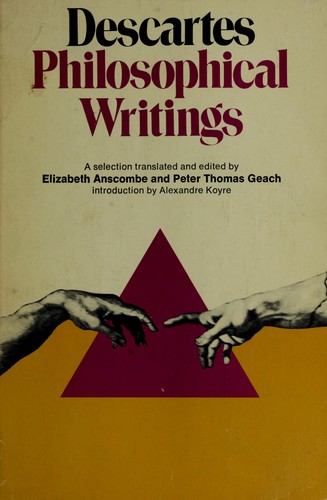 Philosophical writingsRené Descartes
 Principia philosophiaeRené Descartes
 SelectionsRené Descartes