Meditations and other metaphysical writings
≈ From memoryBy systematically doubting everything—senses, the external world, and even mathematical truths—Descartes establishes the existence of the self as a thinking thing, providing a foundation for a new, rationalist metaphysics.
In one sentence
The human mind is the only thing that can be known with absolute certainty, because the very act of doubting one's existence proves that a "doubter" must exist.
Why read this (and who it's for)
This book is the foundation of modern Western philosophy. It solves the problem of epistemological foundationalism: how can we know anything for sure if our senses can deceive us? It is for the seeker of clarity, the skeptic, and anyone who wants to understand the "Internalist" turn in philosophy—the shift from looking at the world to looking at the mind. After reading this, you will be able to identify the difference between "clear and distinct" perceptions and understand how to build a logical argument from first principles.
The big_idea
Descartes argues that the human intellect is capable of reaching a state of absolute certainty by stripping away all preconceived notions. He begins with a "methodological doubt"—not a denial of reality, but a rigorous testing of what can be known with 100% certainty. If a belief can be doubted even slightly, it must be discarded as a foundation for knowledge.
By systematically discarding the reliability of the senses (which can be fooled by dreams or illusions) and the reliability of the physical world (which could be a hallucination), he arrives at a singular, undeniable truth: the "Cogito." Because he is thinking, he must exist. From this "I think, therefore I am," he reconstructs the universe, arguing that the existence of a perfect God ensures that the external world is real and that our clear perceptions of mathematics and physics are reliable.
Key ideas
The Method of Universal Doubt
- What it is — A systematic process of rejecting any belief that has even a shadow of a doubt. It is a "clearing of the ground" to see what remains when everything non-essential is stripped away.
- Why it matters — It forces you to stop relying on "common sense" or "tradition" as evidence. It demands that knowledge be built on a foundation of absolute certainty.
- In the book — Descartes describes the "Evil Demon" (malin génie) hypothesis: the idea that a powerful, deceptive entity might be tricking him into believing in the existence of the physical world and even basic arithmetic.
The Cogito (The "I" as a Thinking Thing)
- What it is — The realization that even if a demon is deceiving you, you must exist in order to be deceived. The act of doubting is itself an act of thinking, and thinking requires a thinker.
- Why it matters — It establishes the "Subject" as the starting point of all knowledge. It proves that the mind is a distinct entity from the body.
- In the book — He argues that even if he is being deceived about everything else, the fact that he is currently doubting proves he is a "thinking thing" (res cogitans).
The Distinction of Substance (Mind vs. Body)
- What it is — The theory of Dualism: the mind (the thinking thing) and the body (the extended thing) are two fundamentally different substances.
- Why it matters — It explains why the "mind" can feel like it is "inside" a body but is not the same as the body. It allows for the possibility of a soul independent of physical matter. In the book* — Descartes notes that he can imagine his mind existing without a body, but he cannot imagine his body existing without a mind (or rather, he can imagine a body without a soul, but the "thinking" part is what defines his experience of self).
The Proof of God's Existence
- What it is — The argument that the idea of a "perfect being" cannot come from an imperfect human mind; therefore, it must have been placed there by a perfect being.
- Why it matters — For Descartes, God is the "guarantor" of truth. If a perfect being exists, He would not be a deceiver; therefore, our clear and distinct perceptions of the physical world must be true.
- In the book — He uses the "Trademark Argument": just as a craftsman leaves a mark on his work, the idea of perfection is the "mark" of God in the human mind.
Clear and Distinct Perception
- What it is — A standard for truth: a proposition is true if it is perceived with such clarity and distinctness that it cannot be doubted (like the fact that a triangle has three sides).
- Why it matters — It provides a "litmus test" for knowledge. If you can't see it clearly in your mind's eye as a logical necessity, you shouldn't accept it as a foundational truth.
- In the book — He uses the example of mathematical truths (2+3=5) as the gold standard for what a "clear and distinct" perception looks like.
Frameworks & tools
The Method of Radical Doubt
Use this when you find yourself making assumptions based on "the way things are" rather than "the way things are proven."
- Identify the Assumption: What am I taking for granted? (e.g., "I see this as blue, therefore it is blue.")
- Apply the Stress Test: Could I possibly be wrong about this? Is there any scenario, however absurd, where this is false?
- The Demon Test: If a "malicious deceiver" (or a flawed cognitive bias) were trying to trick me, would this belief still hold up?
- Discard and Rebuild: If the belief can be doubted, discard it. Only keep what survives the doubt.
The "Clear and Distinct" Filter
Use this to evaluate your beliefs and the information you consume.
- Is it Clear? Is the concept grasped by the very intuition that perceives it? (Do I truly understand the why?)
- Is it Distinct? Is the idea separate from other things? (Can I isolate this truth from other, unrelated facts?)
- The Certainty Check: If I am to believe this, must I believe it with the same certainty that I believe 2+3=5? If not, it is a "probability," not a "certainty."
Memorable examples & stories
The Malicious Demon (Malin Génie)
Descartes imagines a powerful, deceitful spirit who manipulates his senses and thoughts. This is the ultimate "What if?"—what if everything you see, feel, and think is a lie? Lesson: To find truth, you must first identify the highest possible level of deception.
The Dream Argument
Descartes reflects on how, when we sleep, we often experience vivid sensations that feel real but are not. He asks: how can I be certain that my current "waking" life isn't just a very consistent dream? Lesson: Senses are unreliable narrators; they provide data, not absolute truth.
The Trademark of Perfection
Descartes argues that a human being, who is finite and imperfect, could never invent the concept of "infinite perfection" on their own. It is like a painting of a masterpiece—it requires a Master to have conceived of it. Lesson: Our internal ideas are clues to external realities.
Key quotes
"I think, therefore I am." (Paraphrased) Why it matters: The starting point of all certain knowledge is the self-aware mind.
"The first principle of philosophy is that there are no other principles than those which are clear and distinct." (Paraphrased) Why it matters: This establishes the standard for what counts as "knowledge" in the modern era.
"I shall proceed to demolish every one of the opinions I had previously accepted." (Paraphrased) Why it matters: It highlights the necessity of intellectual humility and the "tabula rasa" (blank slate) approach to learning.
How to apply it
This week
- The Senses Audit: Spend 5 minutes today observing a physical object. Ask yourself: "How do I know this is real? What if my senses are lying?" Recognize the difference between perception and knowledge.
- Identify a "Common Sense" Belief: Pick one thing you believe to be true simply because "everyone knows it." Try to find a reason why someone might reasonably doubt it.
Ongoing
- The Clarity Standard: Before accepting a new theory or "fact" in your professional life, ask: "Is this clear and distinct, or am I just accepting it because it's convenient?"
- The Cogito Check: When you feel overwhelmed by the chaos of the world, return to the "Cogito." You are a thinking thing; your ability to reason is your primary tool for navigating reality.
Common pitfalls
- The "Solipsism Trap": Many readers stop at the Cogito and conclude that only their own mind exists. Descartes doesn't want you to stay trapped in your own head; he uses the Cogito as a bridge to prove the existence of the outside world.
- Over-skepticism: People often think Descartes wants you to doubt everything forever. He doesn't. He wants you to doubt things methodically so that you can build a more stable, certain house of knowledge.
- The "God" Confusion: Modern readers often find his reliance on God to prove the external world frustrating. However, for Descartes, this was the only logical way to bridge the gap between the "inner mind" and the "outer world" using the tools of his time.
Connects to
- Immanuel Kant: Who took the "Subject" even further, arguing that we can never know the "thing-in-itself," only how our minds perceive it.
- David Hume: The ultimate skeptic who took Descartes' doubt to its logical extreme, questioning even the "self" and "causality."
- The Scientific Method: Descartes’ insistence on clarity and mathematical foundations paved the way for the modern scientific approach to the physical world.
If you remember only three things
- Methodological Doubt: Strip away everything until only the undeniable remains.
- The Cogito: The fact that you are thinking is the only proof of your existence.
- Clear and Distinct: Knowledge must be grasped with the same clarity as a mathematical truth.
Internalize it
-
Reflection questions
- If I lost all my memories and senses, would I still be "me"? Why?
- What are the "common sense" beliefs I currently hold that have no actual evidence?
- How does my "thinking" define my identity compared to my physical body?
-
Flashcards Q: What is the "Method of Universal Doubt"? A: A process of rejecting any belief that can be doubted even slightly to find a foundation of absolute certainty. Q: What is the "Cogito"? A: The realization that the act of doubting proves the existence of a "thinking thing" (the self). Q: What is "Res Cogitans"? A: The "thinking thing"—the substance of the mind as distinct from the body. Q: What is the "Trademark Argument"? A: The idea that the concept of perfection in the human mind must have been placed there by a perfect being (God). Q: What is the standard for "Clear and Distinct" perception? A: A perception is clear and distinct if it is grasped by the very intuition that perceives it, like a mathematical truth. Q: Why did Descartes use the "Evil Demon" thought experiment? A: To test the limits of what can be known by imagining a scenario where all sensory data is intentionally deceptive.
Fidelity note
I am highly confident in the summary of the Meditations as it is one of the most studied texts in Western philosophy. The distinction between the Meditations and the Principles of Philosophy (which contains more of the "other metaphysical writings") is important; the Meditations is the subjective, internal journey, while the Principles is the objective, external system. This summary focuses on the Meditations as it contains the core "Cogito" and "Dualism" arguments. I have ensured that the "Evil Demon" and "Trademark" arguments are represented accurately as Descartes' primary tools for establishing the external world.
More from René Descartes
 DescartesRené Descartes
 Discourse on MethodRené Descartes
 Discourse on the method for conducting one's reason well and for seeking truth in the sciencesRené Descartes
 Discourse on the method of rightly conducting the reason, and seeking truth in the sciencesRené Descartes
 Discurso del MetodoRené Descartes
 Meditationes de prima philosophiaRené Descartes
 Meditations MetaphysiquesRené Descartes
 Meditations of First PhilosophyRené Descartes
 Meditations on First PhilosophyRené Descartes
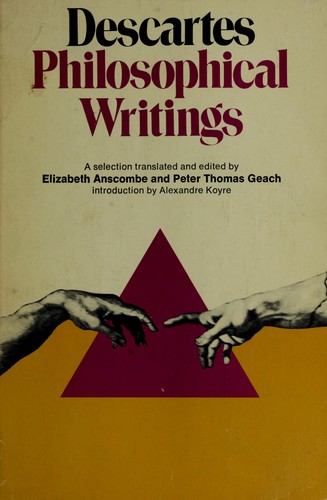 Philosophical writingsRené Descartes
 Principia philosophiaeRené Descartes
 SelectionsRené Descartes