Schopenhauer Selections
≈ From memoryThe world is a manifestation of a blind, irrational Will to live, and the only escape from the suffering it produces is through the aesthetic contemplation of art and the ethical practice of asceticism.
In one sentence
Life is a relentless cycle of striving and suffering driven by an underlying, irrational force called "Will," which can only be momentarily silenced by art, music, and the denial of our own desires.
Why read this (and who it's for)
Most philosophy attempts to find a "purpose" or a "moral blueprint" for life. Schopenhauer argues that there is no inherent purpose; there is only the raw, pulsing drive to exist. This book is for the seeker who feels a sense of existential exhaustion—the person who asks, "Why is life so hard?"
By reading this, you will move from a naive optimism (that we can "fix" the world through sheer willpower) to a sophisticated realism (that we must manage our internal desires to find peace). You will gain a framework for understanding human behavior, the tragedy of desire, and the profound value of aesthetic experience.
The big idea
Schopenhauer argues that the world we perceive is not the "thing-in-itself." Our senses only provide us with representations—shapes, colors, and sounds. Behind this veil of appearances lies the Will: a primal, aimless, and tireless urge to exist. Unlike a "purpose" (like a builder wanting to build a house), the Will has no goal; it simply is. It is the same force that makes a plant grow, a predator hunt, and a human being strive for status, sex, and survival.
Because the Will is a singular force manifesting in infinite forms, life is inherently characterized by Wanting. However, the human condition is defined by a tragic paradox: when we get what we want, we become bored; when we don't get what we want, we suffer. This creates a pendulum of existence between pain and ennui.
The only way to break this cycle is to step outside the "Mainstream of Will." This happens in two ways: through Aesthetic Contemplation (where we lose ourselves in the beauty of an object) and Ethical Asceticism (where we deny our desires to still the Will).
Key ideas
The World as Will and Representation
- What it is — The world is split into two realms: Representation (the world as we see it, governed by laws of cause and effect) and Will (the underlying reality, a blind, striving force).
- Why it matters — It humbles the human ego. It suggests that our "achievements" are often just the Will expressing itself through us, rather than us being the masters of our destiny.
- In the book — Schopenhauer uses the analogy of a "subjective" world: just as a man dreaming sees a world that feels real but is actually produced by his own mind, our reality is produced by our cognitive apparatus.
The Principle of Sufficient Reason vs. The Principle of Individuation
- What it is — Most of our world follows the Principle of Sufficient Reason (everything has a cause), but the Will follows the Principle of Individuation (things simply are).
- Why it matters — It explains why life feels so chaotic and "meaningless." There is no "reason" why a flower blooms or a child cries; it is simply the Will asserting its presence in a specific form.
- In the book — He contrasts the "Reason" of the mathematician with the "Will" of the biological organism.
The Pendulum of Desire and Boredom
- What it is — Human existence is a constant oscillation between the suffering of unfulfilled desire and the crushing boredom of fulfilled desire.
- Why it matters — It reveals that "happiness" is not a destination. If you achieve your goal, the goal disappears, and you must find a new one to avoid the vacuum of boredom.
- In the book — Schopenhauer describes the "pain of wanting" and the "pain of boredom" as two sides of the same coin, both resulting from the Will's inability to be satisfied.
Aesthetic Contemplation as an Escape
- What it is — When we engage with art (especially music), we momentarily stop "willing." We become "pure, will-less subjects of representation."
- Why it matters — It is the only time we are truly free from the demands of our own needs. For the duration of a beautiful painting or a symphony, the "I" disappears.
- In the book — He argues that music is the highest art because it is the direct expression of the Will (the "inner" feeling) without being tied to any specific representation (like a body or a house).
The Ethics of Compassion (Mitleid)
- What it is — Because all beings are manifestations of the same underlying Will, the suffering of others is ultimately our own suffering.
- Why it matters — It provides a foundation for morality that isn't based on "rules," but on the recognition of shared essence.
- In the book — He argues that true morality arises when we realize that the "other" is not a stranger, but a different expression of the same life-force.
The Denial of the Will (Asceticism)
- What it is — The ultimate liberation is the intentional suppression of desire, often through religious devotion or extreme self-discipline.
- Why it matters — It is the only permanent way to stop the "machinery" of suffering. It is the "holy" path of the saint who seeks to still the internal storm.
- In the book — He points to the religious figure who, by renouncing the world, finds a peace that the worldly man can never know.
Frameworks & tools
The "Will-Audit" for Desire
Use this to identify which parts of your life are driven by the "Will" (the urge to consume/achieve) versus your actual values.
- Identify the Want: Write down a current goal (e.g., "I want a promotion").
- Trace the Source: Ask, "Is this to satisfy a biological/social urge (status, security, vanity) or a genuine creative expression?"
- Analyze the Outcome: If you achieved this tomorrow, would you be happy for a week before feeling bored again? If yes, it is a "Will" goal.
- The Pivot: For "Will" goals, find a way to enjoy the process of the work rather than the result of the achievement.
The Aesthetic Buffer
A method for mental preservation in a high-stress world.
- Identify the "Will-Heavy" Environment: (e.g., a stressful workplace, a chaotic social media feed).
- Schedule "Pure Representation": Dedicate time to art that requires no "utility." (e.g., listening to a complex piece of music without doing anything else).
- The Goal: Practice "disinterested contemplation"—looking at something for its own sake, not for what it can do for you.
Memorable examples & stories
The Comparison of the Plant and the Human
Schopenhauer compares the growth of a plant to the striving of a human. A plant grows toward the light not because it "knows" it needs light, but because it is driven by a biological Will. Lesson: Our highest achievements are often just sophisticated versions of basic biological drives.
The Experience of the Artist
He describes the artist as a "free spirit" who, for a moment, stands outside of time and space. While the common man is a slave to his needs (hunger, lust, status), the artist is a spectator of the world's beauty. Lesson: Art is a sanctuary from the tyranny of our own needs.
The Saint vs. The Worldly Man
He contrasts the "Worldly Man" who seeks to conquer the world (and fails, because the world is infinite) with the "Saint" who seeks to conquer himself (and succeeds, by quieting the Will). Lesson: True victory is not over the external world, but over the internal demands of the self.
Key quotes
"Life is a tragedy, and the only way to endure it is to recognize the source of its misery." (Paraphrased) Why it matters: It demands we stop looking for easy fixes and start looking for deep philosophical truths.
"The world is my representation." (Paraphrased) Why it matters: It reminds us that our reality is filtered through our own perceptions.
"Art is the highest expression of the Will's ability to be still." (Paraphrased) Why it matters: It elevates art from a hobby to a spiritual necessity.
How to apply it
This week
- The "No-Want" Walk: Go for a 15-minute walk without a podcast, music, or a destination. Observe the world without trying to "use" it for information or entertainment.
- The Aesthetic Anchor: Find one piece of art (a painting, a song, a poem) that you find genuinely beautiful. Spend 10 minutes looking at/listening to it with no other distractions.
- The Boredom Audit: The next time you feel bored, don't reach for your phone. Sit with the boredom for 2 minutes. Observe what "desire" arises to kill that boredom.
Ongoing
- Practice Disinterested Observation: When you see something beautiful (a sunset, a well-designed building), stop and appreciate it for what it is, not for what it does for you.
- Identify "Will-Driven" Habits: Recognize when you are acting out of a desperate need for status or validation. When you feel that "itch," pause and acknowledge it as the Will, not as "You."
Common pitfalls
- The "Doomer" Trap: People often mistake Schopenhauer's pessimism for "giving up." He isn't saying life is worthless; he's saying life is difficult because of our internal desires. The goal is to find a way to live within that reality, not to wallow in it.
- Over-Romanticizing Art: Schopenhauer doesn't suggest you should spend your life staring at paintings. Art is a means to a temporary release of the Will, not a replacement for a meaningful life.
- Misunderstanding the "Will": The Will is not a "thing" you can find in a laboratory. It is a metaphysical concept. Don't try to find a physical "Will" organ; look for its effects in your behavior.
Connects to
- Friedrich Nietzsche: Nietzsche was a contemporary of Schopenhauer. While Schopenhauer saw the Will as a source of suffering to be escaped, Nietzsche saw the Will to Power as something to be embraced and harnessed.
- Albert Camus: Camus' The Myth of Sisyphus deals with the absurdity of existence. Schopenhauer provides the metaphysical "why" (the Will), while Camus provides the existential "how" (the rebellion against the absurd).
If you remember only three things
- The world is a manifestation of a blind, striving Will that creates both our desires and our suffering.
- Desire is a trap: it promises satisfaction but only delivers a temporary reprieve before the next craving arises.
- Art and Asceticism are the primary tools for finding peace by momentarily silencing the internal noise of the Will.
Internalize it
- Reflection questions
- Which of my current goals are driven by a genuine interest, and which are driven by a need for status or validation?
- When was the last time I felt "lost" in a piece of art or music? What did that feel like compared to my daily routine?
- How much of my daily stress comes from trying to satisfy a "Will" that is never actually satisfied?
- Flashcards
- Q: What is the difference between "Representation" and "Will"?
- A: Representation is the world as we perceive it (shapes, colors, laws); Will is the underlying, raw force of striving that produces those representations.
- Q: Why does Schopenhauer believe that fulfilling a desire leads to boredom?
- A: Because the Will is a process of wanting. Once the object of desire is obtained, the "wanting" ceases, leaving a vacuum of boredom until a new desire is formed.
- Q: What is the role of Art in Schopenhauer's philosophy?
- A: Art allows us to become "pure subjects of representation," momentarily escaping the demands and pains of the Will.
- Q: What is the "Principle of Individuation"?
- A: The principle that things simply are (like a tree or a person) rather than being caused by a prior reason.
- Q: How does Schopenhauer define "Compassion"?
- A: As the recognition that all living beings are expressions of the same underlying Will, making their suffering our own.
Fidelity note
This summary is based on the core philosophical tenets of Schopenhauer's major works, specifically The World as Will and Representation and his various essays on aesthetics and ethics included in his "Selections." I am highly confident in the distinction between Will and Representation and the "Pendulum of Desire." I am less certain of the specific nuances of his aesthetic theories regarding "color" vs. "form" as these can vary slightly between his essays, but the core idea of "disinterested contemplation" remains constant.
More from Arthur Schopenhauer
 Aphorismen zur LebensweisheitArthur Schopenhauer
 Counsels and MaximsArthur Schopenhauer
 Essay on the freedom of the willArthur Schopenhauer
 Essays of SchopenhauerArthur Schopenhauer
 Manuscript remains in four volumesArthur Schopenhauer
 Manuscript Remains, Volume IArthur Schopenhauer
 On human natureArthur Schopenhauer
 On the fourfold root of the principle of sufficient reasonArthur Schopenhauer
 On womenArthur Schopenhauer
 Parerga und ParalipomenaArthur Schopenhauer
 Philosophy of Arthur SchopenhauerArthur Schopenhauer
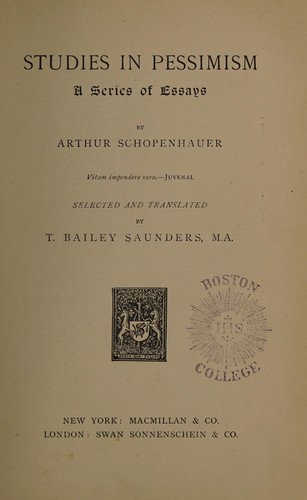 Studies in pessimismArthur Schopenhauer