On human nature
≈ From memoryHuman existence is a relentless, unconscious striving of a blind, irrational Will that creates suffering by perpetually seeking a satisfaction it can never permanently achieve.
In one sentence
Humanity is not a product of rational design or a purposeful spirit, but the manifestation of a blind, insatiable "Will to Live" that uses our intellect merely as a tool to ensure its own survival and propagation.
Why read this (and who it's for)
Most people view human behavior as a series of conscious choices made by a rational "self." Schopenhauer argues this is a fundamental delusion. He argues that we are actually driven by subterranean, biological, and metaphysical forces that we barely understand.
This book is for the seeker of deep psychological truth—the person who feels the frustration of their own lack of willpower, the cyclical nature of their desires, and the "why" behind human cruelty and heroism. After reading this, you will be able to view your own impulses, your ambitions, and your sufferings not as personal failures, but as the inevitable friction of a biological machine driven by a primal Will.
The big idea
Schopenhauer argues that the world we perceive is not the "thing-in-itself." Our senses provide us with a representation of the world (space, time, and causality), but these are merely the filters through which we experience reality. The true essence of the world—the "Will"—is a mindless, aimless force of striving.
This Will is what drives the growth of a crystal, the migration of a bird, and the hunger of a human being. It is not "rational" in the sense that it has a plan; it is "willful" in the sense that it simply is. It wants to persist. It wants to reproduce. It wants to consume.
The human "intellect" is not the driver of this Will; it is the servant. Your intellect is the tool the Will uses to navigate the world. You think you are choosing your career, your spouse, or your hobbies, but Schopenhauer argues these are merely the sophisticated expressions of a deeper, primal urge to survive and propagate the species. Therefore, human life is a constant cycle of wanting, achieving, and immediately desiring something else—a treadmill of perpetual dissatisfaction.
Key ideas
The World as Will and Representation
What it is — The world is split into two realms: Representation (how we see the world) and Will (the underlying reality). Representation is the "veil of Maya" that allows us to navigate life, while Will is the raw, underlying energy of existence. Why it matters — It humbles the human ego. It suggests that our conscious thoughts are not the "source" of our actions, but rather the "report" of what our underlying Will has already decided to do. In the book — Schopenhauer uses the analogy of a dream: just as a dreamer perceives a world that isn't "real" but is nonetheless experienced, we perceive a world of objects that hides the true, unified Will of existence.
The Will to Live
What it is — The fundamental principle of all life. It is a blind, striving force that seeks to preserve itself at any cost. It is not a "purpose" (like a goal) but a "drive" (like gravity). Why it matters — It explains why humans are so often self-destructive and competitive. If the Will is the primary mover, then "success" is merely the Will's way of ensuring its own continuation. In the book — He points to the growth of a plant or the movement of a predator as expressions of this Will, noting that these actions occur without any conscious "plan" from the organism.
The Illusion of the Individual
What it is — The "I" is a grammatical convenience, not a metaphysical reality. We think of ourselves as unique individuals, but we are actually just localized expressions of the universal Will. Why it matters — It shifts the focus from "Who am I?" to "What is the Will doing through me?" It explains why human behavior is so remarkably consistent across cultures and eras. In the book — Schopenhauer argues that the "individual" is like a wave in the ocean: the wave has a shape and a name, but it is entirely composed of the water (the Will) and is not a separate entity from it.
The Role of Intellect as a Tool
What it is — The human intellect is a secondary byproduct of evolution. It is a "handmaiden" to the Will, evolved to help the organism find food, avoid danger, and reproduce. Why it matters — It explains why we can be so brilliantly logical while still making wildly irrational emotional decisions. The intellect is the "how," but the Will is the "why." In the book — He describes the intellect as a "tool" used by the Will, much like a hammer is used by a carpenter. The hammer doesn't decide where the nail goes; it is the instrument of the intent.
The Cycle of Desire and Boredom
What it is — Human life is a pendulum swinging between the pain of wanting (desire) and the agony of having (boredom). Why it matters — It reveals why "getting what you want" never provides lasting happiness. Once a desire is satisfied, the Will immediately creates a new, higher-order desire to keep the engine running. In the book — He observes that once a person achieves a goal, they quickly become bored with the result, and the "Will" demands a new object of pursuit to maintain its activity.
Frameworks & tools
The Hierarchy of Motivation
To understand why you do what you do, stop looking at your conscious "reasons" and look at the underlying Will.
- Identify the Action: What is the behavior you are trying to understand? (e.g., "I want to be famous.")
- Identify the Immediate Reason: What is the intellectual justification? (e.g., "I want to influence people.")
- Identify the Will: What is the primal drive? (e.g., "The Will wants to ensure my existence is recognized and preserved.")
- Analyze the Friction: Recognize that the "Reason" is just the story your brain tells you to make the "Will" feel comfortable.
The Pendulum of Satisfaction
Use this to manage your expectations of happiness.
- The State of Wanting: Recognize that the "pain" of not having something is a signal of the Will's activity.
- The State of Having: Recognize that the "boredom" of having something is the Will's way of resetting the cycle.
- The Strategy: Since neither state provides permanent peace, the goal is to minimize the intensity of the swings through aesthetic contemplation or asceticism (denying the Will).
Memorable examples & stories
The Growth of a Crystal
Schopenhauer uses the growth of a crystal as a primary example of the Will. The crystal doesn't "think" about growing, yet it possesses a relentless, directed force of expansion. Lesson: Nature does not need a "plan" to manifest power; it only needs a Will.
The Predator and the Prey
He describes the brutal, instinctive movements of animals in the wild. These actions are not "moral" or "immoral"; they are the Will expressing itself in its purest, unmediated form. Lesson: Our "civilized" behavior is a thin veneer over these same primal drives.
The "Wave" in the Ocean
The metaphor of the wave illustrates the illusion of the individual. A wave has a distinct shape, a height, and a name, but it is not separate from the ocean. Lesson: Your "personality" is a temporary shape formed by the universal Will.
Key quotes
"The world is my representation." (Paraphrased) Why it matters: We never see the world as it is; we only see it through the lens of our own perceptions.
"The Will is the inner essence of all things." (Paraphrased) Why it matters: This is the "engine" of the universe—a blind, striving force.
"The intellect is the tool of the Will." (Paraphrased) Why it matters: It explains why we can be so smart yet so self-destructive.
How to apply it
This week
- The "Why" Audit: Pick one recurring habit (e.g., scrolling social media, overworking). Ask yourself: "What is the Will trying to achieve here?" (Is it seeking validation? Security? Distraction from boredom?)
- Observe the Pendulum: Notice the exact moment you get something you wanted and the immediate "drop" into boredom. Don't try to fix it; just observe the mechanism.
Ongoing
- Practice Aesthetic Distance: Schopenhauer suggests that art and music allow us to experience the world without the "Will" of our own desires interfering. Engage in hobbies where the process is the point, not the result.
- Intellectual Humility: When you feel a strong emotional impulse (anger, lust, greed), recognize it as the Will speaking. Observe the emotion rather than identifying with it.
Common pitfalls
- The "Doomer" Trap: Many readers interpret Schopenhauer's view of the Will as a reason to give up on life. However, Schopenhauer isn't advocating for despair; he is providing a map of reality. Understanding the Will is the first step toward mastery over it.
- Over-Intellectualizing the Will: Don't mistake the "Will" for a conscious choice. It is not a "you" that wants things; it is a biological/metaphysical force that is wanting.
- Ignoring the Role of Culture: While Schopenhauer focuses on the internal Will, he sometimes underestimates how much our specific cultural "scripts" shape the expression of that Will.
Connects to
- Friedrich Nietzsche: Nietzsche took Schopenhauer's "Will" and transformed it into the "Will to Power." While Schopenhauer saw the Will as a source of suffering to be escaped, Nietzsche saw it as a creative force to be harnessed.
- Sigmund Freud: Freud’s "Id" is a psychological cousin to Schopenhauer's "Will." Both recognize that much of human behavior is driven by unconscious, primal drives that the conscious "Ego" struggles to control.
If you remember only three things
- The world is not what it seems; it is a representation filtered through our senses.
- The fundamental reality of existence is a blind, striving "Will to Live."
- Your intellect is a tool used by this Will, not the master of it.
Internalize it
-
Reflection questions
- When was the last time I felt a "need" that had nothing to do with my conscious goals? What was that need trying to achieve?
- How much of my daily "to-do" list is actually a way to keep the "Will" from becoming bored?
- If I stopped viewing my desires as "mine," how would my relationship with my goals change?
-
Flashcards Q: What is the difference between Representation and Will? A: Representation is the world as we perceive it (space, time, objects); Will is the underlying, raw reality of striving.
Q: Why is the intellect considered a "tool" rather than a "driver"? A: Because the intellect serves the Will; it provides the means for the Will to achieve its goals of survival and propagation.
Q: What is the "Pendulum of Desire"? A: The cycle of human existence swinging between the pain of wanting and the boredom of having.
Q: How does Schopenhauer describe the "Individual"? A: As an illusion; the individual is a temporary shape of the universal Will, like a wave in the ocean.
Q: What is the primary "engine" of all life according to Schopenhauer? A: The Will to Live—a blind, aimless, and persistent striving to exist.
Fidelity note
This summary is grounded in Schopenhauer's core metaphysical framework as presented in The World as Will and Representation and his broader philosophical essays on human nature. I am highly confident in the distinction between Will and Representation, and the concept of the "Will to Live." I am less certain of the specific nuances of his aesthetic theory (how art specifically "stills" the Will) as it is a complex secondary topic, but the core "Will" framework remains the primary takeaway.
More from Arthur Schopenhauer
 Aphorismen zur LebensweisheitArthur Schopenhauer
 Counsels and MaximsArthur Schopenhauer
 Essay on the freedom of the willArthur Schopenhauer
 Essays of SchopenhauerArthur Schopenhauer
 Manuscript remains in four volumesArthur Schopenhauer
 Manuscript Remains, Volume IArthur Schopenhauer
 On the fourfold root of the principle of sufficient reasonArthur Schopenhauer
 On womenArthur Schopenhauer
 Parerga und ParalipomenaArthur Schopenhauer
 Philosophy of Arthur SchopenhauerArthur Schopenhauer
 Schopenhauer SelectionsArthur Schopenhauer
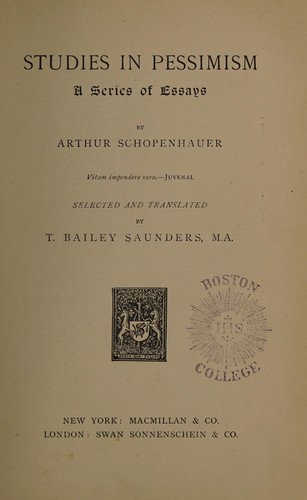 Studies in pessimismArthur Schopenhauer