Philosophy of Arthur Schopenhauer
≈ From memoryThe world is the manifestation of a blind, irrational 'Will' to live, and true liberation is found only in the aesthetic contemplation of art and the ethical practice of compassion.
In one sentence
The world is not a rational construction of a divine architect, but a manifestation of a primal, aimless, and insatiable "Will" that drives all existence, creating a cycle of perpetual suffering that can only be momentarily escaped through art, music, and the recognition of our shared humanity.
Why read this (and who it's for)
Most Western philosophy (from Plato to Kant) assumes that the universe is inherently rational and that human reason is the ultimate tool for discovering truth. Schopenhauer argues the opposite: reason is merely a tool used by a deeper, irrational force.
This book is for the "existentialist" before the term existed—anyone who has ever felt that life is a repetitive cycle of desire and boredom, or anyone who seeks a philosophical framework to explain the inherent "pain" of existence. After reading this, you will be able to view your own desires not as "goals" to be achieved, but as manifestations of a biological/metaphysical drive, allowing you to develop a more stoic and detached relationship with your own cravings.
The big idea
Schopenhauer argues that we mistake the "Representation" (the world as we perceive it) for the "Thing-in-Itself" (the reality behind the perception). We see a chair, a tree, and a person, but these are just appearances. The underlying reality of everything—from a rock to a human being—is a singular, unified force he calls The Will.
The Will is not a conscious choice; it is a blind, striving energy. It is the same force that makes a plant grow toward the sun, a predator hunt its prey, and a human being strive for status, sex, and survival. Because the Will has no ultimate goal other than its own continuation, it is inherently dissatisfied. This is why life feels like a "pendulum" swinging between pain (when we want something we don't have) and boredom (when we get what we want and immediately crave something else).
To find peace, one must realize that the "Self" is not the master of the Will, but its servant. Liberation comes from "denying" the Will—not by destroying the body, but by silencing the constant demands of the Will through the "contemplation of the beautiful" (Art) and the "recognition of the other" (Ethics).
Key ideas
The World as Representation
- What it is — The world we experience is a "phenomenon" filtered through the human brain's categories of time, space, and causality. We never see the world "as it is"; we see it as it appears to a human subject.
- Why it matters — It humbles human intellect. It means that our "reality" is a user interface, not the source code. We are trapped inside a subjective bubble.
- In the book — Schopenhauer uses the analogy of a dreamer: just as a dream feels real while we are in it, the world feels "real" only because our minds are processing the data of the Will.
The Will to Live
- What it is — The fundamental essence of the universe is a tireless, irrational striving. It is the "Will to Live" that powers every biological and geological process.
- Why it matters — It explains why life is so difficult. If the universe were driven by "Reason," it would be harmonious. Because it is driven by "Will," it is a constant, violent competition for existence.
- In the book — He points to the growth of a crystal or the movement of a planet as expressions of this Will, independent of any conscious "plan."
The Principle of Sufficient Reason
- What it is — The rule that everything must have a reason or cause. Schopenhauer argues this only applies to the appearance of the world, not to the essence of the world.
- Why it matters — It warns us against trying to "logic" our way into understanding the ultimate meaning of life. Some things (like the existence of the Will) simply are.
- In the book — He argues that while we can explain how a leaf falls (gravity), we cannot explain why the universe exists at all.
The Aesthetic Experience (The Aesthetic Contemplation)
- What it is — When we look at a beautiful painting or listen to music, we forget our own desires and our own identity. We become "pure, will-less subjects of knowledge."
- Why it matters — It is the only time we are truly free from the "Will." In the moment of aesthetic appreciation, the "I" disappears, and the suffering of desire stops.
- In the book — He highlights Music as the highest art because it is non-representational; it expresses the Will directly without needing to "show" a picture of anything.
The Ethical Principle of Pity (Mitleid)
- What it is — Ethics is not based on "rules" or "contracts," but on the recognition that every living being suffers in the same way we do.
- Why it matters — It breaks the "ego" of the individual. When you see another's pain, you realize that you are not separate from them; you are both expressions of the same underlying Will.
- In the book — He contrasts "pity" (feeling with the sufferer) with "charity" (giving to the sufferer). Only pity recognizes the shared essence of life.
Frameworks & tools
The Pendulum of Existence
Use this to identify and label your emotional states to gain distance from them.
- Identify the Want: Recognize the specific desire (e.g., "I need more likes on this post").
- Identify the Pain: Notice the tension/anxiety created by the lack of that desire.
- Identify the Boredom: Notice the hollow feeling that occurs once the desire is briefly satisfied.
- The Analysis: Label both as "The Will" acting on you. This creates a gap between you and the impulse.
The Aesthetic Pause
A method for mental resetting during periods of high stress or craving.
- Select a Medium: Choose a piece of art, a song, or a view of nature that demands your full attention.
- The Goal of "Self-Forgetfulness": Engage with the object until you lose track of your personal problems and your "to-do" list.
- The Objective: Aim for a state where you are no longer using the art to feel better, but are simply experiencing the art.
Memorable examples & stories
The Growth of a Crystal
Schopenhauer uses the growth of a crystal as an example of the Will. The crystal doesn't "want" to grow, nor does it have a "plan" to be beautiful; it simply happens because the Will of the universe manifests as growth. Lesson: Nature does not require a purpose to function.
The Hunter and the Prey
He describes the brutal, instinctive violence of the animal kingdom. The lion doesn't think about "morality" when it kills; it is the Will in its purest, most terrifying form. Lesson: Our morality is a thin veneer over a much older, primal reality of survival.
The Experience of Music
Schopenhauer argues that when we listen to music, we aren't looking at a representation of a thing (like a painting of a bowl of fruit). Instead, music is the "Will" itself put into sound. Lesson: Music is the closest we can get to experiencing the raw pulse of existence without the distraction of "things."
Key quotes
"The world is my representation." (Paraphrased) Why it matters: It reminds us that our reality is a construction of our own minds.
"Life is a perpetual oscillation between pain and boredom." (Paraphrased) Why it matters: It identifies the fundamental "problem" of human existence.
"The individual is a mere manifestation of the Will to live." (Paraphrased) Why it matters: It strips away the ego, suggesting our desires are often just biological programming.
"Art is the only way to stand outside of ourselves." (Paraphrased) Why it matters: It frames aesthetics as a spiritual necessity, not just a hobby.
How to apply it
This week
- The "Will" Audit: Every time you feel a strong craving (for food, social media, a purchase), stop and say: "This is the Will expressing itself." Do not judge the craving; simply observe it as a biological force.
- The Aesthetic Minute: Spend 60 seconds looking at a piece of art or a beautiful landscape without thinking about how it makes you feel or what it means. Just look.
Ongoing
- Practice Mitleid (Pity): When you see someone struggling, consciously try to feel their pain as your own. Instead of thinking "How can I help them?", think "How is their suffering similar to mine?"
- Cultivate Aesthetic Appreciation: Treat music and art not as "entertainment" to kill time, but as a sanctuary where you can escape the demands of the Will.
Common pitfalls
- The "Doomer" Trap: Many people read Schopenhauer and become depressed because they think life is meaningless. Schopenhauer didn't intend for this; he believed that recognizing the truth of the Will provides a path to a more profound, tranquil kind of freedom.
- The Passive Trap: Some interpret "denying the Will" as giving up on life entirely. Schopenhauer isn't advocating for suicide; he is advocating for a shift in perspective—living in the world while refusing to be enslaved by the constant demands of desire.
- Over-Intellectualizing: Schopenhauer's philosophy is deeply aesthetic and emotional. If you only treat it as a logic puzzle, you miss the "vibe" of his work—the actual feeling of the "Will" and the relief of the "Art."
Connects to
- Immanuel Kant: Schopenhauer builds on Kant's "phenomena" vs. "noumena" but argues that Kant failed to identify what the "noumenon" actually is (the Will).
- Friedrich Nietzsche: Nietzsche was deeply influenced by Schopenhauer's Will, but he rejected Schopenhauer's "pity" and his "denial" of the Will, preferring to embrace and transform the Will (The Will to Power).
- Existentialism (Sartre/Camus): Schopenhauer provides the "metaphysical" foundation for the existentialist's "absurdity." Where they differ is that Schopenhauer sees the absurdity as a fundamental law of the universe, while the Existentialists see it as a result of a godless world.
If you remember only three things
- The world is a "Representation" (appearance) of an underlying, irrational "Will" (reality).
- Human life is a cycle of wanting (pain) and having (boredom).
- Freedom is found in the "Aesthetic" (Art) and the "Ethical" (Pity).
Internalize it
- Reflection questions
- When was the last time I felt a "want" that was entirely unrelated to my conscious goals? What was that "Will" trying to achieve?
- In what ways am I currently letting my "Will" (my desires) dictate my happiness?
- Can I find a moment of "pure" observation in my day where I am not trying to do anything or get anything?
- Flashcards
- Q: What is the "World as Representation"?
- A: The idea that the world we see is a filtered perception shaped by human categories, not the thing-in-itself.
- Q: What is the "Will"?
- A: The primal, irrational, and aimless striving force that underlies all existence.
- Q: Why is life a pendulum between pain and boredom?
- A: Because the Will always wants what it doesn't have (pain) and becomes dull once it achieves its goal (boredom).
- Q: How does Art provide a release from the Will?
- A: It allows us to become "pure subjects of knowledge," forgetting our desires and our identities for a moment.
- Q: What is the basis of Schopenhauer's ethics?
- A: Pity (Mitleid)—the recognition of the shared suffering of all living beings as expressions of the same Will.
Fidelity note
This summary is grounded in the core metaphysical and ethical framework of Schopenhauer's major works (specifically The World as Will and Representation and his essays on aesthetics and ethics). I am highly confident in the distinction between Representation and Will, and the "Pendulum" theory of desire. I am less certain of the specific nuances of his aesthetic theory regarding "non-representational" music, as he explores this in complex, poetic terms that are difficult to reduce to a simple rule. Readers should verify his specific definitions of "Subject" and "Object" in the text to fully grasp his epistemology.
More from Arthur Schopenhauer
 Aphorismen zur LebensweisheitArthur Schopenhauer
 Counsels and MaximsArthur Schopenhauer
 Essay on the freedom of the willArthur Schopenhauer
 Essays of SchopenhauerArthur Schopenhauer
 Manuscript remains in four volumesArthur Schopenhauer
 Manuscript Remains, Volume IArthur Schopenhauer
 On human natureArthur Schopenhauer
 On the fourfold root of the principle of sufficient reasonArthur Schopenhauer
 On womenArthur Schopenhauer
 Parerga und ParalipomenaArthur Schopenhauer
 Schopenhauer SelectionsArthur Schopenhauer
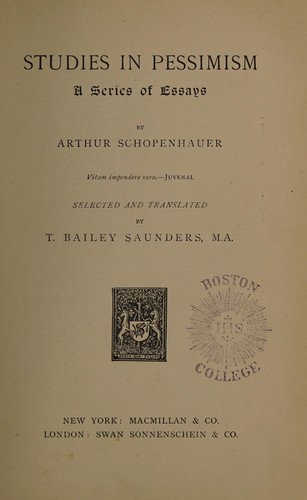 Studies in pessimismArthur Schopenhauer