Essays of Schopenhauer
✓ Source-groundedHuman existence is a cycle of suffering driven by an underlying 'Will,' where even our most profound emotions—like love—are merely biological illusions designed to ensure the survival of the species.
In one sentence
The world is a manifestation of a blind, striving "Will" that uses human consciousness as a mere vehicle for its own preservation, often deceiving us into believing our desires are personal rather than biological.
Why read this (and who it's for)
This work provides a "spectacle of disillusionment" for anyone seeking to understand the underlying mechanics of human behavior, social structures, and personal desires. It is for the seeker who wants to strip away "tinsel sentiment" and social hypocrisies to see the raw, often brutal, metaphysical machinery of life. After reading, you will be able to identify the "biological illusions" in your own motivations and recognize the "metaphysical" forces (like the Will to Live) that drive human history and interpersonal relationships.
The big idea
Schopenhauer argues that human life is not a pursuit of inherent meaning, but a "compound of needs" that are fundamentally impossible to satisfy. We live in a state of perpetual striving; when a need is met, we do not find lasting peace, but rather fall into the "emptiness of life"—which he calls Boredom. Boredom is the ultimate proof of the worthlessness of existence: if life had inherent value, the mere act of existing would be enough to satisfy us.
The core of his philosophy is the Will to Live. This is the primary source of all being, a blind force that manifests in the human organism as a drive for survival and reproduction. Because humans are "phenomena"—beings of appearance—we are often unaware of this underlying force. We believe we act out of personal choice or individual happiness, but Schopenenhauer argues that Nature uses illusion to mask the "general" benefit of the species as an "individual" pleasure. This is most vividly seen in the "Metaphysics of Love," where passionate love is revealed not as a romantic triumph, but as a biological mechanism for the "perpetuation of the species."
Key ideas
The Art of Not Reading
- What it is — A disciplined refusal to consume "noisy," popular, or "shallow" literature (political/religious pamphlets, trendy novels) that offers no lasting value.
- Why it matters — Because life and mental energy are limited, reading "bad" books is "intellectual poison" that destroys the mind and wastes the time that should be spent on "great minds."
- In the book — Schopenhauer argues that the public prefers "shallow, insipid gossip" because it is "homogeneous and agreeable," whereas true literature grows slowly and produces "permanent" works.
Boredom as the Proof of Worthlessness
- What it is — The feeling of the "emptiness of life" that arises when a need is satisfied and the "striving" ceases.
- Why it matters — It reveals that the "pomp and splendour" of human achievement is a futile attempt to escape the inherent misery of existence.
- In the book — He notes that if existence had positive value, it would satisfy us; instead, we only feel satisfaction when "striving after something," and once attained, the goal vanishes.
Religion as Pia Fraus (Pious Fraud)
- What it is — The claim that religion is a "brilliant side" of a deception, acting as a necessary "mask" to deliver truth to a "weak-minded" public.
- Why it matters — It suggests that while there can be true philosophy, there is no "true" religion; religion is a social glue and a "necessary evil" to maintain social order.
- In the book — He describes religion as a "monogram" of the moral world, where truth is hidden behind myth and fable to affect the masses.
The "Will to Live" and the Illusion of Pleasure
- What it is — The primary source of all being is a blind, striving force that uses the individual as a vessel for the species' survival.
- Why it matters — It explains why human desires are often irrational; we are being manipulated by our own biology to ensure the "perpetuation of the species."
- In the book — He argues that the "will to live" manifests in the human organism but ultimately "falls to dust" because it has no unconditioned value.
The Metaphysics of Love
- What it is — Passionate love is a "metaphysical yearning of the will" to objectivise itself in a unique individual to ensure the survival of the human type.
- Why it matters — It strips the "romance" from love, revealing it as a biological mechanism where the individual is a mere tool for the "spirit of the species."
- In the book — He describes love as a "profound illusion" that induces a man to sacrifice everything for a woman who may satisfy him no more than any other.
The "Acid/Alkali" Metaphor of Selection
- What it is — The principle that individuals seek partners who possess the "exact opposite" of their own weaknesses to produce a balanced "neutral salt" (the child).
- Why it matters — It explains why we are attracted to specific types of people: we are seeking a "corrective" for our own biological defects.
- In the book — A physically weak man seeks a muscular woman; a snub-nosed person finds an aquiline nose pleasing to balance their own traits.
The "Epicycle" Model of Progress
- What it is — The idea that human progress is like a planet's course, where the race often follows "epicycles"—false paths that return to where they started.
- Why it matters — It distinguishes "Great Minds" from the masses, as only the great minds do not accompany the race on these repetitive, false loops.
- In the book — This model explains how the public remains trapped in a "mire" of prevailing ideas while true progress remains rare and slow.
Frameworks & tools
The Rule of Selection (Reading Strategy)
To protect your intellect from "intellectual poison," apply this filter to all media consumption:
- Identify the Source: Is this a "Great Mind" (one who surpasses others across all times/countries) or "Apparent Literature" (the noisy, fleeting works of the present)?
- Assess the Value: Does this work offer a "permanent" truth, or is it "homogeneous and agreeable" gossip?
- The Discipline of Refusal: Actively refuse to read what is bad. Because life is short, you must never read what is "insipid" or "noisy."
- The Double Reading: For important works, always read twice. The first reading is for the "impression"; the second is for the "mastery" of the whole.
The Corrective Principle of Selection (Relationship Analysis)
To understand the "metaphysics" of attraction, analyze your preferences using these three categories:
- Absolute Considerations (The Species Type): Look for "Upright gait," "small feet," and "plumpness" (signs of strong vegetative function).
- Gender-Specific Instincts: Recognize that women often prefer "strength and courage" (to ensure robust children), while men are often driven by "physical beauty."
- Relative Considerations (The Neutralization Principle): Identify your own "one-sidedness." Who possesses the "exact opposite" of your weaknesses? (e.g., if you are intellectually brilliant but physically frail, you may be biologically drawn to a physically robust partner).
Memorable examples & stories
The "Waste Paper" Publisher
Schopenhauer’s first major work, The World as Will and Idea, initially sold so poorly that the publisher eventually sold copies at "waste paper price." Lesson: True genius is often ignored by the masses until it is recognized by the "Great Minds" (like Goethe) and eventually accepted by the public.
The "Miserable Jargon" of Linguistic Decay
Schopenhauer warns that if we stop learning old languages and reading the classics, the German language will be reduced to "miserable jargon" and a "barbaric, stupid, and worthless" literature will emerge. Lesson: The preservation of high culture requires a constant, disciplined connection to the "purifying" stream of the past.
The "Acme of Generative Power"
Schopenhauer notes that women are often driven by instinct to prefer men aged 30–35, the "acme of generative power," regardless of the man's intellectual qualities. Lesson: Biological instincts often override personal "taste" or intellectual preferences.
The "Spectator at a Theatre"
Schopenhauer describes the only way to find peace as viewing the world as a "spectator at a theatre"—a purely intellectual pursuit that allows one to observe the "phenomenon" without being consumed by the "Will." Lesson: True freedom from the cycle of desire is found in the detached observation of the world.
Key quotes
"The essence of existence is misery; the 'pomp and splendour of the rich' is a futile attempt to escape it." Why it matters: It highlights the futility of material success in solving the underlying problem of existence.
"The public prefers 'shallow, insipid gossip' of the present over the thoughts of great minds because it is more 'homogeneous and agreeable.'" Why it matters: It explains the social dynamics of why "bad" media dominates our attention.
"Real, passionate love is not a pursuit of individual happiness but a biological mechanism for the perpetuation of the species." Why it matters: It strips away the romantic illusion of love to reveal its biological function.
"The rest of the world is a 'phenomenon'—a world of appearances." (Paraphrased) Why it matters: It establishes the distinction between the world we see and the "Will" that drives it.
How to apply it
This week
- The "Noisy" Audit: Identify one "popular" news source or social media account you consume daily. If it provides "insipid gossip" rather than "Great" thought, unsubscribe or mute it immediately.
- The Double Reading: Take a book you have already read once. Read it again, but this time, focus on the "end" first to understand the "beginning" (the "mastery" of the whole).
- The Spectator Exercise: Spend 10 minutes observing a crowded place (or a busy street) without judging or participating. View the scene as a "spectator at a theatre" to practice the detachment of the philosopher.
Ongoing
- The Rule of Selection: Before reading anything new, ask: "Does this belong to the 'Great Minds' or is it 'Apparent Literature'?"
- The Neutralization Principle: When evaluating your personal preferences (in friends, partners, or colleagues), ask: "Am I seeking a 'corrective' for my own one-sidedness?"
- The Boredom Awareness: When you feel bored, instead of immediately seeking a distraction, recognize it as the "feeling of the emptiness of life." Observe the feeling without trying to "fill" it with meaningless consumption.
Common pitfalls
- Mistaking "Will" for "Choice": People often think Schopenhauer is saying we have no free will. He isn't; he is saying that our motivations are often hijacked by a biological "Will" that we mistake for our own desires.
- Overlooking the "Pious Fraud": One might think Schopenhauer is anti-religious. He actually argues that religion is a necessary tool for the masses, but it must eventually be "euthanized" as humanity matures into true philosophy.
- The "Waste of Time" Trap: A common mistake is thinking that because "bad" books are "intellectual poison," you should read nothing. The goal is not to read nothing, but to read only the "Great Minds."
Connects to
- Friedrich Nietzsche: While Schopenhauer focuses on the "Will" as a source of misery, Nietzsche explores the "Will to Power" as a creative, albeit destructive, force.
- Sigmund Freud: Schopenhauer’s "biological illusions" and the hidden forces of the unconscious prefigure Freud’s exploration of the unconscious mind and the "Id."
- Evolutionary Psychology: Schopenhauer’s "Metaphysics of Love" is a direct philosophical ancestor to modern evolutionary psychology's study of mate selection and reproductive strategies.
If you remember only three things
- Boredom is the proof of life's worthlessness: Satisfaction only leads to boredom; therefore, the "striving" itself is the only thing that feels like "living."
- The Will to Live is the hidden engine: Most of what we call "personality" or "desire" is actually the "Will" using us to ensure the survival of the species.
- The Rule of Selection: Protect your mind like a garden; only allow the "Great Minds" of history to enter, and ruthlessly prune the "intellectual poison" of the masses.
Internalize it
-
Reflection questions
- In what areas of my life am I currently being driven by "biological illusions" (e.g., a need for status, a specific type of attention) rather than my own conscious goals?
- When I feel bored, what is my immediate "reflex" to fill that emptiness? Is that reflex helping me grow, or is it just a way to avoid the "emptiness of life"?
- If I were to treat my reading list as a "medicine" for my mind, which books would I keep as "cures" and which would I discard as "poison"?
-
Flashcards Q: What does Schopenhauer mean by "Boredom"? A: It is the "feeling of the emptiness of life" that occurs when a need is satisfied and the "striving" ceases. Q: What is the "Will to Live"? A: The primary source of all being; a blind force that manifests in the human organism to ensure the survival of the species. Q: How does Schopenhauer define "Apparent Literature"? A: Works that go at a gallop with great noise, produced by the masses, and which vanish after a few years. Q: What is the "Acid/Alkali" metaphor in mate selection? A: The idea that individuals seek partners who possess the "exact opposite" of their own weaknesses to produce a balanced "neutral salt" (the child). Q: Why does Schopenhauer call religion a "Pious Fraud"? A: Because it is a necessary deception used to provide a "metaphysical system" for the masses who cannot grasp true philosophy. Q: What is the "Spectator at a Theatre" approach? A: A way to view the world as a "phenomenon" to achieve a state of intellectual peace and detached observation.
Fidelity note
This summary is grounded in the provided notes. I am highly confident in the sections regarding the "Metaphysics of Love," "Boredom," and "The Rule of Selection." The "Epicycle" model and the "Acid/Alkali" metaphor are clearly defined in the text. Note that the text mentions Schopenhauer's "Metaphysics of Love" as a primary indicator of his philosophy, but the provided notes focus heavily on the mechanics of that love rather than the full metaphysical system. Readers should verify the specific "Aristotelian" and "Platonic" distinctions in the section on Christianity against the original text for full nuance.
More from Arthur Schopenhauer
 Aphorismen zur LebensweisheitArthur Schopenhauer
 Counsels and MaximsArthur Schopenhauer
 Essay on the freedom of the willArthur Schopenhauer
 Manuscript remains in four volumesArthur Schopenhauer
 Manuscript Remains, Volume IArthur Schopenhauer
 On human natureArthur Schopenhauer
 On the fourfold root of the principle of sufficient reasonArthur Schopenhauer
 On womenArthur Schopenhauer
 Parerga und ParalipomenaArthur Schopenhauer
 Philosophy of Arthur SchopenhauerArthur Schopenhauer
 Schopenhauer SelectionsArthur Schopenhauer
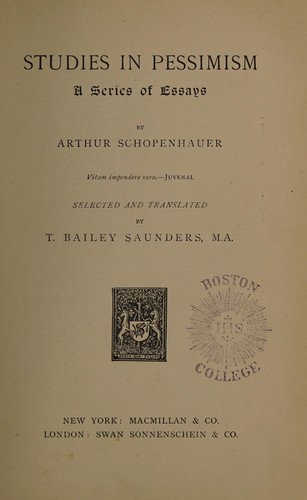 Studies in pessimismArthur Schopenhauer