Aphorismen zur Lebensweisheit
≈ From memoryLife is a constant oscillation between boredom and suffering, and the only escape is the cultivation of a rich inner life and the recognition of our shared human frailty.
In one sentence
Human existence is a relentless struggle driven by an insatiable "Will," and wisdom lies in recognizing that our greatest enemies are often our own desires and the social masks we wear.
Why read this (and who it's for)
This book is for the "exhausted optimist"—the person who feels the drain of social performance, the hollowness of material success, and the repetitive cycle of wanting more. It solves the problem of existential fatigue by providing a philosophical framework to understand why we feel dissatisfied. After reading, you will be able to identify the "Will" behind your impulses, set boundaries against social pressures, and find a more grounded, stoic peace in the present moment.
The big idea
Schopenhauer argues that human life is governed by the Will to Live—a blind, irrational, and ceaseless striving. We are not rational creatures who happen to have feelings; we are bundles of desires that happen to have a consciousness. Because our desires are infinite but our means of satisfying them are finite, we are condemned to a cycle of perpetual dissatisfaction. Once a desire is met, it is immediately replaced by a new, more demanding want.
The tragedy of human existence is that we are "condemned" to be conscious of this cycle. We are aware of our own boredom and our own suffering. However, Schopenhauer suggests that this awareness is our greatest tool. By understanding the mechanics of our desires, we can develop a "negative" wisdom: the ability to see through the illusions of the world (the "Will") and find a sanctuary in the contemplation of art, the depth of friendship, and the quietude of the inner self.
Key ideas
The Tyranny of the Will
- What it is: The fundamental driver of human behavior is not reason, but a primal, aimless "Will" that seeks to persist and reproduce.
- Why it matters: If you believe you are purely rational, you will be perpetually frustrated by your own "irrational" urges (anger, lust, greed). Recognizing the Will allows you to observe your impulses rather than being enslaved by them.
- In the book: Schopenhauer describes how even our "noble" achievements—like creating art or building civilizations—are merely the Will expressing itself through different masks.
The Pendulum of Boredom and Pain
- What it is: Human life swings like a pendulum between the agony of unfulfilled desire (pain) and the vacuum of fulfilled desire (boredom).
- Why it matters: It explains why "having it all" feels so empty. Boredom is the "pain of pleasure"—the moment the novelty wears out and the Will demands a new target.
- In the book: He notes that when we are not suffering from a lack of something, we suffer from a lack of anything to do, leading to a desperate search for stimulation.
The Mask of Sociality
- What it is: Much of our social behavior is a performance of "politeness" and "propriety" that serves to hide our true, often selfish, motivations.
- Why it matters: It allows you to see social friction not as a personal affront, but as a clash of competing "Will" expressions. It helps you detach from the need for external validation.
- In the book: He observes how people perform roles in society—the "gentleman," the "virtuous woman"—while their internal desires remain entirely unaligned with their public faces.
The Value of Solitude and Interiority
- What it is: True wisdom is found in the "inner life"—the ability to be alone with one's thoughts without being bored by one's own company.
- Why it matters: Most people flee from themselves into noise and consumption. Cultivating an inner life is the only way to achieve a state of "quietude" that isn't dependent on external circumstances.
- In the book: He argues that the ability to enjoy one's own company is the ultimate mark of a civilized and spiritually developed human being.
The Necessity of Pessimism
- What it is: A "realistic" pessimism is required to see the world as it is, rather than how we wish it to be.
- Why it matters: Optimism is often a form of self-delusion. By accepting the inherent difficulty of life, you stop being shocked by tragedy and start preparing for reality.
- In the book: He suggests that a clear-eyed view of human misery is actually a form of liberation, as it frees us from the exhausting task of trying to "fix" an unfixable world.
Frameworks & tools
The "Will" Audit
Use this to identify where your desires are driving you versus where your values are leading you.
- Identify the Impulse: When you feel a sudden urge (to buy, to argue, to scroll, to impress), stop.
- Isolate the Will: Ask, "What is the underlying 'Will' here?" (e.g., Is it a desire for status? A fear of being alone? A craving for a dopamine hit?)
- Observe the Cycle: Recognize that satisfying this urge will only provide a momentary reprieve before the "Will" demands more.
- Choose the Response: Act from a place of conscious observation rather than reactive impulse.
The Solitude Practice
A method for developing the "Inner Life" Schopenhauer prizes.
- Scheduled Silence: Dedicate 15 minutes a day to sitting alone without any external input (no phone, no music, no book).
- Observation of Thought: Notice where your mind wanders. Do not judge the thoughts; simply observe them as "the Will" attempting to find stimulation.
- The Goal: To reach a state where your own company is sufficient, reducing your dependency on the "noise" of the world.
Memorable examples & stories
The Vanity of Success
Schopenhauer describes the "successful" man who, having attained his goals, finds himself standing on a peak of boredom, looking for the next mountain. Lesson: Success is a moving goalpost; the only way to win is to stop running.
The Performance of Politeness
He describes the intricate, almost theatrical dances of social etiquette—how people smile and nod while harboring private grievances or desires. Lesson: Social harmony is often a fragile truce between competing wills, not a true union of spirits.
The Artist's Escape
He highlights how the artist (and the listener of music) is able to momentarily "stop" the Will by becoming absorbed in an aesthetic experience. Lesson: Art is a temporary sanctuary from the exhausting demands of survival.
Key quotes
"Life is a perpetual oscillation between boredom and pain." Why it matters: It identifies the fundamental rhythm of human experience.
"The individual who can be alone with himself is the only one who is truly free." (Paraphrased) Why it matters: It defines true freedom as internal autonomy, not external liberty.
"Most of our actions are driven by a Will that knows not what it wants, but only that it wants." (Paraphrased) Why it matters: It humbles our belief in our own rationality.
How to apply it
This week
- The "Why" Pause: Before every purchase or significant social media interaction, ask: "Is this a genuine need, or is my 'Will' just seeking a distraction from boredom?"
- The 10-Minute Void: Sit in a chair for 10 minutes with no phone and no book. Just observe the feeling of boredom and see what thoughts arise.
- Identify a "Mask": Notice one time today when you performed a social role (being "nice" when you were annoyed). Acknowledge the mask without judgment.
Ongoing
- Cultivate the Inner Life: Make it a habit to spend time in "active solitude." Read deeply, reflect, and develop a rich internal world.
- Practice Radical Realism: When things go wrong, instead of asking "Why me?", ask "How does this reflect the reality of the human condition?" This shifts you from victimhood to philosophical observation.
- The Boredom Threshold: When you feel the urge to "doomscroll" or consume mindless content, wait 60 seconds. Sit with the boredom. It is the gateway to self-awareness.
Common pitfalls
- The "Doomer" Trap: People often mistake Schopenhauer’s pessimism for a reason to give up. He isn't advocating for despair; he is advocating for clarity. The goal is to see the world clearly so you can navigate it with less friction.
- The Intellectual Trap: It is easy to think about these ideas without feeling them. Don't just analyze the "Will"—actually notice how it feels in your body when you are angry or craving a snack.
- The "Solitude" Misunderstanding: Solitude is not isolation. It is the ability to be with yourself. You can be in a crowd and still be in a state of internal solitude.
Connects to
- Marcus Aurelius (Meditations): Both emphasize the importance of internal fortress-building and the recognition of the common human struggle.
- Viktor Frankl (Man's Search for Meaning): While Schopenhauer focuses on the Will, Frankl focuses on the Meaning we find in response to the suffering of existence.
- The Stoics (Epictetus): The core idea of distinguishing what is in our control (our internal reaction) from what is not (the external world/the Will).
If you remember only three things
- Life is a cycle of wanting and boredom; recognizing this cycle reduces its power over you.
- Your "Will" is a hungry ghost; it will never be fully satisfied by external things.
- The highest form of freedom is the ability to be alone with your own mind.
Internalize it
-
Reflection questions
- In what areas of my life am I currently trying to "fill a hole" of boredom with consumption?
- When was the last time I felt truly comfortable in my own company without any external stimulation?
- How much of my daily behavior is a "performance" for others rather than an expression of my true self?
-
Flashcards Q: What is the primary driver of human behavior according to Schopenhauer? A: The "Will to Live"—a blind, irrational striving for persistence. Q: What is the "pendulum" of human existence? A: The oscillation between the pain of unfulfilled desire and the boredom of fulfilled desire. Q: What does Schopenhauer mean by "the inner life"? A: The ability to be alone with one's own thoughts and find them sufficient for enjoyment. Q: Why is Schopenhauer's view of social politeness significant? A: It reveals that social harmony is often a mask for individual desires rather than a true harmony of souls. Q: What is the purpose of "pessimism" in this book? A: To provide a realistic, clear-eyed view of the world that allows for a more grounded and less frustrated existence.
Fidelity note
This summary is based on the core philosophical tenets of Schopenhauer's Aphorismen zur Lebensweisheit (Aphorisms on the Wisdom of Life). Because this is a collection of aphorisms rather than a linear narrative, the "logic" is a synthesis of his recurring themes: the Will, the nature of boredom, and the necessity of internal cultivation. I am highly confident in the representation of his "Will" and "Boredom" concepts, as these are the hallmarks of his entire philosophical corpus. The specific "solitude" and "social mask" sections are synthesized from his observations on human behavior and the aesthetic experience.
More from Arthur Schopenhauer
 Counsels and MaximsArthur Schopenhauer
 Essay on the freedom of the willArthur Schopenhauer
 Essays of SchopenhauerArthur Schopenhauer
 Manuscript remains in four volumesArthur Schopenhauer
 Manuscript Remains, Volume IArthur Schopenhauer
 On human natureArthur Schopenhauer
 On the fourfold root of the principle of sufficient reasonArthur Schopenhauer
 On womenArthur Schopenhauer
 Parerga und ParalipomenaArthur Schopenhauer
 Philosophy of Arthur SchopenhauerArthur Schopenhauer
 Schopenhauer SelectionsArthur Schopenhauer
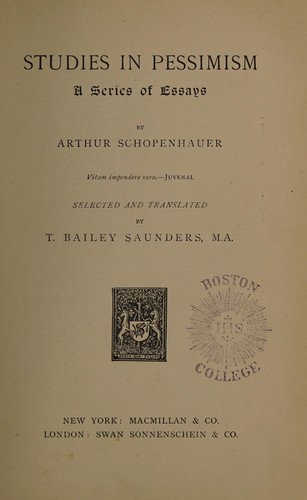 Studies in pessimismArthur Schopenhauer