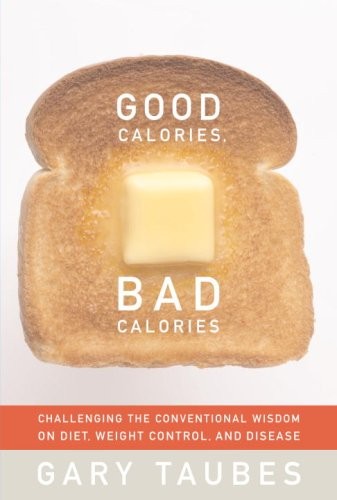
The Diet Delusion
≈ From memoryThe modern obesity epidemic is not a failure of willpower or a lack of information; it is a biological response to an environment where calorie-dense food is unnaturally abundant.
In one sentence
Obesity is a metabolic adaptation to an environment of caloric surplus, and "dieting" is a futile attempt to override a deeply ingrained evolutionary survival mechanism.
Why read this (and who it's for)
This book is for anyone who feels like a failure for struggling to lose weight. It shifts the blame from your "lack of discipline" to the "biological reality" of our modern food environment. It solves the frustration of the "information overload" in nutrition by stripping away the noise of conflicting diets and focusing on the underlying mechanism of human evolution. After reading, you will understand why your body fights against weight loss and how to navigate a world designed to make you overeat.
The big ideas
Taubes argues that humans evolved in an environment of scarcity. For millions of years, food was hard to find, and calories were rare. Consequently, our bodies developed a sophisticated, highly efficient system to store energy as fat whenever it became available. This was a survival masterpiece: it allowed our ancestors to survive droughts, winters, and famines.
The problem, Taubes asserts, is that we have moved from a world of scarcity to a world of "hyper-abundance." We now live in an environment where high-calorie, palatable foods are everywhere, always available, and engineered to be addictive. Our ancient biological machinery—designed to prevent starvation—is now malfunctioning in a world of surplus.
Because our bodies are programmed to defend their fat stores at all costs, "dieting" (trying to eat less while still living in a calorie-rich environment) is an uphill battle against our own evolution. To succeed, we must acknowledge that the human body is not a simple machine that obeys "common sense" logic; it is a biological organism that reacts to environmental cues.
Key ideas
The Evolutionary Context of Scarcity
- What it is: Humans evolved in a "low-calorie" environment where food was difficult to acquire and unpredictable.
- Why it matters: If you don't understand the history of our species, you cannot understand why your body reacts the way it does to a cheeseburger. Your body thinks it's still in the Stone Age.
- In the book: Taubes describes how our ancestors survived periods of famine by efficiently storing fat, a trait that was once a competitive advantage but is now a liability in a world of industrial food production.
The "Fat-Storage" Mechanism
- What it is: The human body is designed to be an incredibly efficient storage unit for calories. When we eat more than we burn, the body doesn't just "waste" the energy; it stores it as adipose tissue.
- Why it matters: This means weight gain is the "default" setting of the human body. Weight loss is the "exception" that requires fighting against our internal chemistry.
- In the book: Taubes explains that the body treats fat as a survival reserve. The harder you try to lose weight, the harder the body fights back by slowing metabolism and increasing hunger signals.
The Role of Palatability and Reward
- What it is: Modern food is engineered to be hyper-palatable—hitting the perfect balance of salt, sugar, and fat to trigger dopamine releases in the brain.
- Why it matters: This creates a "pleasure" feedback loop that overrides our satiety signals. We aren't just eating for calories; we are eating for the neurological reward.
- In the book: He discusses how industrial food processing creates "craveable" products that hijack our ancient reward systems, making it nearly impossible to resist certain foods.
The Failure of "Information"
- What it is: The idea that "knowing" what to eat is enough to cause weight loss is a myth.
- Why it matters: If willpower were the only factor, people with the most information would be the thinnest. Instead, we see a massive obesity epidemic despite a surplus of nutritional information.
- In the book: Taubes argues that our biology is not "rational." You can know that a donut is bad for you, but your brain's reward system still reacts to the sugar and fat as a high-value prize.
The Environment as the Primary Driver
- What it is: The "obesogenic" environment—the availability of cheap, calorie-dense food—is the primary driver of the weight gain epidemic.
- Why it matters: It shifts the focus from individual "choices" to the systemic reality of our food environment.
- In the book: Taubes points out that we live in a world where it is easier and cheaper to buy a 1,000-calorie snack than a piece of fruit, and that our environment is constantly "nudging" us toward overconsumption.
Frameworks & tools
The Evolutionary Logic of Weight
To understand why you struggle with weight, look at the three layers of the "Evolutionary Trap":
- Scarcity History: Our ancestors lived in a world where calories were rare.
- Storage Mechanism: Our bodies evolved to store every spare calorie as fat to survive the next "famine."
- Modern Mismatch: We now live in a world of infinite calories, but our "storage" software hasn't been updated.
The "Environment Audit"
To manage weight, you must stop looking at "willpower" and start looking at "friction."
- Identify Triggers: What foods are most "hyper-palatable" (highly rewarding) for you?
- Increase Friction: Make those foods harder to access (e.g., don't keep them in the house).
- Decrease Friction: Make healthy, low-calorie choices the "path of least resistance" (e.g., prep-made healthy meals).
- Audit the Environment: Recognize that your kitchen, your workplace, and your social circles are all "nudging" you toward certain caloric choices.
Memorable examples & stories
The "Famine" Ancestor
Taubes describes the ancestral human who survived a brutal winter by storing fat. This ancestor wasn't "lazy"; they were a biological success story. The lesson: Your body's current behavior is a survival strategy that worked for thousands of years, but it is poorly suited for a supermarket.
The Hyper-Palatable Food Lab
The description of how food scientists engineer products to be "addictive" by manipulating the ratio of salt, sugar, and fat. The lesson: You are competing against a multi-billion dollar industry that uses your own biology against you.
The Information Paradox
The observation that as we have become more "informed" about nutrition, the obesity rates have continued to climb. The lesson: Knowledge is not a substitute for biological reality. You cannot "think" your way out of a metabolic response.
Key quotes
"The human body is not a rational machine; it is a biological organism that reacts to its environment." (Paraphrased) Why it matters: It humbles the reader's belief that they can simply "will" their way into a different body.
"We have moved from a world of scarcity to a world of hyper-abundance, and our biology hasn't caught up." (Paraphrased) Why it matters: It identifies the "mismatch" as the root cause of the problem.
"The problem is not a lack of information; it is a surplus of calories." (Paraphrased) Why it matters: It clarifies that the solution isn't more "tips" but a change in the caloric environment.
How to apply it
This week
- Identify your "High-Reward" foods: List the 3 foods you find hardest to resist. Notice how they are engineered for palatability (usually high in salt, sugar, or fat).
- The "Out of Sight" Rule: Remove one of those high-reward foods from your immediate environment (the pantry, the desk, the fridge).
- Audit your "Nudges": Notice how many times today you were prompted to eat (notifications, smells, visual cues) and how many of those were not driven by actual physical hunger.
Ongoing
- Environment Design: Instead of relying on willpower, design your home to make healthy choices the easiest ones (e.g., pre-chopped vegetables in the front of the fridge).
- Acknowledge the Biological Resistance: When you feel intense cravings, recognize them as your "scarcity-era" brain trying to protect you from a famine that isn't coming.
- Focus on Caloric Density: When choosing foods, prioritize those that provide volume and nutrients without the "hyper-palatable" triggers of processed foods.
Common pitfalls
- The "Willpower" Trap: The biggest mistake is believing that if you just "try harder," you can override your biology. Taubes argues that the harder you fight, the more your body may resist.
- The "Information" Trap: Searching for the "perfect" diet (Keto, Paleo, Vegan, etc.) is often a distraction. While different diets have different effects, the underlying problem is the caloric surplus in an obesogenic environment.
- Over-simplifying "Balance": While Taubes focuses on calories, he doesn't suggest you ignore nutrition entirely. However, his point is that knowing what is healthy is secondary to managing the caloric environment.
Connects to
- "Atomic Habits" by James Clear: While Taubes explains why the environment matters biologically, Clear provides the framework for how to redesign that environment to make habit formation easier.
- "Deep Work" by Cal Newport: Though in a different field, Newport's concept of "environmental design" to minimize distraction applies perfectly to Taubes' concept of "environmental design" to minimize caloric temptation.
- "The Omnivore's Dilemma" by Michael Pollan: Pollan looks at the source of our food (industrial agriculture), while Taubes looks at the biological response to that food. Together, they provide a complete picture of the modern food system.
If you remember only three things
- Your body is evolved to store fat because, for most of human history, food was scarce.
- Modern food is engineered to be "hyper-palatable," hijacking your brain's reward system.
- Success in weight management comes from changing your environment, not just your willpower.
Internalize it
-
Reflection questions
- In what ways is my current home/office environment designed to make me overeat?
- When I feel a "craving," what is my body's evolutionary logic trying to tell me?
- If I stopped relying on willpower and started relying on "friction," what would I change about my kitchen today?
-
Flashcards Q: What is the primary evolutionary reason humans store fat? A: To survive periods of food scarcity and famine.
Q: Why is "knowing" about nutrition often insufficient to stop weight gain? A: Because the human body is a biological organism, not a rational machine; it reacts to environmental cues and rewards, not just information.
Q: What does Taubes mean by "hyper-palatable" foods? A: Foods engineered to hit a specific balance of salt, sugar, and fat to trigger a dopamine reward in the brain.
Q: What is the "mismatch" theory of obesity? A: The mismatch between our ancient biology (evolved for scarcity) and our modern environment (characterized by caloric abundance).
Q: How does the body react when we try to "diet" in a calorie-rich environment? A: It often fights back by increasing hunger signals and slowing metabolism to protect its fat stores.
Fidelity note
I have a high level of confidence in the core arguments of this summary. Taubes' central thesis—the evolutionary mismatch between our ancestral environment and modern food abundance—is the cornerstone of his work. I am confident in the "hyper-palatability" and "scarcity" arguments. However, because I am summarizing from memory, the specific nuances of certain secondary studies he might cite (e.g., specific metabolic rate measurements) should be verified in the text if you require granular data points. The "Environment Audit" and "Friction" concepts are synthesized from his arguments about environmental design, as he does not provide a formal "step-by-step" numbered list in the book, but rather describes the principles of environmental management.