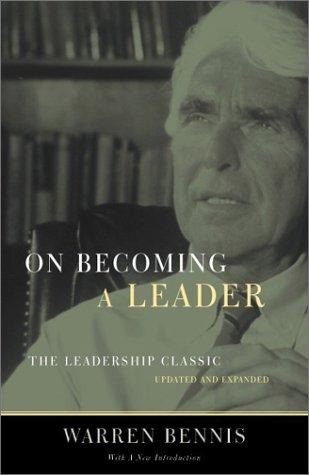
Up the Organization
≈ From memoryLeadership is not a set of technical skills but a distinct craft of influence, vision, and human connection that requires a shift from 'doing' to 'being'.
In one sentence
Leadership is a distinct discipline of human influence and vision that cannot be mastered by simply applying management techniques to people; it requires a fundamental shift in identity from a "doer" to a "leader."
Why read this (and who it's for)
Most professionals fail at leadership because they treat it as a "promotion" of their existing skills—assuming that being a great individual contributor or a great manager automatically makes them a great leader. This book solves the "competency trap" where experts become bottlenecks because they can't stop doing the work and start enabling the work.
This is for high-achievers, managers, and executives who feel they are working harder than ever but find their teams are not growing, their vision is becoming muddled, and their personal influence is hitting a ceiling. After reading, you will be able to distinguish between management (systems/processes) and leadership (people/purpose), and you will have a framework to transition your identity from a "technical expert" to a "cultural architect."
The big idea
Bennis argues that leadership is a unique craft, separate from management. While management is about complexity—organizing resources, predicting outcomes, and maintaining systems—leadership is about change and meaning. Management asks, "How can we do this better?" Leadership asks, "Why are we doing this at all?"
The core thesis is that leadership is a "soft" skill in the sense that it is deeply human, but it is "hard" because it requires the most difficult psychological shift of all: the surrender of control. To lead, you must stop being the smartest person in the room who has all the answers and start being the person who asks the questions that unlock the potential of others. It is a shift from technical proficiency to relational influence.
Key ideas
The Distinction Between Management and Leadership
- What it is: Management is the art of handling complexity; leadership is the art of handling change. Management focuses on the "how" (processes, budgets, schedules), while leadership focuses on the "why" (purpose, values, inspiration).
- Why it matters: If you try to "manage" a vision into existence, you will get a compliant team that lacks initiative. If you try to "lead" a budget, you will have a chaotic mess. You must master both, but you must know which tool to grab for which problem.
- In the book: Bennis contrasts the manager who ensures the project is on time with the leader who ensures the project actually matters to the people doing the work.
The Leadership of Meaning
- What it is: Leadership is the ability to provide a sense of purpose and meaning to the work. It is about creating a "shared reality" where people see their own contributions as part of a larger, noble goal.
- Why it matters: Without meaning, work is just a transaction. When people find meaning in their work, they become self-motivated, resilient, and creative.
- In the book: Bennis emphasizes that a leader's primary job is to provide a "north star" that helps others navigate the fog of daily operations.
The Shift from "Doing" to "Enabling"
- What it is: The greatest hurdle for many leaders is the "Expert Trap"—the tendency to revert to technical tasks because they are easier and provide a sense of immediate accomplishment.
- Why it matters: When a leader "does" the work, they rob their team of the opportunity to grow and they create a single point of failure. Leadership is the act of creating a space where others can succeed.
- In the book: Bennis argues that the leader's success is measured by the success of the followers, not by the leader's personal output.
The Importance of Relational Influence
- What it is: Leadership is fundamentally about the quality of the relationships between people. It is built on trust, empathy, and the ability to communicate a compelling vision.
- Why it matters: You cannot "command" someone to believe in a vision. You can only inspire them to adopt it as their own. This requires a high degree of emotional intelligence and personal presence.
- In the book: Bennis highlights that leadership is a "social" act; it happens in the space between people, not in a vacuum of instructions.
The Courage to be Uncertain
- What it is: Leadership requires making decisions with incomplete information and taking responsibility for the consequences of those decisions.
- Why it matters: Management seeks to minimize risk through data; leadership accepts that some risks cannot be mitigated by data alone. It requires the courage to stand alone in a decision.
- In the book: Bennis notes that the most significant leadership moments occur when there is no "right" answer, only a "chosen" path.
Frameworks & tools
The Management vs. Leadership Matrix
Use this to audit your daily activities. If you are spending 90% of your time in one category, you are likely neglecting the other.
Management (The "How"):
- Planning: Setting goals, budgets, and timelines.
- Budgeting: Allocating resources and tracking spend.
- Organizing: Structuring teams and workflows.
- Staffing: Hiring, training, and evaluating performance.
- Problem Solving: Fixing immediate operational bottlenecks.
Leadership (The "Why"):
- Setting Direction: Defining the long-term vision.
- Aligning People: Ensuring everyone understands and believes in the vision.
- Motivating/Inspiring: Creating a sense of urgency and purpose.
- Communicating: Articulating the "why" clearly and repeatedly.
- Empowering: Giving others the authority to make decisions.
The "Shift of Identity" Checklist
When you feel yourself slipping back into "Expert" mode (doing the work instead of leading the people), run this checklist:
- Am I the only one who can do this task? (If yes, delegate it immediately).
- Am I providing a solution or a question? (Try to ask a question that leads the team to the solution).
- Is my team growing because of my involvement? (If they are becoming dependent on you, you are managing, not leading).
- Have I communicated the 'Why' today? (Ensure the team knows why their specific task matters to the big picture).
Memorable examples & stories
The Expert Trap
Bennis describes the common trajectory of a high-performing individual who is promoted to management. Because they were successful as an expert, they try to "expert" their way into leadership. They become the bottleneck because they can't stop doing the work. Lesson: Leadership is a different skill set, not a promotion of your old skills.
The Visionary vs. The Administrator
Bennis contrasts leaders who can see over the horizon with those who can only see the next step. He illustrates how a team can be perfectly organized (managed) but headed in the wrong direction because no one was looking at the horizon. Lesson: Efficiency without direction is a waste of resources.
The Power of Shared Meaning
Bennis discusses how some of the most enduring organizations are built not on superior products, but on a shared sense of mission. When people believe in a "cause," they perform at levels that cannot be coerced by management alone. Lesson: Meaning is the ultimate motivator.
Key quotes
"Management is about complexity; leadership is about change." Why it matters: This distinguishes the "maintenance" of a system from the "evolution" of a purpose.
"The hardest thing for a leader to do is to stop doing." (Paraphrased) Why it matters: It highlights the psychological difficulty of letting go of the 'Expert' identity.
"Leadership is the art of making people want to do something they wouldn't otherwise do." (Paraphrased) Why it matters: It defines leadership as a form of inspiration and influence, not just coordination.
How to apply it
This week
- The "Stop Doing" Audit: Identify one task you currently do that someone on your team could do with some guidance. Delegate it entirely by Friday.
- The "Why" Connection: In your next team meeting, spend the first 5 minutes explicitly connecting a current project to the company's long-term mission.
- The Questioning Rule: For one day, try to answer as few questions as possible. Instead, respond to every inquiry with a clarifying question (e.g., "What do you think the best next step is?").
Ongoing
- Schedule "Vision Time": Block 1 hour a week where you are forbidden from looking at emails or "to-do" lists. Use this time only to think about the "Why" of your department.
- The Feedback Loop: Regularly ask your team: "Do you feel clear on our purpose? Where do you feel we are losing sight of the big picture?"
- Identity Shift: When you feel the urge to "jump in" and fix a problem, pause. Ask yourself: "Am I helping them learn, or am I just making it faster for me?"
Common pitfalls
- The "Both" Fallacy: People often think they are doing both management and leadership simultaneously. Bennis argues they are distinct. You must be intentional about which "mode" you are in at any given moment.
- The Personality Myth: People often think leadership is just "charisma." Bennis argues it is a discipline of purpose and vision. You can be a quiet, steady leader who provides immense clarity and meaning.
- Over-indexing on Management: Many leaders think they are "leading" because they are "busy." Being busy with tasks is often just high-level management. If you aren't changing the trajectory of the people, you aren't leading.
Connects to
- "The 7 Habits of Highly Effective People" by Stephen Covey: Extends the idea of "Beginning with the End in Mind" (Leadership) vs. "Putting First Things First" (Management).
- "Extreme Ownership" by Jocko Willink: Challenges the "soft" side of leadership by emphasizing the absolute accountability required to lead people through hard changes.
- "Good to Great" by Jim Collins: Provides the organizational data to back up Bennis's claims about the necessity of Level 5 Leadership (humility + will).
If you remember only three things
- Leadership is about Change; Management is about Complexity.
- Your job is to provide Meaning, not just to provide Instructions.
- The hardest part of leadership is letting go of the "Expert" role to become an "Enabler."
Internalize it
- Reflection questions
- What is the one thing I do every day that I should stop doing so that my team can grow?
- If my team could only do one thing this year, what would it be? Can I articulate why that is the most important thing?
- When was the last time I inspired someone to take action based on a vision rather than a deadline?
- Flashcards Q: What is the primary difference between management and leadership? A: Management handles complexity (processes, systems); Leadership handles change (vision, meaning). Q: What is the "Expert Trap"? A: The tendency for high-achieving individuals to try to lead by doing the work themselves rather than enabling others. Q: What is the "Leadership of Meaning"? A: The ability to provide a sense of purpose and shared reality so that people find their work significant. Q: How does a leader handle uncertainty? A: By making decisions with incomplete information and taking responsibility for the chosen path. Q: What is the ultimate measure of a leader's success? A: The success and growth of the followers, not the leader's personal output.
Fidelity note
This summary is based on the core philosophical framework presented by Warren Bennis in Up the Organization. I am highly confident in the distinction between management and leadership, as this is the cornerstone of Bennis's entire body of work. I am less certain of specific, minor anecdotes (as Bennis often uses a wide variety of corporate examples), but the core principles of "Meaning," "Change vs. Complexity," and the "Expert Trap" are the definitive pillars of the book. Readers should verify specific organizational case studies in the text for a deeper dive into his historical examples.