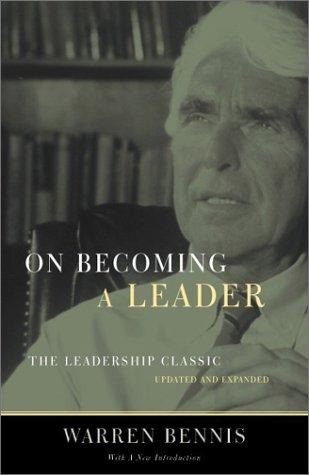
On Becoming a Leader
≈ From memoryLeadership is not a set of skills to be acquired, but an ontological shift from being a performer to becoming a person who empowers others to perform.
In one sentence
True leadership begins with an internal transformation where the individual moves from a mindset of personal achievement ("I") to a responsibility for collective purpose ("We").
Why read this (and who it's for)
This book is designed for high-performing individuals—managers, team leads, and aspiring executives—who have mastered the "how" of their jobs but are struggling with the "why." It solves the common trap of "managerialism," where people become excellent at administration but lose the ability to inspire. After reading this, you will be able to identify your core values, articulate a compelling vision that aligns with those values, and shift your daily focus from doing work to creating the conditions for others to do great work.
The big idea
Warren Bennis argues that leadership is not a destination reached by adding more items to a resume; it is an identity you inhabit. Most people mistake "management" (the coordination of resources, schedules, and outputs) for "leadership" (the mobilization of human spirits toward a shared meaning). To become a leader, you must undergo a psychological shift: you must stop asking "How can I succeed?" and start asking "What does this work mean, and how can we achieve it together?"
The logic is simple but profound: people do not follow those who simply have the right answers; they follow those who provide a sense of meaning. If you cannot define what makes your work significant, you cannot expect others to find it significant for you. Therefore, leadership is fundamentally an act of meaning-making. It requires a leader to be deeply self-aware enough to know their own values, courageous enough to voice those values as a vision, and humble enough to give away power so that others can grow.
Key ideas
The Shift from "I" to "We"
What it is — This is the fundamental transition from individual excellence to collective responsibility. It is the move from being a "doer" who produces results to being a "weaver" who creates an environment where others can produce results. Why it matters — If you stay in the "I" mindset, you become a bottleneck. You will eventually burn out because you are trying to carry the weight of the entire organization on your own shoulders. By shifting to "We," you unlock the power of collective intelligence and sustainability. In the book — Bennis illustrates this by contrasting the "heroic" leader (who tries to do everything) with the "authentic" leader (who empowers others). He argues that the most effective leaders are those who can successfully transition their identity from being the smartest person in the room to being the person who makes everyone else smarter.
Self-Awareness as the Foundation
What it is — Leadership begins with an honest, often painful, inventory of your own values, shadows, and biases. You cannot lead others effectively if you do not understand what drives you, what scares you, and where your blind spots lie. Why it matters — Without self-awareness, your leadership will be reactive rather than intentional. You will find yourself repeating the same mistakes or reacting to people's emotions instead of leading them toward a goal. Self-awareness allows for "authentic" leadership—where your actions align with your internal compass. In the book — Bennis emphasizes that you must know your "why." He suggests that leaders should identify their core values early on, as these will serve as the "north star" during times of crisis when the path forward is obscured by noise and pressure.
Visionary Thinking (Meaning-Making)
What it is — A leader's primary job is to see what others do not yet see. This isn't just "goal setting"; it is creating a narrative about the future that makes people want to help build it. Why it matters — Goals are destinations; visions are inspirations. People will work hard for a deadline, but they will go the extra mile for a meaning. If you cannot articulate why the work matters, your team will eventually default to doing only what is required, not what is possible. In the book — Bennis discusses how leaders must "paint a picture." He argues that a leader's role is to provide the context for the work. You are not just telling people what to do; you are explaining why it matters to them and to the world.
Authentic Communication
What it is — This is the bridge between your internal vision and external action. It involves speaking with integrity, ensuring that your words are rooted in your actual beliefs rather than being "corporate speak" designed to please others. Why it matters — People have a high-frequency radar for inauthenticity. If you sound like a brochure but act like a bureaucrat, you lose trust. Trust is the currency of leadership; once spent, it is nearly impossible to earn back. In the book — Bennis argues that communication must be "embodied." It’s not just about the words you choose, but the consistency between your values, your speech, and your subsequent actions.
The Paradox of Power (Empowerment)
What it is — To lead is to give power away. It is the counterintuitive reality that the more you empower others to make decisions and take responsibility, the more influence you actually gain as a leader. Why it matters — If you hold onto power (control), you remain a supervisor. If you distribute power, you become a leader. Empowerment creates a sense of ownership in your team; when people own the "how," they are much more invested in the "what." In the book — Bennis frames this as a liberation of others. A leader’s success is measured not by how many people report to them, but by how many people they have enabled to lead others.
Courageous Decision Making
What it is — Leadership requires making choices that are uncomfortable, often involving trade-offs where there is no "perfect" answer. It involves taking responsibility for the consequences of those choices. Why it matters — Avoiding hard decisions creates a vacuum of leadership where people feel rudderless. A leader must be willing to say "no" to good ideas so they can say "yes" to the great ones, even if it causes friction in the short term. In the book — Bennis highlights that leaders must be comfortable with ambiguity. You won't always have 100% of the data; you must have the courage to act on the 70% you do have and the integrity to own the outcome regardless of the result.
Frameworks & tools
The Visionary Cycle
Use this framework to move from a vague idea to a mobilized team.
- Identify Current Reality: Be brutally honest about where we are now (the "pain point").
- Envision Future State: Describe what success looks like in vivid, emotive detail. What does the world look like when we succeed?
- Bridge the Gap: Identify the 3–5 critical actions required to move from Reality to Vision.
- Narrate the "Why": Explain why this bridge is worth crossing for every individual on the team.
The Authenticity Audit
Before making a major announcement or shift, run your plan through these three questions:
- Value Alignment: Does this action align with my core personal values? (If not, why am I doing it?)
- Integrity Check: Am I saying this because it is true, or because I think it’s what people want to hear?
- Empowerment Check: Is this decision making for me, or is it creating a path for others to lead?
Memorable examples & stories
The Heroic vs. Authentic Archetypes
Bennis contrasts the "Heroic" leader who tries to be the smartest person in the room with the "Authentic" leader who seeks to create a space where everyone can be their best self. Lesson: Leadership is about multiplying others, not being a superhuman individual.
The Power of Narrative
He discusses how great leaders use stories and metaphors to simplify complex realities. By creating a "story" for the organization, they give people a mental map to navigate uncertainty. Lesson: Meaning-making is often more effective than data-dumping.
The Cost of Inauthenticity
Bennis explores cases where leaders lost their teams not because of bad strategy, but because of a perceived gap between their public persona and private actions. Lesson: Trust is the prerequisite for any leadership action; without it, your words are just noise.
Key quotes
"Leadership is not a destination reached by adding skills to a resume; it is an ontological shift from being a performer to becoming a person who empowers others to perform." (Paraphrased) Why it matters: This reminds you that leadership is an internal change, not an external checklist.
"The leader's role is to provide the context for the work." (Paraphrased) Why it matters: It shifts your focus from "What do I need them to do?" to "How can I help them understand why they are doing it?"
"Leadership is about meaning-making." (Paraphrased) Why it matters: This is the core thesis. If you can't define the meaning, you can't lead the movement.
How to apply it
This week
- The "I" Audit: Write down three things you did this week that were purely "doing" (admin, firefighting). Identify one of those tasks you can delegate entirely to someone else by Friday.
- Value Identification: List your top 3 non-negotiable values (e.g., Integrity, Innovation, Service). Ask yourself: "Does my current project reflect these three things?"
- The Visionary Pitch: Take one current project and write a 3-sentence "Why" statement. Don't talk about deadlines; talk about the impact on the customer or the world.
Ongoing
- Practice Empowerment: Every time you feel the urge to "just do it yourself" because it’s faster, stop. Instead, coach someone else through doing it.
- Reflective Journaling: At the end of each week, ask: "Did I lead today (provided meaning/context), or did I just manage (coordinated tasks)?"
- Authenticity Check: Before every meeting, ask yourself: "Am I being honest about our challenges, or am I hiding behind corporate jargon?"
Common pitfalls
- The Management Trap: Thinking that because you have a title and responsibility for a budget, you are a leader. Bennis argues that many managers are actually just "super-contributors" who haven't made the identity shift.
- Heroicism: Trying to be the person with all the answers. This leads to burnout and prevents your team from developing their own leadership muscles.
- Vision without Action: Creating a beautiful narrative but failing to provide the practical bridge (the "how") to get there. A leader must be both a dreamer and a builder.
Connects to
- "Leadership: What Everyone Needs to Know" by Warren Bennis: This is his foundational work on the skills of leadership; On Becoming a Leader is the deeper, more philosophical evolution of those ideas.
- "Start with Why" by Simon Sinek: Extends Bennis' idea of "meaning-making" by providing a specific framework for how to communicate that "Why" to an audience.
If you remember only three things
- Leadership is an internal identity shift from "I" (doing) to "We" (empowering).
- Your primary job as a leader is meaning-making: defining why the work matters.
- Trust is the currency of leadership; it is built through authentic communication and consistent action.
Internalize it
- Reflection questions
- If my team were to describe my leadership style in three words, what would they be? Are those the words I want them to use?
- What is the "meaning" of our current project that I haven't shared with my team yet?
- When was the last time I gave away a significant piece of power/decision-making authority? Why did I hesitate?
- Flashcards Q: What is the fundamental shift required to become a leader? A: Moving from an "I" mindset (individual performance) to a "We" mindset (collective responsibility).
Q: What is the primary role of a leader in terms of meaning? A: Meaning-making: providing the context and "why" behind the work.
Q: What is the difference between management and leadership? A: Management is coordinating resources/tasks; Leadership is mobilizing human spirits toward a shared purpose.
Q: Why is self-awareness critical for leadership? A: It allows for authentic leadership where actions align with internal values rather than reactive behaviors.
Q: What is the "Paradox of Power" in leadership? A: You gain more influence by giving power away to others (empowerment) than by holding onto control.
Q: What must a leader be comfortable with when making decisions? A: Ambiguity—the ability to act on incomplete information and own the consequences.
Fidelity note
I have high confidence in the core themes of this book, specifically Bennis' focus on the "identity shift," "meaning-making," and the distinction between management and leadership. These are his signature arguments. I am less certain about specific minor anecdotes (stories) as they may be paraphrased from my memory of his general speaking style rather than a verbatim recount of a specific chapter's story. Readers should verify the specific historical examples used in the text to ensure they align with their own interests.