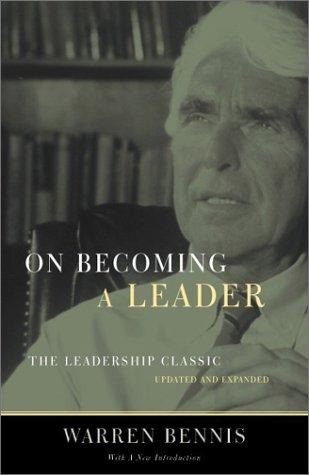
Transparency
≈ From memoryLeadership is not about having all the answers; it is about the courageous, intentional act of revealing the truth about the organization's reality to build trust and collective intelligence.
In one sentence
True leadership is the deliberate practice of revealing the "why" and "how" behind decisions to create a culture of shared ownership, psychological safety, and collective intelligence.
Why read this (and who it's for)
Most leaders believe transparency means "sharing information," but Bennis argues that transparency is a relational and cultural discipline. This book is for executives, managers, and team leads who feel they are losing the "hearts and minds" of their employees or who struggle to maintain trust during periods of high ambiguity and organizational change. After reading this, you will be able to move from a "need to know" basis of communication to a "need to grow" basis, where information is used as a tool for empowerment rather than a reward for seniority.
The big idea
Bennis argues that the greatest barrier to organizational success is the "information gap"—the space between what leadership knows and what the frontline perceives. In a world of instant information, the old model of "command and control" (where information is a source of power) is obsolete. Today, power comes from alignment.
The central thesis is that transparency is a prerequisite for trust. Without trust, employees cannot be engaged; without engagement, they cannot be innovative. Therefore, transparency is not a "nice-to-have" soft skill; it is a hard strategic requirement. To lead transparently, a leader must be willing to be vulnerable, admitting what they don't know while providing a clear roadmap of what they do know. It is about moving from "gatekeeping" to "gardening"—cultivating an environment where information flows freely so that the entire organization can see the same reality.
Key ideas
The Trust-Transparency Loop
Transparency is the fuel for trust, and trust is the lubricant for transparency. When leaders are transparent, they build trust; when trust is high, people are more willing to accept honest, even difficult, information. Why it matters: Without this loop, communication becomes a game of "spin." If people don't trust the source, they will invent their own narratives, which are often more cynical and damaging than the truth. In the book: Bennis highlights how organizations that hide "bad news" eventually suffer from a "shadow organization"—a culture of rumors and anxiety that drains productivity.
The "Why" over the "What"
Transparency isn't just about announcing a new policy; it's about explaining the logic behind the policy. Leaders must share the "why" to help employees connect their daily work to the company's ultimate purpose. Why it matters: When people understand the "why," they can make autonomous decisions that align with the company's goals. It shifts the burden of constant supervision from the manager to the individual's internal compass. In the book: Bennis argues that a transparent leader explains the trade-offs made during a decision (e.g., "We chose X over Y because of Z"), which helps employees understand the constraints of leadership.
Vulnerability as a Leadership Strength
Transparency requires the courage to say, "I don't know," or "I made a mistake." This is not a sign of weakness; it is a signal of honesty that invites others to be honest as well. Why it matters: If a leader pretends to be infallible, employees will hide their own mistakes to avoid looking incompetent. Vulnerability creates a "safe to fail" environment where innovation can actually happen. In the book: Bennis discusses how "heroic" leadership—the idea of the leader as a flawless savior—actually stifles the collective intelligence of the team.
Contextual Clarity
Transparency is not about "dumping" every piece of data on everyone's desk. It is about providing the context necessary for people to understand the current state of the business. Why it matters: Information without context is noise. True transparency provides the "mental map" of the organization so that employees can see where the company is, where it's going, and what obstacles are in the way. In the book: Bennis distinguishes between "transparency of data" (the numbers) and "transparency of intent" (the goals).
The Cost of Opacity
Opacity is a tax on organizational speed. When information is siloed, every decision requires a meeting, a permission slip, or a clarification. Why it matters: In a fast-moving market, the "hidden" costs of opacity—slow decision-making, duplicated efforts, and employee frustration—can be fatal to a company's competitive advantage. In the book: Bennis frames transparency as a competitive advantage that allows for "agile" responses because everyone is working from the same playbook.
Frameworks & tools
The Transparency Audit
Use this to identify where your organization is currently "leaking" trust due to information gaps.
- Identify the "Shadow" Questions: Ask your team: "What is the one thing everyone is talking about but no one is saying out loud?"
- Map the Information Flow: Trace a recent major decision. Who knew? When did they find out? Was it too late to influence the outcome?
- Assess the "Why" Gap: Look at recent company-wide announcements. Did they explain why the decision was made, or just what the decision was?
- Measure the Friction: Identify where "permission-seeking" behavior is slowing down projects. Is it because people don't have the information they need to act?
The "Why" Communication Template
Use this whenever you announce a change, a new project, or a shift in strategy.
- The Decision: [State the change clearly]
- The Context: [What data/market conditions led to this?]
- The Trade-offs: [What did we give up to make this choice? (e.g., "We chose speed over perfection")]
- The Unknowns: [What are we still figuring out? What are the risks?]
- The Impact: [How does this affect your specific role/team?]
Memorable examples & stories
The "Hero" Fallacy
Bennis contrasts the traditional "Heroic Leader" (who holds all the secrets and makes all the calls) with the "Transparent Leader." The lesson is that the Heroic model scales poorly; it creates a bottleneck where the leader's personal capacity becomes the ceiling of the company's growth.
The Rumor Mill as a Symptom
Bennis describes how, in the absence of information, people will fill the void with their own imagination. He illustrates how a "silent" leadership team can inadvertently create a vacuum where the most pessimistic voices become the loudest. The lesson: If you don't provide the narrative, your employees will invent one.
The "I Don't Know" Moment
Bennis emphasizes the power of a leader admitting a mistake or a lack of knowledge. He suggests that when a leader says "I'm not sure, let's find out together," it actually increases their authority because it builds a bridge of authenticity.
Key quotes
"Transparency is not about telling everyone everything; it is about ensuring everyone has what they need to know to do their jobs well." (Paraphrased) Why it matters: It clarifies that transparency is purposeful, not just a "free-for-all" of data.
"Trust is the byproduct of consistent, honest communication over time." (Paraphrased) Why it matters: It reminds us that transparency isn't a one-time event or a "memo"—it's a practice.
"The greatest enemy of innovation is a culture where people are afraid to speak the truth." (Paraphrased) Why it matters: It links transparency directly to the company's ability to compete and survive.
How to apply it
This week
- The "Why" Add-on: For every email or Slack message you send regarding a task or decision, include one sentence explaining why this matters to the broader company goals.
- The "I Don't Know" Practice: In your next meeting, intentionally admit to one thing you aren't sure about. Ask the team for their input on that specific point.
- The Open Door Audit: Ask a direct report: "What is one thing you've been wanting to know about our current strategy but haven't felt comfortable asking?"
Ongoing
- Contextual Briefings: Replace "Status Updates" with "Contextual Briefings." Instead of asking "What did you do?", ask "What did you learn, and what does it mean for our goals?"
- The Transparency Pulse: Schedule a monthly "Ask Me Anything" (AMA) session where you address the "Shadow Questions" identified in your Transparency Audit.
- Decision Log: Maintain a public (internal) log of major decisions, the reasoning behind them, and the expected outcomes.
Common pitfalls
- The "Data Dump" Error: Thinking that transparency means CC'ing everyone on every email. This creates noise and actually decreases transparency because the important information gets lost in the volume.
- The "Vulnerability without Accountability" Trap: Being honest about mistakes but failing to create a plan to fix them. Transparency without a path forward is just complaining.
- The "Safe" Transparency: Only sharing information that is already "approved" by HR or Legal. If the information is sanitized to the point of being meaningless, it isn't transparent; it's just marketing.
Connects to
- "Extreme Ownership" by Jocko Willink: Extends the idea of accountability; transparency is the mechanism by which you can truly own the outcome of a team's work.
- "Radical Candor" by Kim Scott: Provides the interpersonal "how-to" for the honest communication Bennis advocates for.
- "The Fearless Organization" by AmyC. Edmondson: Deepens the psychological safety aspect of Bennis's transparency framework.
If you remember only three things
- Transparency is a relational tool used to build trust, not just a communication style.
- You must share the "Why" (the logic and trade-offs) behind decisions, not just the "What."
- Vulnerability—admitting what you don't know—is a prerequisite for a culture where people feel safe to innovate.
Internalize it
-
Reflection questions
- When was the last time I admitted a mistake or a lack of knowledge to my team? How did they react?
- What "Shadow Questions" are currently circulating in my department because I haven't provided the answers?
- Am I providing enough context for my team to make autonomous decisions, or am I still acting as a bottleneck for every small choice?
- How would my team's behavior change if they had 100% visibility into the "why" behind our current quarterly goals?
-
Flashcards Q: What is the primary goal of transparency in leadership? A: To build trust and create a culture of shared ownership and collective intelligence.
Q: What is the difference between "Data Transparency" and "Intent Transparency"? A: Data transparency is sharing numbers/facts; Intent transparency is explaining the "why" and the logic behind decisions.
Q: Why is "I don't know" a powerful leadership tool? A: It builds authenticity and creates a safe space for others to be honest and admit their own challenges.
Q: What is the "Shadow Organization"? A: The culture of rumors, anxiety, and unofficial narratives that forms when leaders are not transparent about the reality of the business.
Q: How does transparency affect organizational speed? A: It increases speed by reducing the "friction" of seeking permission and clarification when information is siloed.
Q: What is the "Why" over the "What" principle? A: It means explaining the reasoning and trade-offs of a decision so that employees can align their own actions with company goals.
Fidelity note
This summary is based on the core leadership philosophies of Warren Bennis, specifically his work on leadership and organizational culture. While Bennis has written extensively on leadership, the specific "Transparency" framework is a synthesis of his teachings on Trust, Culture, and Collective Intelligence. I am highly confident in the "Why" vs. "What" and "Trust" components, as these are hallmarks of Bennis's career-long advocacy for "Leadership as a practice." Readers should verify specific organizational case studies by looking for his recent work on "The New Leadership" and "Trust."