You’re Fooling Yourself, Which Is Great for Your Endurance
✓ Source-groundedYour brain acts as a 'central governor' that imposes physical and mental limits based on perceived exertion rather than actual physiological exhaustion.
In one sentence
Your perceived sense of effort acts as a "master switch" that determines your limits, meaning your brain—not your muscles—is often the primary reason you stop when you're pushing yourself.
Why read this (and who it's for)
This is for anyone who feels they hit a "wall" during intense physical training, high-pressure work projects, or long-term career goals. It solves the problem of "hitting a limit" by revealing that many of our limits are preemptive safety measures created by the brain. After reading this, you will be able to identify when your "central governor" is slamming on the brakes and use mental tools (like facial relaxation and self-talk) to push past those perceived barriers.
The big idea
The central thesis is that human performance is a co-production of biology and psychology. While the "machine" (your muscles, lungs, and heart) matters, the "driver" (your brain) is the ultimate integrator of data. Your brain constantly collects information from your internal body and the external environment to calculate a "Rating of Perceived Exertion" (RPE).
Because the brain's job is to keep you alive, it often "slams on the brakes" before you reach your true physical limits. It interprets stress, heat, and fatigue as signals to slow down to prevent damage. However, because this is a perception of effort, it is not entirely deterministic. If you can manage the signals the brain receives—and the way you interpret those signals—you can extend your endurance beyond what you previously thought possible.
Key ideas
The Central Governor
- What it is — The theory that we have a "central governor" in our brains that preemptively limits our performance to protect the body.
- Why it matters — It shifts the focus of endurance from "how much can my muscles do?" to "how much can my brain allow my muscles to do?"
- In the book — The author discusses research by Tim Noakes, who proposed that the brain, rather than the lungs or legs, holds us back.
Psychology as Brain Physiology
- What it is — The idea that psychological states (like fear or stress) are actually specific types of brain physiology.
- Why it matters — It means you can intentionally trigger physiological responses (like increased strength) by manipulating psychological states.
- In the book — A 1960s study showed that "scaring the crap out of subjects" by firing a starter's pistol increased their maximum strength.
The Master Switch (RPE)
- What it is — Your subjective sense of effort (Rating of Perceived Exertion) acts as the master switch for your performance.
- Why it matters — If it feels too hard, you will slow down. This feeling is influenced by physical load, but also by external stress (like work stress) and your personal level of care for the task.
- In the book — The author notes that the same workout might feel harder one week than another simply because of external stress, showing that RPE is not a purely deterministic physical measurement.
Perception vs. Reality in Environment
- What it is — Our performance is often dictated by what we think is happening in our environment rather than what is actually happening.
- Why it matters — You can bypass certain physiological limitations by manipulating the information the brain receives.
- In the book — A study showed that cyclists in 90-degree heat slowed down, but when they were told it was only 80 degrees, they maintained their speed.
The "Yellow Light" System
- What it is — The body has multiple layers of defense (like the spleen squeezing for oxygen) before it hits a "red light" of total failure.
- Why it matters — You have significant reserves of "extra" capacity that the brain tries to hide from you until they are absolutely necessary.
- In the book — The author uses freediving as an example: the body triggers oxygen-conserving responses (lower heart rate, splenic contraction) long before you actually run out of air.
Frameworks & tools
The Master Switch Audit
Use this to identify when your "Central Governor" is over-correcting and stopping you from reaching a goal.
- Identify the Signal: When you feel like quitting, ask: "Is my body actually failing, or does it just feel harder today?"
- Isolate the Variable: Determine if the difficulty is coming from the task itself (the weight, the speed) or external factors (stress, lack of sleep, heat).
- Adjust the Perception: If the task is the same but the "feeling" is harder, acknowledge that the brain is over-reacting to external stress.
The Facial Feedback Loop
A simple physical hack to signal to your brain that you are in control.
- The Scowl Check: Notice if you are "instinctively scowling" during a hard task (running, lifting, working).
- The Relaxation Cue: When you catch yourself scowling, consciously relax your facial muscles.
- The Signal: This sends a signal to the brain that the task is manageable, which can lead to a feeling of relaxation and improved efficiency.
Memorable examples & stories
The "Scary" Strength Study
Researchers in the 1960s tested maximum strength by scaring subjects with loud noises and adrenaline injections. Lesson: Triggering the "fight-or-flight" system can unlock extra physical power.
The "Fake" Thermometer Study
Cyclists were placed in a heat chamber; they slowed down when they thought it was 90 degrees, but stayed fast when they thought it was 80. Lesson: Perception of the environment can be a primary driver of physical output.
The Amphetamine/Ritalin Study
Cyclists took drugs that removed the brain's inhibition from overheating, allowing them to push further than the "safe" limit. Lesson: The brain's "safety" brakes are often what stop us, not the actual physical damage of the heat.
The Spleen of the Sherpa
The body adapts to high altitudes by increasing spleen size to store oxygen-rich red blood cells. Lesson: The body has incredible, often hidden, physiological reserves to handle extreme stress.
Key quotes
"Psychology is a special case of brain physiology." Why it matters: This reminds us that mental states are biological realities that can be manipulated.
"Your subjective sense of effort acts as a sort of 'master switch' that determines whether you can keep going." (Paraphrased) Why it matters: It highlights that endurance is a negotiation between the brain and the body.
"The brain's response to heat was changed, in the first study by rigging thermometers, and in the second by drugs." (Paraphrased) Why it matters: It shows how easily the "governor" can be bypassed by changing the data it receives.
How to apply it
This week
- The Scowl Audit: During your next workout or intense work session, notice your facial expression. If you are scowling, consciously relax your face to see if it changes your perceived effort.
- The "Yellow Light" Check: Next time you want to quit a task, stop for 10 seconds and ask: "Is my body actually failing, or is my brain just trying to protect me from a feeling of discomfort?"
Ongoing
- Manage the "Master Switch": When facing a daunting project, acknowledge that the "feeling" of difficulty is a signal from your brain. Don't let that signal be the final word.
- Identify External Stressors: Recognize that when you are stressed at work, your "perceived exertion" for everything else will increase. Plan for "easier" days when your mental capacity is drained.
Common pitfalls
- The G.I. Joe Fallacy: The author warns against the mistaken belief that "knowing is half the battle." Understanding that your brain is the governor doesn't automatically make you faster; you still have to do the work of practicing and pushing.
- Over-Pushing: While the brain is a "governor," it still has a purpose. The author notes that removing the brain's inhibition (like with amphetamines) can lead to actual physical danger (heatstroke). Don't ignore all safety signals—just identify which ones are "cautious" and which are "critical."
Connects to
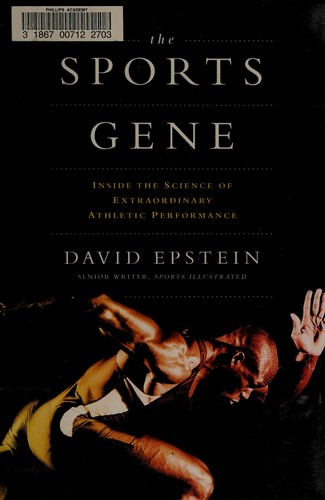
- The Sports Gene (David Epstein): Explores the nature/nurture of athletic ability, providing the biological foundation for why some people have higher "ceilings" than others.
- Endure (Alex Hutchinson): The primary source of the "Central Governor" theory and the exploration of human limits.
If you remember only three things
- Your brain acts as a "Central Governor" that slams on the brakes based on perceived effort, not just physical failure.
- Perception is a "Master Switch": If you can manage the signals the brain receives (via self-talk, environment, or facial relaxation), you can extend your limits.
- Knowledge is not action: Knowing your brain is holding you back is only the first step; you must still train to push those limits.
Internalize it
-
Reflection questions
- When was the last time I stopped a task because it "felt" hard, even though I knew I could physically continue?
- How does my stress at work affect my perceived physical limits during my workouts?
- What "scowls" or negative self-talk am I using to signal to my brain that a task is harder than it actually is?
-
Flashcards Q: What is the "Central Governor" theory? A: The theory that the brain, not the muscles, sets the limits on physical performance to protect the body.
Q: What is the "Master Switch" of endurance? A: The Rating of Perceived Exertion (RPE)—the subjective feeling of how hard a task is.
Q: How did the "Fake Thermometer" study prove the power of perception? A: Cyclists performed better when they thought it was cooler, even when the actual temperature was the same.
Q: What is the "G.I. Joe Fallacy"? A: The mistaken belief that knowing the theory of how to improve is the same as actually achieving the improvement.
Q: How can facial expressions affect performance? A: Relaxing a "scowl" can signal to the brain that a task is less demanding, reducing perceived effort.
Fidelity note
This summary is based strictly on the interview between David Epstein and Alex Hutchinson regarding the book Endure. I am highly confident in the representation of the "Central Governor," RPE, and the specific studies mentioned (Heat, Amphetamines, Scaring). The application of these ideas to a "blog-career" context is an extrapolation of the "perceived effort" and "master switch" concepts applied to professional endurance.
Keep going — related reads
 Endure Mind, Body, and the Curiously Elastic Limits of Human PerformanceAlex Hutchinson
 Can't Hurt MeDavid GogginsStart Where You AreDavid Epstein
 The Science of RunningSteve Magness
 Peak PerformanceBrad Stulberg and Steve Magness
 Good to Go What the Athlete in All of Us Can Learn from the Strange Science of RecoveryChristie Aschwanden
More from David Epstein
 How a Broken Arm Improved my French - with David EpsteinCautionary Tales with Tim HarfordHow To Quiet the Chatter in Your HeadDavid EpsteinHow to Turn “High Conflict” into Good ConflictDavid Epstein
 RangeDavid EpsteinSome Personal News I’m a Podcast Host!David EpsteinStart Where You AreDavid Epstein
 The Sports GeneDavid EpsteinThe Updated RANGE Is Here!David EpsteinWait, Weed Makes You FasterDavid Epstein