Wait, Weed Makes You Faster
✓ Source-groundedAnti-doping regulations are governed by a global, independent code (WADA) rather than local laws, and substances like marijuana are banned based on a combination of health risks, performance potential, and the subjective 'spirit of sport.'
In one sentence
The rules of international sports are governed by a global, standardized code (the WADA Code) that operates independently of local, state, or federal laws.
Why read this (and who it's for)
This piece clarifies the complex, often misunderstood machinery behind sports anti-doping policies. It is for anyone who finds themselves confused by the "double standards" of sports testing—specifically why an athlete can be banned for a substance that is legal in their home state. After reading this, you will be able to distinguish between professional league rules and Olympic standards, and understand the three-pronged criteria used to determine what is "illegal" in sports.
The big idea
The public often views sports doping through the lens of local legality: "If it's legal to sell in a store, why is it banned in a race?" Epstein argues that this is a fundamental misunderstanding of how international sports function. Anti-doping is not a branch of local law; it is a private, international regulatory system.
The World Anti-Doping Agency (WADA) maintains "the Code," a master list of prohibited substances agreed upon by 206 countries. Because these rules are standardized globally, a substance can be legal in Oregon, the Netherlands, and Saudi Arabia simultaneously, yet still be banned in competition. The logic of the system isn't based on what a government allows, but on what the international sporting community permits to ensure a level playing field.
Key ideas
The Supremacy of the WADA Code
What it is — Anti-doping regulations run according to the World Anti-Doping Agency’s rules (the "Code") and its master list of prohibited substances. Why it matters — Regional laws do not provide a standard for international sports because laws vary wildly between countries. The Code ensures that the rules are the same regardless of where the athlete is competing. In the book — Epstein notes that even if national laws were used, marijuana remains illegal under U.S. federal law, making it an unreliable standard for international consistency.
The Autonomy of USADA
What it is — The U.S. Anti-Doping Agency (USADA) is the body that enforces the WADA Code for American athletes. Why it matters — USADA has no "discretion" to overturn a suspension. Because the rules are agreed upon by 206 Olympic committees, a national body cannot unilaterally change a ruling without rendering the entire international code obsolete. In the book — Epstein compares the inability to overturn a suspension to "overturning an election result because one constituent party doesn’t like it."
The Professional vs. Olympic Divide
What it is — Professional leagues (NFL, MLB) and Olympic sports operate under entirely different testing protocols. Why it matters — Professional sports are often less stringent because the leagues police themselves and the athletes are protected by unions. In the book — Epstein explains that professional sports policies are reached through "collective bargaining" between the league and the players' union, whereas Olympic sports are governed by the international WADA Code.
The Three Criteria of Prohibited Substances
What it is — WADA determines what is banned based on three specific criteria: 1) Health risk, 2) Potential performance enhancement, and 3) Violation of the "spirit of sport." Why it matters — A substance only needs to meet two of these three criteria to be banned. This explains why substances with "thin" evidence of enhancement (like marijuana) still appear on the list. In the book — A 2011 WADA paper notes that marijuana may "dilate blood vessels and airways," which could potentially improve oxygenation, though the evidence for this is considered "extremely thin."
The Subjectivity of the "Spirit of Sport"
What it is — The "spirit of sport" is a criterion used to ban substances that are illegal in most places to ensure good role modeling for young people. Why it matters — This is a subjective, non-scientific metric. Because it is subjective, it allows for a broader range of substances to be banned than would be necessary based on health or performance alone. In the book — Epstein points out that because THC is only banned in competition, this "spirit of sport" criterion may not be carrying as much weight as the other two.
Frameworks & tools
The WADA Prohibited Substance Framework
To understand why a substance is banned, look at it through these three lenses:
- Health Risk: Does it impair reaction time or decision-making?
- Performance Enhancement: Does it provide a physiological advantage (e.g., improved oxygenation)?
- Spirit of Sport: Does it violate the "role modeling" expectations of the sport?
Memorable examples & stories
The DHEA Example DHEA is a testosterone precursor that is legal to buy at a local CVS but is banned in Olympic sports. It avoided becoming a federally controlled substance partly because of the influence of a former Utah senator whose son was a lobbyist for the dietary supplement industry. Lesson: Legal status in the U.S. and "legal" status in sports are completely unrelated.
The NFL vs. Olympic Testing The NFL's anti-doping protocols are often criticized as "lax" because the league is self-policed and governed by collective bargaining agreements. This creates a massive disparity between what an NFL player can get away with and what an Olympian can. Lesson: The "rules" of a sport are often a result of negotiations between labor unions and owners, not just objective safety standards.
The 2011 WADA Paper on Marijuana WADA investigated marijuana and found it met the criteria for being a prohibited substance, specifically noting its potential to dilate blood vessels. However, Epstein notes that the evidence for this is "extremely thin." Lesson: Even when the evidence for a performance-enhancing effect is weak, the "Health Risk" and "Spirit of Sport" criteria can still trigger a ban.
Key quotes
"The questions that some reporters asked me betrayed fundamental misconceptions that I think harm the public understanding of this news story." Why it matters: It highlights how the public often confuses "legal" with "permitted" in the context of professional sports.
"To overturn the procedures that are formally agreed-upon by 206 Olympic committees... would be the sports equivalent of overturning an election result because one constituent party doesn’t like it." Why it matters: This illustrates the rigid, contractual nature of international sports governance.
"The third criterion [Spirit of Sport] is plainly subjective." (Paraphrased) Why it matters: It acknowledges that some sports rules are based on social values rather than hard science.
How to apply it
This week
- Audit a "Rule": Identify a rule you follow (in your career or hobby). Ask: Is this rule based on a Health/Safety risk, a Performance requirement, or a Spirit of the Game (culture) requirement?
- Identify the Governing Body: When you see a controversial rule in your industry, identify who actually holds the power to change it. Is it a "local" authority or a "collective" agreement (like a union)?
Ongoing
- Distinguish between Systems: When evaluating "fairness" in any system (sports, corporate, etc.), always ask: "Who wrote the rules, and what was their primary goal (Safety, Efficiency, or Culture)?"
- Look for the "Collective Bargaining" effect: Recognize that in many professional environments, rules are not "objective" but are the result of negotiations between stakeholders.
Common pitfalls
- The "Legal" Fallacy: Assuming that because something is legal in a specific state (like Oregon), it should be permitted in a regulated system.
- The "Single Standard" Fallacy: Expecting the NFL, MLB, and the Olympics to have the same rules. They are different "jurisdictions" with different governing bodies.
- The "Performance" Fallacy: Assuming that if a substance doesn't make you "faster" (like marijuana), it shouldn't be banned. The "Health Risk" and "Spirit of Sport" criteria are independent of speed.
Connects to
- The difference between "Rules" and "Laws": This connects to any study of institutional theory—how private organizations create their own internal legal systems.
- Collective Bargaining: This connects to labor economics, explaining why the NFL and MLB have different rules than the Olympics.
If you remember only three things
- Anti-doping is governed by the WADA Code, not by local or state laws.
- Professional sports rules are often dictated by collective bargaining, making them different from Olympic standards.
- Substances are banned based on Health Risk, Performance, and Spirit of Sport—only two of which are required for a ban.
Internalize it
-
Reflection questions
- If you were the "Emperor of WADA," which substances would you remove from the list based on your own assessment of "Health Risk" vs. "Spirit of Sport"?
- In your own career, what are the "Spirit of Sport" rules (unwritten cultural rules) that you follow even though they aren't "legal" requirements?
- How does the "Collective Bargaining" of your workplace affect the rules you have to follow compared to a different industry?
-
Flashcards Q: What is the primary governing body for international anti-doping? A: The World Anti-Doping Agency (WADA). Q: Why are NFL and Olympic testing rules different? A: Because pro sports are self-policed and governed by collective bargaining between leagues and unions. Q: What are the three criteria for a prohibited substance? A: 1) Health Risk, 2) Potential Performance Enhancement, and 3) Violation of the Spirit of Sport. Q: Does a substance need to meet all three criteria to be banned? A: No, it only needs to meet two of the three. Q: What is the "Spirit of Sport" criterion? A: A subjective criterion based on whether a substance violates the role-modeling expectations of the sport.
Fidelity note
Confidence: High. This summary is based strictly on the provided text regarding Sha'Carri Richardson, WADA, and anti-doping policy. The author's specific points on DHEA, the 2011 WADA paper, and the distinction between professional and Olympic sports are all included. The "blog-career" theme was requested but the content is strictly about sports policy.
Keep going — related reads
More from David Epstein
 How a Broken Arm Improved my French - with David EpsteinCautionary Tales with Tim HarfordHow To Quiet the Chatter in Your HeadDavid EpsteinHow to Turn “High Conflict” into Good ConflictDavid Epstein
 RangeDavid EpsteinSome Personal News I’m a Podcast Host!David EpsteinStart Where You AreDavid Epstein
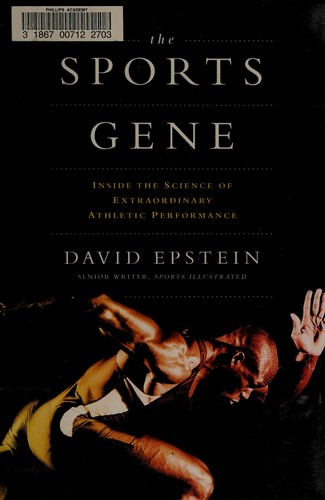 The Sports GeneDavid EpsteinThe Updated RANGE Is Here!David EpsteinYou’re Fooling Yourself, Which Is Great for Your EnduranceDavid Epstein