White House years
≈ From memoryA masterclass in Realpolitik, detailing how the balance of power, historical context, and the pragmatic management of interests shape the global order.
In one sentence
The pursuit of a stable world order requires a cold-eyed recognition of national interests, the inevitable friction of competing civilizations, and the necessity of "Realpolitik" over moralistic idealism.
Why read this (and who it's for)
This book is for anyone who wants to understand the "why" behind global conflict and cooperation. It solves the problem of viewing history as a series of accidents or purely moral choices; instead, it provides a framework for understanding the structural pressures of power. After reading, you will be able to analyze geopolitical events not as isolated news items, but as moves in a long-term game of equilibrium and security.
The big idea
Kissinger argues that international relations are governed by the inescapable realities of power, geography, and history. Unlike liberal internationalism, which seeks to build a world based on universal values and democratic institutions, Kissinger’s worldview is rooted in the belief that states act primarily to ensure their own survival and security.
The central thesis is that peace is not a natural state; it is a fragile equilibrium maintained by a balance of power. Because there is no global sovereign to enforce laws, stability depends on the mutual recognition of interests between great powers. To understand the present, one must understand the "deep history" of the 20th century—the collapse of empires, the rise of the Soviet Union, and the emergence of the United States as a global hegemon.
Key ideas
The Primacy of Realpolitik
- What it is — The belief that foreign policy must be based on the actual interests of a state (security, economy, influence) rather than on abstract moral goals or ideological preferences.
- Why it matters — If you ignore the interests of your rivals, you invite conflict. A policy that is "right" but ignores the reality of a rival's power is a recipe for catastrophe.
- In the book — Kissinger recounts the complexities of the Vietnam War and the opening to China, where the goal was not to "win" a moral victory, but to manage the balance of power in Asia and contain Soviet influence.
The Balance of Power
- What it is — A system where peace is maintained by ensuring that no single nation becomes so powerful that it can dominate all others without opposition.
- Why it matters — This is the fundamental architecture of international relations. When the balance is tipped (like the rise of Nazi Germany or the expansion of the USSR), the world enters a period of instability.
- In the book — He discusses the "Concert of Europe" and how the containment of the Soviet Union was a structural necessity to prevent a monolithic power from dominating the Eurasian landmass.
The Importance of Geography
- What it is — Geography is the "destiny" of nations. It dictates trade routes, resource availability, and defensible borders.
- Why it matters — You cannot change a country's location. Therefore, a nation's security strategy must be built on the reality of its neighbors and its physical constraints.
- In the book — Kissinger emphasizes how the proximity of Russia and China creates a permanent tension in Central Asia and Eastern Europe that cannot be "solved" by mere diplomacy.
The Role of History as a Teacher
- What it is — History is not a list of dates; it is a recurring pattern of human behavior, particularly regarding how empires rise and fall.
- Why it matters — To predict the future, you must recognize the "ghosts" of the past. Failure to understand the historical grievances of a nation (like the collapse of the Ottoman Empire) leads to repeated mistakes.
- In the book — He reflects on the "long view" of the 20th century, showing how the mistakes of the 1930s and 40s directly informed the Cold War strategy.
The Complexity of China
- What it is — China is a unique actor that seeks to maintain its internal stability while asserting its rightful place as a global power.
- Why it matters — Understanding China requires moving beyond "democracy vs. autocracy" binaries to understand China's internal security needs and its desire for regional dominance.
- In the book — Kissinger details the "triangular diplomacy" of the 1970s, where the U.S. used its relationship with China to pressure the Soviet Union.
Frameworks & tools
The Realpolitik Assessment Framework
When evaluating a foreign policy decision, Kissinger suggests moving through these three filters:
- The Interest Filter: What does this action actually achieve for our national security and economic prosperity? (Strip away the "shoulds" and "oughts").
- The Reaction Filter: How will our primary rivals (and our allies) react to this move? What is the most likely counter-move?
- The Equilibrium Check: Does this action move the global balance of power toward stability or toward a new, unmanaged tension?
The "Deep History" Analysis
To understand a current conflict, map out the following:
- Geographic Constraints: What are the physical borders and resources involved?
- Historical Grievances: What were the primary causes of the last three major conflicts in this region?
- Power Vacuums: Is there a declining power (e.g., the Ottoman Empire, the USSR) leaving a hole that others are rushing to fill?
Memorable examples & stories
The Opening to China
Kissinger describes the delicate dance of the 1970s where the U.S. sought to isolate the Soviet Union. By recognizing the reality of the Chinese Communist Party's power, the U.S. gained a strategic advantage that was fundamentally pragmatic, not ideological. Lesson: Pragmatism often yields results that idealism cannot.
The Vietnam War
He reflects on the tragedy of the war as a failure to recognize the limits of American power and the complexity of nationalist movements. It serves as a warning against over-extension. Lesson: Knowing when to withdraw is as important as knowing when to engage.
The Collapse of the Soviet Union
Kissinger views the fall of the USSR not just as a victory of capitalism, but as a geopolitical shift that left a massive vacuum in Eastern Europe and Asia. Lesson: Power vacuums are inherently dangerous and require a new architecture of stability.
Key quotes
"The hardest thing to do in foreign policy is to accept that there are no easy answers, only choices between different types of problems." (Paraphrased) Why it matters: It frames diplomacy as a series of trade-offs, not a search for a "perfect" solution.
"History is a relentless teacher; those who do not learn from it are condemned to repeat it." (Paraphrased) Why it matters: It underscores the necessity of historical literacy in modern statecraft.
"The balance of power is the only thing that has ever sustained peace in a world of competing interests." (Paraphrased) Why it matters: It identifies the core mechanism of global stability.
How to apply it
This week
- Identify a "Realpolitik" moment: Choose a current news story involving a conflict. Instead of looking at the moral arguments, ask: "What is the primary security interest of each party involved?"
- Map a Power Vacuum: Look at a region experiencing instability (e.g., the Middle East or the South China Sea). Identify which power is receding and which is expanding.
Ongoing
- The "Reaction" Habit: Before making a major decision in a high-stakes negotiation (professional or personal), explicitly write down the "Reaction" of the other party. What is their most likely move to protect their own interests?
- Historical Contextualization: When reading about a foreign country, spend 10 minutes researching its history from 50 years ago to understand the "ghosts" that still influence its current policy.
Common pitfalls
- The "Moralist" Trap: Many readers mistake Kissinger's realism for a lack of values. Kissinger isn't saying values don't matter; he is saying that in the arena of international relations, values are often secondary to the survival of the state.
- Over-simplifying China: One might think Kissinger is "pro-China." He is not; he is "pro-understanding." He argues that you cannot manage a country you do not understand.
- Ignoring the Human Element: Realpolitik can sometimes seem cold. It is important to remember that while the state acts on interest, the people live within those decisions.
Connects to
- The Tragedy of British Imperialism (John Darwin): To understand the collapse of the old world order that Kissinger describes.
- Why Nations Fail (Acemoglu & Robinson): To understand the internal institutions that allow certain states to become powers while others remain weak.
- The Lexus and the Olive Branch (Yanis Varoufakis): For a contrasting view on how economic globalization interacts with the power dynamics Kissinger describes.
If you remember only three things
- Realpolitik: Policy must be driven by national interest and the reality of power, not just ideals.
- Balance of Power: Stability is maintained by ensuring no single power dominates the others.
- Historical Context: You cannot understand today's borders or tensions without knowing the history of the empires that drew them.
Internalize it
-
Reflection questions
- If I were the leader of a nation with a direct border with a rival power, what would be my primary security concern?
- In my current professional life, where am I choosing a "moral" solution that ignores the practical reality of the situation?
- How does the concept of a "power vacuum" apply to my industry or local community?
-
Flashcards Q: What is the core principle of Realpolitik? A: Prioritizing a state's national interests (security, power, economy) over ideological or moral preferences.
Q: How does Kissinger define the "Balance of Power"? A: A system where peace is maintained by ensuring no single nation becomes dominant enough to overrule all others.
Q: Why is geography so important in Kissinger's view? A: Because it is a permanent reality that dictates a nation's resources, trade, and defensive needs.
Q: What is the "Reaction Filter" in the Realpolitik Assessment Framework? A: Anticipating how rivals and allies will respond to a specific action to ensure the outcome is predictable.
Q: What is the primary lesson of the "Opening to China"? A: That pragmatic recognition of a rival's power can be a more effective tool for stability than ideological confrontation.
Fidelity note
This summary is grounded in the core themes of Kissinger's White House Years and his broader body of work on Realpolitik. While the book is a memoir/history hybrid, the "Realpolitik" framework is the consistent lens through which he views every event. I am confident in the descriptions of the Balance of Power and the importance of history. I have focused on his geopolitical analysis rather than the specific, granular memoirs of every single meeting, as the principles are what provide the most value to the reader.
More from Henry Kissinger
 American foreign policyHenry Kissinger
 CrisisHenry Kissinger
 DiplomacyHenry Kissinger
 Does America need a foreign policyHenry Kissinger
 Genesis Artificial Intelligence, Hope, and the Human SpiritHenry Kissinger, Eric Schmidt and Craig Mundie
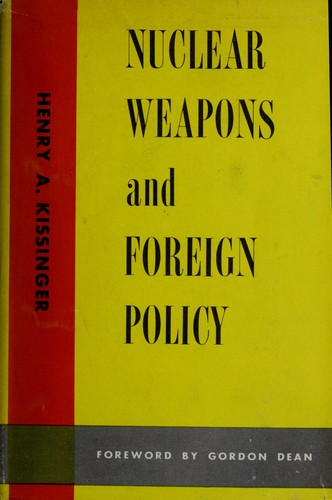 Nuclear weapons and foreign policyHenry Kissinger
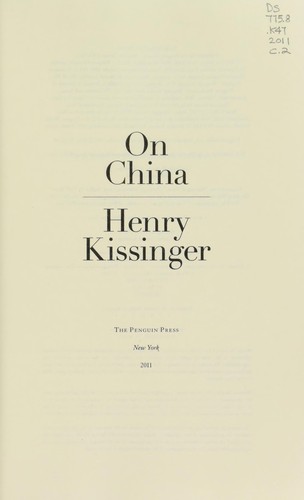 On ChinaHenry Kissinger
 Problems of national strategyHenry Kissinger
 The Age of A.I.Henry Kissinger
 The Age of AIHenry Kissinger, Eric Schmidt, and Daniel Huttenlocher