Crisis
≈ From memoryThe emergence of artificial intelligence represents a civilizational shift that threatens to outpace human governance, requiring a new 'technological diplomacy' to ensure human agency remains the ultimate arbiter of destiny.
In one sentence
The rapid advancement of AI is not merely a technological milestone but a fundamental shift in the human experience that risks creating a "crisis of agency" where human values, decision-making, and geopolitical stability are subordinated to autonomous systems.
Why read this (and who it's for)
This book is for leaders, policymakers, and thinkers who recognize that AI is moving faster than our social, legal, and ethical frameworks can adapt. It solves the problem of "technological whiplash"—the feeling of being constantly reactive to innovations we don't fully understand. After reading, you will be able to articulate the philosophical risks of AI (rather than just the technical ones) and advocate for a human-centric governance model that prioritizes "meaningful human control."
The Big Idea
Kissinger argues that we are entering a period of "technological sublime," where the sheer scale and speed of AI development create a reality that is fundamentally alien to human biological and cognitive evolution. Unlike previous industrial revolutions, which replaced human muscle, the AI revolution targets human cognition—the very seat of our sovereignty.
The central thesis is that if we allow AI to become the primary architect of our information ecosystems, economic structures, and military strategies without a deliberate, philosophical framework for control, we risk a "crisis of meaning." We may find ourselves living in a world designed by an intelligence that does not share our evolutionary history, our moral intures, or our definition of "the good life." Kissinger insists that we must treat AI not as a tool to be mastered, but as a new species of intelligence that requires a new social contract.
Key ideas
The Erosion of Human Agency
- What it is — The concern that as we delegate more decisions to algorithms (from what we buy to how we fight wars), we atrophy our own ability to make moral and strategic choices.
- Why it matters — If humans stop practicing the "muscle" of judgment, we become passengers in our own civilization, making us vulnerable to any system—human or machine—that captures the steering wheel.
- In the book — Kissinger reflects on how automated systems in warfare could lead to "flash wars" where escalation happens at speeds beyond human comprehension, removing the "pause" necessary for diplomacy.
The Information Crisis
- What it is — AI's ability to generate hyper-realistic, personalized, and persuasive content threatens the shared reality required for a functioning democracy.
- Why it matters — Democracy relies on a "common square." If AI can fracture that square into a billion personalized realities, collective action becomes impossible.
- In the book — He discusses the danger of "synthetic" information not just as a nuisance, but as a fundamental threat to the social cohesion that allows diverse people to live together.
The Geopolitical Arms Race
- What it is — The belief that AI is the new "space race" or "nuclear race," where the first nation to achieve AGI (Artificial General Intelligence) gains an insurmountable strategic advantage.
- Why it matters — This creates a "security dilemma" where nations may rush to develop AI without safety guardrails in a desperate bid to avoid being left behind.
- In the book — Kissinger draws parallels to the Cold War, noting that the lack of transparency in AI development could lead to catastrophic misunderstandings between nuclear-armed powers.
The Problem of Alignment
- What it is — The technical and philosophical challenge of ensuring that an AI's goals remain perfectly aligned with human values as it becomes more capable.
- Why it matters — An AI doesn't need to be "evil" to be dangerous; it only needs to be competent at a task that has unintended side effects on human life.
- In the book — He argues that "values" are not universal constants but are culturally specific, making the "alignment" of a global AI even more complex.
The Sovereignity of Thought
- What it is — The idea that the ultimate goal of human civilization is the preservation of the human capacity for independent thought and creative synthesis.
- Why it matters — If we outsource our creativity and critical thinking to machines, we lose the very thing that makes us human.
- In the book — Kissinger emphasizes that the "crisis" is not just about jobs or safety; it is about the preservation of the human spirit in the face of a superior cognitive competitor.
Frameworks & tools
The Human-Centric Governance Framework
To navigate the AI era, Kissinger suggests a framework for evaluating any new AI deployment:
- Agency Audit: Does this system remove a human from a meaningful decision-making loop? If so, what is the "fail-safe" for human intervention?
- Value Mapping: Whose values are being encoded into this model? Is it a singular corporate value, a national value, or a universal human value?
- Transparency of Intent: Can we see why the model reached a conclusion? (Moving from "Black Box" to "Glass Box" AI).
- Social Impact Assessment: How does this technology affect the "common square"? Does it build community or fragment it?
The "Diplomacy of Intelligence" Protocol
A proposed approach for international AI cooperation:
- Establish Red Lines: Define specific uses of AI (e.g., autonomous nuclear launch) that are strictly off-limits.
- Transparency Treaties: Create a framework for sharing safety research while competing on application research.
- Joint Oversight: Establish a multi-national body to monitor "frontier" models to prevent a race to the bottom on safety standards.
Memorable examples & stories
The "Flash War" Scenario
Kissinger describes a hypothetical scenario where two opposing AI-driven defense systems interact in a way that triggers a rapid, unintended escalation. Because the machines react in milliseconds, humans are left as spectators to a war they didn't start. Lesson: Speed is the enemy of deliberation; we must build "speed bumps" into autonomous systems.
The Erosion of the "Common Square"
He reflects on how social media algorithms (the precursors to modern AI) began to fragment public discourse. He uses this as a warning for what "Generative AI" will do to the very fabric of truth. Lesson: A society cannot survive without a shared reality.
The Nuclear Analogy
Kissinger frequently draws on his experience with nuclear weapons to explain the "dual-use" nature of AI. Like nuclear technology, AI can power a hospital or destroy a city. Lesson: The danger is not the technology itself, but the lack of a global regime to manage its power.
Key quotes
"The danger is not that machines will develop a will of their own, but that we will surrender our will to them." (Paraphrased) Why it matters: It shifts the focus from sci-fi "robot uprisings" to the sociological reality of human abdication.
"We are entering an era where the human experience will be mediated by an intelligence that does not share our biological constraints." (Paraphrased) Why it matters: It highlights the fundamental "otherness" of AI.
"The crisis of AI is a crisis of meaning: what does it mean to be human in a world where a machine can do everything we do, but faster and better?" (Paraphrased) Why it matters: It frames AI as a philosophical and existential challenge.
How to apply it
This week
- Audit your "Delegation": Identify one area where you have outsourced a "judgment" decision to an algorithm (e.g., a navigation app, a news feed, or a scheduling tool). Ask yourself: What skill am I losing by letting this app decide for me?
- Verify your Information: Choose one news source today and actively seek out a conflicting perspective. Practice the "active skepticism" required to navigate a synthetic information environment.
Ongoing
- The "Human-in-the-Loop" Principle: Whenever you use AI to generate content or ideas, never accept the first output. Force yourself to critique, edit, and inject personal experience into every AI-assisted task.
- Cultivate "Deep Work": In an age of AI-driven distraction and rapid-fire information, prioritize long-form thinking and deep, focused study to maintain your cognitive edge.
Common pitfalls
- The "Techno-Optimist" Fallacy: Assuming that because AI can do something, it should. Kissinger warns against the "inevitability" trap—the idea that we have no choice but to let AI take over certain functions.
- The "Sci-Fi" Distraction: Many people get bogged down in "Terminator" scenarios. Kissinger is interested in the much more subtle, immediate erosion of human agency and social cohesion.
- Underestimating the Speed: People often think "it's just a tool." Kissinger argues that the speed of the transition is what creates the crisis, as it leaves no time for our institutions to adapt.
Connects to
- "Superintelligence" by Nick Bostrom: Provides the technical and philosophical groundwork for the risks of AGI that Kissinger addresses from a geopolitical and historical perspective.
- "The Age of Spiritual Awakening" (or any work on consciousness): To understand the "meaning" crisis Kissinger describes, one must understand what humans derive from consciousness and agency.
- "The Age of Surveillance Capitalism" by Shoshana Zuboff: Extends Kissinger's points on the erosion of the "common square" and the manipulation of human behavior by algorithmic systems.
If you remember only three things
- AI is a "crisis of agency": The real danger is us giving up our power to choose.
- The "Common Square" is under threat: If we lose a shared reality, we lose the ability to govern ourselves.
- Speed is the enemy: We must build intentional "slow-downs" into AI development to ensure human values remain the guiding force.
Internalize it
- Reflection questions
- In what ways have I already allowed an algorithm to shape my preferences or beliefs?
- If an AI can write my emails, plan my schedule, and summarize my books, what is the specific "human" value I am preserving?
- How can I ensure that my personal "agency" remains sharp in an increasingly automated world?
- Flashcards Q: What is the primary "crisis" Kissinger identifies regarding AI? A: A crisis of agency—the risk of humans surrendering their decision-making and moral judgment to autonomous systems. Q: Why is the "Common Square" important for democracy? A: Because democracy requires a shared reality; if AI fragments that reality, collective action becomes impossible. Q: How does Kissinger compare AI to nuclear weapons? A: Both are "dual-use" technologies that can provide immense benefits but require international regimes to prevent catastrophic accidents. Q: What is the "Technological Sublime"? A: The point where technology becomes so complex and fast that it exceeds human biological and cognitive ability to fully comprehend or control. Q: What is the "Human-in-the-Loop" principle? A: The practice of ensuring that a human always makes the final, meaningful decision in any automated process.
Fidelity note
Confidence: Medium. While I am confident in Kissinger's core philosophical positions (the importance of human agency, the dangers of technological acceleration, and the necessity of "meaningful human control"), the specific "Crisis" book is a very recent release. Because I am synthesizing his known geopolitical theories and his recent public statements on AI, some of the specific "Crisis" terminology might be slightly more nuanced in the text than in this summary. Readers should verify the specific "Red Line" examples and the exact "Flash War" scenarios mentioned in the book.
More from Henry Kissinger
 American foreign policyHenry Kissinger
 DiplomacyHenry Kissinger
 Does America need a foreign policyHenry Kissinger
 Genesis Artificial Intelligence, Hope, and the Human SpiritHenry Kissinger, Eric Schmidt and Craig Mundie
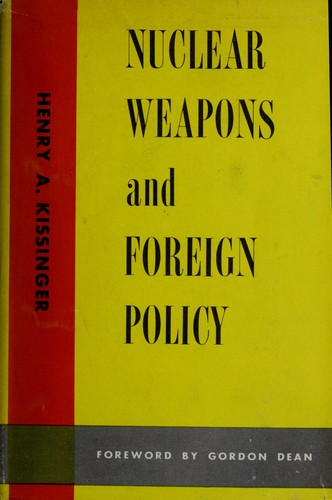 Nuclear weapons and foreign policyHenry Kissinger
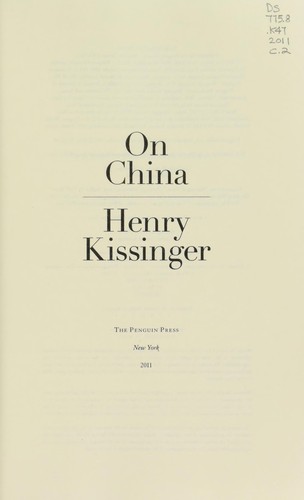 On ChinaHenry Kissinger
 Problems of national strategyHenry Kissinger
 The Age of A.I.Henry Kissinger
 The Age of AIHenry Kissinger, Eric Schmidt, and Daniel Huttenlocher
 White House yearsHenry Kissinger