Diplomacy
≈ From memoryDiplomacy is the art of managing the inevitable friction between sovereign states by balancing power, understanding historical legacies, and acknowledging that there is no permanent moral order in international relations.
In one sentence
True diplomacy is not the pursuit of a utopian global harmony, but the pragmatic management of competing interests and the preservation of a balance of power to prevent catastrophic conflict.
Why read this (for who it's for)
This book is for anyone who wants to understand why the world behaves the way it does. It solves the problem of "naive idealism"—the belief that if we just explain our values clearly enough, everyone will agree. Kissinger argues that nations act based on security, geography, and history. After reading this, you will be able to look at a modern conflict (like the South China Sea or Ukraine) and see the underlying structural pressures—the "realpolitik"—that drive the actors involved.
The big ideas
Kissinger argues that the international system is fundamentally anarchic. Because there is no world government to enforce laws, states must rely on a "Balance of Power." This is not a cynical view; it is a recognition of reality. Stability is maintained when no single power can dominate the others, and when the costs of aggression outweigh the benefits of expansion.
The core of the book is the interplay between Geopolitics (the physical reality of land, sea, and resources) and History (the cultural and psychological legacies of past empires). A country’s behavior is dictated by its "security dilemma": when one state builds up its defenses, its neighbor feels unsafe and builds up its own, creating a spiral of tension. Diplomacy is the craft of slowing that spiral and finding "equilibrium" points where both sides can coexist without total war.
Key ideas
The Balance of Power
- What it is: The principle that peace is maintained when the distribution of power among nations is such that no single state can dominate the others.
- Why it matters: If you ignore the balance of power, you assume that "good" intentions will stop a country from seeking security. In reality, a state that feels insecure will act aggressively regardless of its stated morality.
- In the book: Kissinger discusses the "Concert of Europe" after the Napoleonic Wars, where a balance of power was established to prevent any one nation from dominating the continent.
The Security Dilemma
- What it is: A situation where a state's efforts to increase its own security (e.g., building a military) are perceived by others as threats, leading to a counter-response that makes the original state less secure.
- Why it matters: It explains why even "peace-loving" nations can end up in arms races. It forces you to realize that intentions are often invisible; only actions (capabilities) are visible.
- In the book: He illustrates this through the Cold War, where the US and USSR were locked in a cycle of defensive buildup that created a perpetual state of high-alert tension.
Realpolitik vs. Idealism
- What it is: Realpolitik is the pursuit of national interest based on power and practical considerations; Idealism is the pursuit of a world based on universal values and moral principles.
- Why it matters: While values are important, Kissinger argues that a leader who ignores the reality of power in favor of pure ideals will likely lead their country into disastrous wars.
- In the book: He contrasts the "moral" goals of the League of Nations with the pragmatic, often brutal, necessities of the balance of power that actually kept Europe stable for a time.
The Importance of Geography
- What it is: Geography is the "destiny" of a nation. Mountains, rivers, and oceans dictate where a country can expand, how it can defend itself, and who its neighbors will be.
- Why it matters: You cannot understand a nation's foreign policy without understanding its physical borders. Geography creates "hard" constraints that even the most modern technology cannot fully erase.
- In the book: Kissinger analyzes how the "Heartland" of Eurasia and the importance of the Mediterranean have dictated centuries of conflict.
The Role of History and Culture
- What it is: History is not just a list of dates; it is the "collective memory" of a people that shapes their perceptions of what is possible and what is permissible.
- Why it matters: A nation’s identity—its sense of pride, its fears of invasion, and its historical grievances—determines its "red lines." Diplomacy fails when you ignore the cultural psyche of the other side.
- In the book: He explores how the German sense of "Lebensraum" and the Russian fear of invasion shaped the brutal dynamics of the 20th century.
Frameworks & tools
The Balance of Power Assessment
When evaluating a geopolitical situation, use this checklist to determine the stability of a region:
- Identify the Hegemon: Who currently holds the most power in this region?
- Identify the Challengers: Who is actively seeking to displace that power?
- Assess the "Buffer States": Are there smaller nations that act as a cushion between the powers?
- Determine the "Cost of Conflict": If a war breaks out, who wins? Is the victory worth the destruction?
- Find the Equilibrium: What concessions would allow both sides to feel secure without surrendering their core interests?
The Security Dilemma Analysis
To understand why a country is acting "aggressively," ask:
- What is the perceived threat? (What does this country fear?)
- What is the "Defensive" justification? (How are they framing their actions to their own people?)
- What is the "Offensive" capability? (What can they actually do?)
- The Communication Gap: How can we communicate that our actions are defensive, not offensive, to reduce the other side's fear?
Memorable examples & stories
The Treaty of Westphalia (1648)
Kissinger describes how this treaty established the concept of "sovereign states"—the idea that each nation has exclusive authority over its own territory. Lesson: The modern world order is built on the recognition of borders; violating a border is the ultimate violation of the international order.
The Balance of Power in the 19th Century
He details how the "Great Powers" (Britain, France, Russia, Prussia, Austria) managed to avoid a general European war for a century by constantly shifting alliances. Lesson: Stability is often a result of a delicate, shifting equilibrium, not a permanent peace treaty.
The Cold War Dynamics
Kissinger analyzes the "containment" of the Soviet Union and the "detente" period, explaining how the US had to manage the balance of power in Europe and Asia simultaneously. Lesson: Diplomacy is often about managing competing priorities where there is no "perfect" solution, only a "least-bad" one.
Key quotes
"The primary purpose of diplomacy is to prevent war." (Paraphrased) Why it matters: Diplomacy is not about making friends; it is about managing the friction of competing interests to ensure survival.
"History is a continuous process of interaction between the past and the present." (Paraphrased) Why it matters: You cannot understand a country's current actions without knowing what they were taught to fear or celebrate in their history books.
"The balance of power is the only thing that has ever provided a lasting peace in a world of competing interests." (Paraphrased) Why it matters: It rejects the idea that "international law" alone can stop a determined power from seeking security.
How to apply it
This week
- Map your "Security Dilemma": Identify a recurring conflict in your personal life (e.g., a coworker who over-communicates because they fear being ignored). Analyze what they are trying to protect and how your reaction reinforces their fear.
- Geographic Awareness: Look at a map of a current news conflict (e.g., Taiwan Strait). Identify the physical geography (water, islands, straits) and explain how those features make the conflict harder to resolve.
Ongoing
- The "Realpolitik" Filter: When reading news about international relations, ask: "What is this country's security interest here?" instead of "Who is right/wrong?"
- Historical Contextualization: Before forming an opinion on a country's actions, spend 10 minutes researching their historical grievances regarding that specific territory or issue.
Common pitfalls
- The "Moralist" Trap: Many readers assume Kissinger is "pro-war" or "anti-peace." He is actually "pro-realism." He argues that ignoring reality leads to more war.
- Over-reliance on "Values": People often think that if we just promote democracy and human rights, the world will be safe. Kissinger warns that while these are noble, they do not provide security if they are not backed by a balance of power.
- Static Thinking: A common mistake is thinking a "balance" is a permanent state. It is a dynamic, constantly shifting equilibrium that requires constant adjustment.
Connects to
- "The Tragedy of and other essays" by Robert Jervis: Explores the psychological roots of the Security Dilemma.
- "The Grand Strategy of China" by various: Extends Kissinger's geographic and historical analysis to the modern rise of China.
- "Why Nations Fail" by Acemoglu and Robinson: Provides the economic counterpoint to Kissinger's geopolitical focus.
If you remember only three things
- The Balance of Power: Peace is maintained when no single power can dominate others.
- The Security Dilemma: Actions taken for defense are often perceived as threats, creating a cycle of escalation.
- Geography is Destiny: Physical reality (mountains, oceans, resources) dictates the limits of what a nation can achieve.
Internalize it
-
Reflection questions
-
If you were a leader of a country with a small population but a massive military, how would you manage your neighbors' fears?
-
How does the "Security Dilemma" apply to your professional relationships? How can you signal "non-threatening" intent?
-
When looking at a global conflict, what is the "geographic" reality that makes a peaceful resolution difficult?
-
Flashcards Q: What is the "Security Dilemma"? A: A situation where one state's efforts to increase its security (like building a military) lead other states to feel less secure, causing them to respond with their own buildup.
Q: What is the primary purpose of the "Balance of Power"? A: To ensure that no single nation becomes so powerful that it can dominate the others, thereby preventing large-scale war.
Q: Why is geography considered "destiny" in Kissinger's view? A: Because physical features like mountains, seas, and resources create permanent constraints on a nation's power and security.
Q: How does Kissinger distinguish between Realpolitik and Idealism? A: Realpolitik is based on power and practical interests; Idealism is based on moral principles and universal values.
Q: What is the role of history in diplomacy? A: History provides the "collective memory" and cultural identity that shapes a nation's perceptions of what is necessary for its survival.
Fidelity note
This summary is based on a high-level synthesis of Kissinger's "Diplomacy" (1994). I am highly confident in the core concepts of the Balance of Power, the Security Dilemma, and the role of Geography. Because the book is a dense historical narrative, some specific dates or minor diplomatic nuances may be generalized for the sake of clarity. Readers should verify specific historical dates regarding the Treaty of Westphalia and the Concert of Europe in the text.
More from Henry Kissinger
 American foreign policyHenry Kissinger
 CrisisHenry Kissinger
 Does America need a foreign policyHenry Kissinger
 Genesis Artificial Intelligence, Hope, and the Human SpiritHenry Kissinger, Eric Schmidt and Craig Mundie
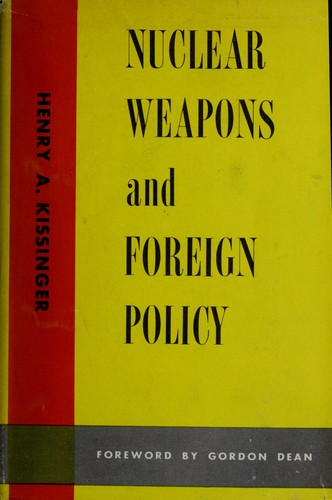 Nuclear weapons and foreign policyHenry Kissinger
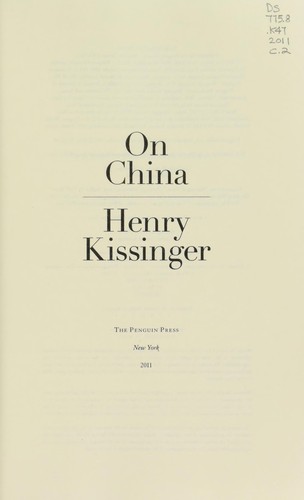 On ChinaHenry Kissinger
 Problems of national strategyHenry Kissinger
 The Age of A.I.Henry Kissinger
 The Age of AIHenry Kissinger, Eric Schmidt, and Daniel Huttenlocher
 White House yearsHenry Kissinger