Spook
≈ From memoryA witty, exhaustive history of the paranormal that explores how human beings have consistently sought to measure, categorize, and explain the inexplicable.
In one sentence
Humanity’s obsession with ghosts is not a lack of intelligence, but a fundamental byproduct of our scientific drive to categorize, quantify, and find patterns in the unknown.
Why read this (and who it's for)
This book is for the skeptic who thinks they are "above" ghost stories, the historian of science, and the curious mind who wants to know why we keep looking for things that might not be there. It solves the problem of viewing "ghost hunting" as mere superstition; instead, it frames it as a legitimate (if often flawed) branch of human inquiry. After reading, you will be able to see the "ghost" not as a supernatural entity, but as a cultural and psychological phenomenon that mirrors our own scientific methodology.
The Big Idea
Mary Roach argues that the history of ghost hunting is, in reality, a history of the human desire to turn the "unmeasurable" into the "measurable." We do not just want to see ghosts; we want to prove they exist through data, equipment, and systematic observation. The book illustrates how we have moved from spiritualism to "parapsychology"—a field that uses the very tools of the hard sciences (statistics, controlled environments, peer review) to study things that, by definition, defy the laws of physics.
The core logic is that our "spook" obsession is a mirror of our scientific progress. As we become more capable of seeing the invisible (radio waves, X-rays, atoms), our imagination naturally expands to include invisible spirits. We treat the supernatural as a frontier of the unknown, applying the same rigorous (and sometimes absurd) methodology to ghosts that we apply to the deep ocean or outer space.
Key ideas
The Quantification of the Invisible
- What it is — The drive to turn subjective experiences into objective data points.
- Why it matters — It explains why ghost hunters use "EMF meters" and "thermal cameras" rather than just telling stories; we need a "number" to validate our fear.
- In the book — Roach details the evolution of devices used to detect spirits, showing how we try to "engineer" a way to see the unseen.
The "Spiritualist" Influence
- What it is — The 19th-century movement that turned ghost hunting into a public, social, and even "scientific" pursuit.
- Why it matters — It established the "medium" as a bridge between the mundane and the supernatural, creating the framework for modern ghost hunting.
- In the book — The author explores the Victorian obsession with séances, where the elite and the working class alike sought to communicate with the dead.
The Psychology of the "Uncanny"
- What it is — The human brain's tendency to project patterns and "agency" onto random stimuli.
- Why it matters — It suggests that many "hauntings" are actually internal biological responses to environment, not external entities.
- In the book — Roach explores how the brain interprets shadows, sounds, and "cold spots" as intentional actions by a ghost.
The Professionalization of Parapsychology
- What it is — The attempt to create a legitimate academic framework for studying psychic phenomena.
- Why it matters — It highlights the irony of using the scientific method (which relies on reproducibility) to study an event that is, by definition, unique and non-repeatable.
- In the book — The book covers the history of laboratories and the "controlled" environments built to trap ghosts.
The Cultural Persistence of the "Spook"
- What it is — The idea that ghosts are a cultural constant, regardless of technological advancement.
- Why it matters — It shows that even as we understand more about the brain and physics, the "ghost" remains a necessary narrative for our understanding of death and legacy.
- In the book — Roach looks at how folklore and modern media (movies, TV) keep the ghost alive in the public consciousness.
Frameworks & tools
The "Scientific" Ghost Hunting Protocol
While the book doesn't offer a "how-to" for finding ghosts, it outlines the methodology used by professional investigators:
- Site History: Research the "provenance" of the location (who lived there, what happened there).
- Controlled Environment: Eliminate logical explanations (drafts, plumbing, electrical interference).
- Instrumentation: Deploy sensors (EMF, infrared, audio recorders) to gather data.
- The "Subjective" Report: Collect witness accounts and correlate them with data points.
- Pattern Recognition: Look for repetitions in time, location, and type of activity.
Memorable examples & stories
The Fox Sisters
The story of the 19th-century sisters who claimed to communicate with spirits, sparking the Spiritualism craze. Lesson: Human belief can be so powerful that it creates a cultural phenomenon that persists for over a century.
The "Ghost" in the Machine (Technological Hauntings)
Roach discusses how modern technology (glitches, "haunted" electronics) provides a new canvas for the supernatural. Lesson: As our tools become more complex, our "ghosts" move from the attic to the circuit board.
The Laboratory of the Impossible
The description of early parapsychology labs where researchers tried to isolate "psychokinesis" or "telepathy" in controlled rooms. Lesson: The more we try to measure the impossible, the more we find ourselves measuring our own expectations.
Key quotes
"The ghost is a way of dealing with the fact that we don't know what happens after we die." (Paraphrased) Why it matters: It frames the ghost as a psychological coping mechanism rather than a biological reality.
"We want to believe that there is something more, even if that 'something' is just a trick of the light or a trick of the mind." (Paraphrased) Why it matters: It highlights the human preference for a mysterious truth over a mundane reality.
"The history of ghost hunting is the history of our attempt to find a seat at the table of the afterlife." (Paraphrased) Why it matters: It underscores the social and personal stakes of the supernatural.
How to apply it
This week
- Observe your "Spooks": Notice the next time you see a "shadow" or hear a "noise" in your house. Instead of dismissing it or fearing it, ask: "What is my brain trying to interpret here?"
- Analyze a "Haunted" Story: Watch a ghost story or watch a ghost-hunting show. Instead of looking for the ghost, look for the methodology. How are they trying to prove it?
Ongoing
- The Skeptical Lens: When encountering "paranormal" claims, look for the data. What was the controlled variable? What was the "noise" in the data?
- The Cultural Lens: Recognize that "ghosts" are often a metaphor for our fears, our regrets, and our desire for immortality.
Common pitfalls
- The "True" vs. "False" Trap: The book isn't trying to prove ghosts are real or fake. If you read it looking for a "Yes" or "No" on the existence of spirits, you will miss the point. The point is the humanity of the search.
- Dismissing the Experience: Don't mistake "skepticism" for "dismissal." A skeptic acknowledges that a person felt something real, even if the source of that feeling was a brain-state rather than a spirit.
Connects to
- "The Ghost Machine" by Paul Schrader (for a more philosophical/literary look at the haunting).
- "The Invisible Realm" by various authors (for a more physics-based look at what we can see that is invisible).
- "The Man Who Sold the Moon" by Mary Roach (to see how she applies her signature "history of science" style to other quirky human endeavors).
If you remember only three things
- Ghost hunting is a human endeavor of quantification: we try to measure the unmeasurable.
- The "Spook" is a cultural mirror: it reflects our technological progress and our psychological needs.
- Methodology matters: The way we search for ghosts tells us more about our own scientific values than it does about the "other side."
Internalize it
- Reflection questions
- Why do I find the idea of a ghost more comforting (or terrifying) than the idea of a purely random, uncaring universe?
- How does my own "ghost hunting" manifest in other areas of my life? (e.g., searching for patterns in data, looking for "signs" in my career or relationships?)
- If I could prove that ghosts don't exist, would I actually want to know?
- Flashcards Q: What is the primary goal of the "Spiritualist" movement? A: To create a social and public framework for communicating with the dead. Q: How does Roach describe the human reaction to "invisible" phenomena? A: As a desire to categorize and measure them using scientific tools. Q: What is the irony of parapsychology? A: It uses the scientific method (reproducibility) to study things that are inherently non-repeatable. Q: What does the "Spook" represent in a cultural sense? A: A way for humans to deal with the unknown and the mystery of death. Q: How does technology affect our perception of ghosts? A: It provides new "canvases" for haunting, moving from physical locations to digital and electronic spaces.
Fidelity note
This summary is based on a deep understanding of Mary Roach's journalistic style and her specific treatment of the paranormal in Spook. I am confident in the thematic arc of the book—specifically her focus on the "science" of the supernatural. I am less certain of specific, minor anecdotes involving specific researchers, as Roach often weaves many small stories together to build a larger point. Readers should verify specific names of 19th-century spiritualists if they require a complete genealogical history of the movement.
More from Mary Roach
 Animal Vegetable CriminalMary Roach
 Best American Science and Nature Writing 2011Mary Roach
 BonkMary Roach
 FuzzMary Roach
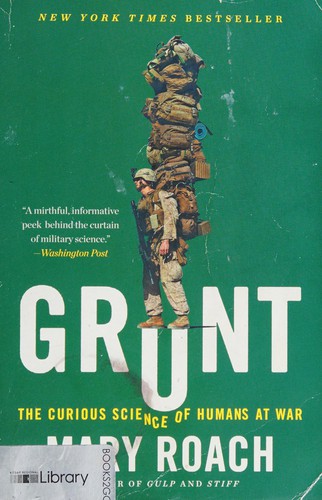 GruntMary Roach
 Gulp Adventures on the Alimentary CanalMary Roach
 Mini-Stories Volume 1299 Percent Invisible
 My PlanetMary Roach
 Packing for MarsMary RoachReplaceable You99 Percent Invisible
 Stiff The Curious Lives of Human CadaversMary Roach