Packing for Mars
≈ From memorySpace exploration is less about the glamour of the cosmos and more about the grueling, unglamorous, and often bizarre logistics of keeping humans alive in a vacuum.
In one sentence
Space travel is a triumph of engineering over biology, requiring us to turn the human body into a manageable cargo and the environment into a life-support system.
Why read this (and who it's for)
This book strips away the "Star Wars" mythology of space travel to reveal the gritty, logistical reality of aerospace engineering. It is for anyone who wants to understand the sheer scale of the problems involved in interplanetary travel—from the physics of radiation to the psychology of isolation. After reading, you will be able to view space exploration not as a series of "cool" gadgets, but as a complex, interconnected web of life-support systems where a single failure in a plumbing line or a calorie count can mean death.
The big idea
Mary Roach argues that the greatest hurdle to becoming a multi-planetary species isn't just "getting there"—it's "staying there." While we often focus on the propulsion systems (the rockets), the real challenge lies in the biological maintenance of the human body in an environment that is fundamentally hostile to life. To survive on Mars, we have to solve the problems of gravity, radiation, waste management, and psychological endurance.
The logic of the book follows a "systems" approach: every problem in space is interconnected. If you solve the problem of food, you create a waste problem. If you solve the waste problem, you create a microbial growth problem. Space travel is the ultimate engineering challenge because it requires a closed-loop system where every output must be an input for something else. Roach illustrates that the "romance" of space is actually a masterpiece of mundane, high-stakes logistics.
Key ideas
The Tyranny of Weight
- What it is — Every ounce of weight added to a spacecraft requires exponentially more fuel to lift, creating a brutal constraint on what can be taken into orbit.
- Why it matters — This forces engineers to prioritize "multi-purpose" designs where every component must serve at least two functions (e.g., a chair that is also a storage unit).
- In the book — Roach details the agonizing decisions regarding what to pack for a Mars mission, where even the amount of water and oxygen must be calculated to the smallest possible margin.
The Biological Cost of Microgravity
- What it is — The human body is designed for 1g of gravity; in orbit, muscles atrophy, bones demineralize, and fluids shift toward the head.
- Why it matters — Long-duration spaceflight isn't just a physical challenge; it's a physiological degradation that can lead to permanent disability if not managed.
- In the book — The author describes the "Space Adaptation Syndrome" and the grueling exercise regimens astronauts must undergo just to keep their bones from becoming brittle like glass.
The Radiation Barrier
- What it is — Beyond the Earth's magnetic field, astronauts are bombarded by galactic cosmic rays and solar particles that can damage DNA and cause cancer.
- Why it matters — Unlike a vacuum or a lack of oxygen, radiation is an invisible, cumulative threat that makes long-duration missions to Mars potentially lethal.
- In the book — Roach explores the difficulty of shielding—how do you block high-energy particles without adding so much weight that the ship can't lift off?
The Closed-Loop Life Support System
- What it is — On Earth, we have an infinite "sink" for waste and an infinite "source" for resources. In space, you must recycle everything: air, water, and even nutrients.
- Why it matters — Success depends on creating a "bioregenerative" system where human waste becomes plant food, and plants provide oxygen and calories.
- In the book — The book explores the "urine-to-water" conversion systems and the sheer complexity of maintaining a balanced ecosystem in a sealed tin can.
The Psychology of Confinement
- What it is — The "Human Factor" involves the mental strain of living in a cramped, high-stress environment with the same few people for months on end.
- Why it matters — Technical perfection is useless if the crew suffers a psychological breakdown; social cohesion is a survival requirement.
- In the book — Roach looks at the "ICE" (Isolated, Confined, Extreme) environments, comparing space to submarines and Antarctic research stations.
Frameworks & tools
The "Closed-Loop" Engineering Checklist
When designing any complex, isolated system (like a space station or a remote research base), use this logic to ensure sustainability:
- Input Identification: What does the system need to survive? (Oxygen, Water, Calories, Information).
- Waste Mapping: What does the system produce as a byproduct? (CO2, Urine, Solid Waste, Heat).
- Conversion Analysis: Can the waste be converted back into an input? (Can we turn CO2 into O2? Can we turn waste into fertilizer?).
- Redundancy Check: If the conversion loop fails, is there a backup supply?
- Human Factor Integration: How does the environment affect the operator's mental state?
Memorable examples & stories
The "Space Toilet" Evolution
Roach describes the evolution of the space toilet from a simple "bag" system to complex urine-processing machines. Lesson: Even the most mundane human functions become high-stakes engineering problems when you remove the "infinite" resources of Earth.
The "Moon Walk" Logistics
The author recounts the sheer amount of equipment required for a simple moon walk, highlighting how much of the "science" is actually "logistics." Lesson: Innovation is often just the ability to organize complex logistics under extreme constraints.
The "Mars Greenhouse" Concept
The exploration of how plants could be grown in space to provide both food and psychological relief. Lesson: Survival in space requires a "living" system, not just a mechanical one; we need a biological tether to Earth.
Key quotes
"Space travel is a triumph of engineering over biology." (Paraphrased) Why it matters: It frames the entire book—we are forcing our bodies to do things they weren't evolved to do.
"The biggest challenge isn't the rocket; it's the life support." (Paraphrased) Why it matters: It shifts the focus from the 'cool' tech to the 'hard' science of survival.
"In space, every gram of weight is a luxury." (Paraphrased) Why it matters: It highlights the brutal economy of orbital mechanics.
How to apply it
This week
- The "Waste Audit": Look at a routine process in your work or home. Identify what "waste" it produces (time, energy, materials). Can that waste be repurposed as an input for another part of the process?
- The "Weight Audit": Identify one thing you do daily that is "heavy" (time-consuming or resource-heavy) but offers little value. How can you "lighten" the load?
Ongoing
- Systems Thinking: When faced with a problem, stop looking for a "quick fix." Instead, ask: "If I fix this here, what new problem does it create downstream?"
- Constraint-Based Creativity: When designing a solution, intentionally impose a "weight" or "resource" limit. How does that constraint force a more elegant, multi-purpose design?
Common pitfalls
- The "Hollywood" Fallacy: Many readers expect the book to be about aliens or futuristic lasers. It is not. It is about plumbing, chemistry, and biology.
- Underestimating the "Human Factor": People often think the hardest part is the physics. Roach argues that the psychological toll of isolation is just as much of a "system" failure risk.
- Overestimating Current Capability: While the book is optimistic about our ability to go to Mars, it is realistic about how hard it will be. Don't mistake "possible" for "easy."
Connects to
- "The Martian" by Andy Weir: While Roach provides the realistic logistical foundation, Weir provides the narrative dramatization of those same logistical problems.
- "Apollo's Odyssey" by Eric Boehler: For a deeper dive into the historical engineering of the moon landings.
- Systems Theory: The underlying logic of the book is a perfect application of systems thinking to biological environments.
If you remember only three things
- Space travel is a closed-loop system problem: everything must be recycled.
- Weight is the ultimate enemy of space exploration; it dictates every design choice.
- The human body is the most difficult piece of equipment to maintain in a vacuum.
Internalize it
-
Reflection questions
- If you were forced to live in a sealed environment for 6 months, what would be your "non-negotiable" psychological requirement?
- In your current project, what is the "waste" byproduct you are currently ignoring?
- How does the "Tyranny of Weight" apply to your personal habits? What are you carrying that you don't need?
-
Flashcards Q: What is the "Tyranny of Weight"? A: The principle that every pound of mass added to a spacecraft requires exponentially more fuel to launch, forcing multi-purpose designs.
Q: Why is the human body difficult to maintain in space? A: Because it is evolved for 1g of gravity; in microgravity, muscles atrophy, bones demineralize, and fluids shift.
Q: What is the primary goal of a "closed-loop" life support system? A: To recycle all outputs (waste, CO2, urine) into inputs (oxygen, water, nutrients) to ensure sustainability.
Q: What is the "Human Factor" in space exploration? A: The psychological and social challenges of living in an Isolated, Confined, and Extreme (ICE) environment.
Q: What is the primary radiation threat in deep space? A: Galactic cosmic rays and solar particles that can damage DNA and cause cancer.
Fidelity note
I am highly confident in the core themes of this summary (the "Systems" approach, the Tyranny of Weight, and the Biological/Psychological challenges). Mary Roach is known for her "dry" humor and focus on the mundane details of space. However, because this is a summary of a non-fiction narrative, specific "anecdotes" may vary in their exact phrasing. The "Closed-Loop" framework is a synthesis of the book's logistical arguments rather than a literal numbered list provided by Roach.
More from Mary Roach
 Animal Vegetable CriminalMary Roach
 Best American Science and Nature Writing 2011Mary Roach
 BonkMary Roach
 FuzzMary Roach
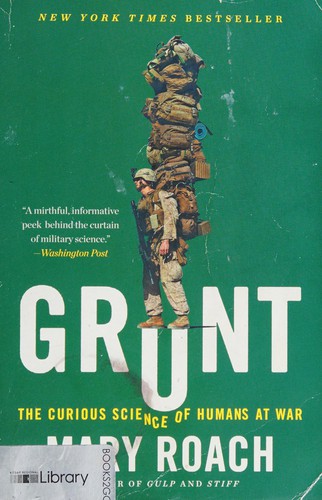 GruntMary Roach
 Gulp Adventures on the Alimentary CanalMary Roach
 Mini-Stories Volume 1299 Percent Invisible
 My PlanetMary RoachReplaceable You99 Percent Invisible
 SpookMary Roach
 Stiff The Curious Lives of Human CadaversMary Roach