The philosophy of existentialism
≈ From memoryExistence precedes essence: humans are not born with a purpose, but must create themselves through continuous, unburdened choice.
In one sentence
Human beings are radically free, lacking any pre-determined blueprint or divine purpose, which means we are entirely responsible for what we become through the choices we make.
Why read this (and who it's for)
This is for anyone who feels paralyzed by the weight of choice, the "crisis of meaning," or the feeling that life is a series of arbitrary actions. Sartre solves the problem of moral vertigo—the anxiety we feel when we realize there is no rulebook for life. After reading this, you will be able to identify "Bad Faith" in your own life (the excuses you make to avoid responsibility) and move toward an authentic existence where you own your actions without hiding behind social roles or biological determinism.
The big idea
Sartre argues that for human beings, existence precedes essence. To understand this, look at a manufactured object, like a letter opener. Before it was made, the creator had a concept of it (an essence). It was designed for a purpose. However, a human being appears on the scene, exists, and only afterwards defines themselves. There is no "human nature" to fall back on; there is no pre-written script for what a "good" or "successful" human should be.
Because there is no blueprint, you are "condemned to be free." This freedom is not a gift; it is a burden because it implies total responsibility. If there is no God to provide a moral compass and no biology to dictate your desires, you are the sole author of your values. Every action you take is a vote for what a human should be.
The logic follows that because we are free, we are constantly in a state of "becoming." You are not a "student," a "parent," or a "worker" in the sense of a fixed identity; these are roles you perform. The moment you stop acting, the identity vanishes. Therefore, the only thing that is real is your project—the continuous movement of your choices toward a self-defined goal.
Key ideas
Existence precedes essence
What it is — Unlike objects, humans exist first and define themselves later. There is no inherent "humanity" that dictates how you should act. Why it matters — It strips away the comfort of destiny. You cannot blame your upbringing, your genes, or "fate" for who you are; you are the sum of your actions. In the book — Sartre contrasts the "paperweight" (an object with a clear purpose) with a human being (a being who must create their own purpose).
Radical Freedom (Condemned to be free)
What it is — Freedom is not just the ability to choose between options; it is the ability to choose the very values by which you judge those options. Why it matters — It means you are always responsible. Even choosing not to choose is a choice. You cannot escape the fact that you are the source of your own meaning. In the book — Sartre describes the "anguish" of the individual who realizes that nothing—not even their past—determines their future.
Bad Faith (Mauvaise Foi)
What it is — The act of lying to oneself to escape the overwhelming weight of freedom. It is pretending you "have" to do something because of your job, your social status, or your personality. Why it matters — It is the primary way humans survive the anxiety of existence. We treat ourselves as objects (things) rather than subjects (free agents). In the book — The famous example of the waiter who plays at being a waiter—moving with too much precision, being too "waiter-like"—to convince himself that his identity is fixed by his job.
The Look (Le Regard)
What it is — The moment you realize you are being watched by another person, you become an object in their world. Why it matters — Our identity is partially constructed by how others see us. We are "frozen" into a definition by the gaze of the Other. In the book — Sartre describes a man sitting alone in a cafe who realizes someone is watching him. Suddenly, he is no longer a free subject; he is a "body" in a space, defined by the observer's perspective.
Facticity vs. Transcendence
What it is — Facticity is the "facts" of your life (where you were born, your body, your past). Transcendence is your ability to consciousy project yourself beyond those facts. Why it matters — To be human is to be both. You are a body in a room (facticity), but you are also the consciousness that can imagine being elsewhere (transcendence). In the book — Sartre argues that "Bad Faith" occurs when we pretend we are only facticity (e.g., "I can't help it, I'm just a grumpy person") or only transcendence (e.g., "I am a hero," while doing nothing to prove it).
Frameworks & tools
The Audit of Bad Faith
Use this to identify where you are lying to yourself to avoid the discomfort of choice.
- Identify the "Must": Write down a situation where you say, "I have to do [X]."
- Analyze the Constraint: Is the constraint internal (your personality) or external (a physical law)?
- Identify the Role: Are you hiding behind a label? (e.g., "I'm just a perfectionist," "I'm just a rebel.")
- The Freedom Test: Ask: "Could I choose to do the opposite right now, even if the consequences are painful?"
- The Ownership Shift: If the answer is yes, acknowledge that you are choosing the current path to avoid the anxiety of a different one.
The Project of the Self
Use this to move from "Who am I?" to "What am I doing?"
- Define your Facticity: List your current non-negotiables (job, location, physical limitations).
- Identify your Transcendence: What do you want to be doing that is not currently happening?
- The Actionable Project: What is one specific action you can take today that aligns with your desired transcendence?
- Commitment: Recognize that this action is not a "requirement" of your destiny, but a choice you are making to define your essence.
Memorable examples & stories
The Waiter in the Cafe
Sartre describes a waiter whose movements are slightly too stylized, whose personality is too "waiter-ish." He is performing a role to escape the reality of his own freedom. The Lesson: We often perform roles to convince ourselves that our lives are predetermined, making them easier to endure.
The Man in the Theater
A man sits alone in a theater, enjoying his own internal thoughts. Suddenly, he realizes someone else is there. He becomes aware of himself as an object in the world of another. The Lesson: Our self-consciousness is often sparked by the "Look" of the Other, which turns our fluid freedom into a fixed identity.
The Paperweight
Sartre uses the analogy of a paperweight to describe an object whose "essence" (to hold down paper) precedes its physical existence. The Lesson: Humans are the only beings whose "existence" comes before their "essence." We are the only things that are not "made" for a purpose.
Key quotes
"Existence precedes essence." The fundamental starting point of existentialism: you are born as a blank slate of consciousness.
"Man is condemned to be free; because once he is thrown into the world, he is responsible for everything he does." Freedom is not a choice of options; it is the inescapable responsibility of authorship.
"Bad faith is the act of pretending that we are not free." (Paraphrased) We use social roles and biological excuses as shields against the terrifying responsibility of our own choices.
How to apply it
This week
- The "No-Excuse" Audit: Every time you say "I have to" or "I can't" regarding a personal choice, stop and ask: "What would I do if I weren't afraid of the consequences?"
- Identify your "Waitering": Observe one moment today where you are performing a social role (the "cool" friend, the "busy" employee) and notice how it feels to step out of that role for just one minute.
Ongoing
- Own your Choices: Stop attributing your personality traits to "just the way I am." Instead, view them as a series of choices you have made repeatedly until they became habits.
- Embrace the Anguish: When you feel anxious about a big decision, recognize that anxiety as the "dizziness of freedom." It is a sign that you are truly free to choose.
Common pitfalls
- The "Anything Goes" Fallacy: People often think existentialism means you can do whatever you want without consequence. Sartre argues that while you are free to choose, you are still bound by the "facticity" of the world (you cannot fly by flapping your arms).
- The Nihilism Trap: Existentialism is often confused with nihilism (the belief that nothing matters). Sartre argues the opposite: because nothing matters inherently, you have the supreme responsibility to create meaning.
- The "No Responsibility" Error: Some think that if there is no God, there are no rules. Sartre argues that because there is no God, you are the sole source of morality, which makes your responsibility even heavier.
Connects to
- Albert Camus (The Myth of Sisyphus): While Sartre focuses on the responsibility of choice, Camus focuses on the absurdity of the struggle itself.
- Viktor Frankl (Man's Search for Meaning): A psychological application of existentialism; Frankl explores how humans find meaning in the face of extreme suffering.
- Carl Jung (The Shadow): Jung's work on the unconscious can be seen as a psychological counterpoint to Sartre's radical focus on conscious choice and agency.
If you remember only three things
- Existence precedes essence: You are not born with a purpose; you create your purpose through your actions.
- Bad Faith: We lie to ourselves by pretending we aren't free to choose our reactions and identities.
- Condemned to be free: Freedom is a burden of total responsibility; you are the sole author of your life's meaning.
Internalize it
- Reflection questions
- In what areas of my life am I currently pretending I "have" no choice?
- If I stripped away my job title, my family roles, and my past history, what would I choose to do today?
- How does the "Look" of others influence the way I perform my identity?
- Flashcards
- Q: What does "existence precedes essence" mean?
- A: It means humans exist first and then define who they are through their choices; there is no pre-determined human nature.
- Q: What is "Bad Faith"?
- A: The act of deceiving oneself into believing one is not free, often by hiding behind social roles or "facts" of personality.
- Q: Why is freedom described as a "condemnation"?
- A: Because once we are in the world, we are entirely responsible for our actions, and there is no external blueprint to tell us what to do.
- Q: What is the difference between Facticity and Transcendence?
- A: Facticity is the "given" facts of your life (body, past, location); Transcendence is your ability to consciously project yourself beyond those facts.
- Q: What is "The Look"?
- A: The moment of awareness where another person's gaze turns you into an object, defining you from the outside.
Fidelity note
This summary is based on the core tenets of Sartre's existentialist philosophy as presented in his major works (including Existentialism is a Humanism and Being and Nothingness). I am highly confident in the definitions of "Bad Faith," "Existence precedes essence," and "Facticity." The specific examples of the "waiter" and the "man in the theater" are standard pedagogical tools used to explain Sartre's work. However, because Sartre's writing is dense and ontological, some of the nuances of his "Being-in-itself" vs "Being-for-itself" distinctions are simplified for the sake of practical application. Readers should consult Existentialism is a Humanism for a more accessible entry point into these specific themes.
More from Jean-Paul Sartre
 BaudelaireJean-Paul Sartre
 Being and NothingnessJean-Paul Sartre
 Essays in aestheticsJean-Paul Sartre
 Essays in existentialismJean-Paul Sartre
 Existential psychoanalysisJean-Paul Sartre
 Existentialism and humanismJean-Paul Sartre
 Existentialism is a HumanismJean-Paul Sartre
 L' imaginaireJean-Paul Sartre
 L'être et le néantJean-Paul SartreL'être et le néantJean-Paul Sartre
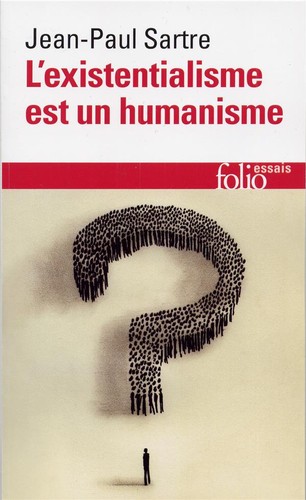 L'existentialisme est un humanismeJean-Paul Sartre
 Les jeux sont faitsJean-Paul Sartre