Existentialism and humanism
≈ From memoryHuman beings are not born with a pre-defined purpose; we are radically free and therefore entirely responsible for the values we create through our actions.
In one sentence
Existence precedes essence: humans first appear on the scene, encounter themselves, and only afterwards define what they are through their choices.
Why read this (and who it's for)
This book is a defense of existentialism against the charge that it is a philosophy of despair or "subjectivism." It is for anyone who feels paralyzed by the weight of choice, anyone seeking a moral framework in a secular world, and anyone who wants to understand the radical responsibility of personal agency. After reading, you will be able to identify the "bad faith" in your own excuses and recognize that your identity is a continuous project of action, not a fixed set of traits.
The big idea
Sartre argues against the traditional metaphysical view that things have an "essence" before they exist. For a letter opener or a chair, the concept (essence) comes first—the designer thinks of the purpose, and then the object is made. However, for human beings, there is no "God" or "Nature" to provide a blueprint. We are thrown into the world as a blank slate of consciousness.
Because there is no pre-determined blueprint, we are "condemned to be free." This freedom is not a gift; it is a burden because it means there is no external authority (divine, biological, or social) to tell us what is "right." We are the sole source of value. Therefore, when we choose for ourselves, we are not just choosing for an individual; we are creating an image of what a human ought to be. Every action is a vote for a certain type of humanity.
Key ideas
Existence precedes essence
What it is — Unlike objects, humans exist first and then define themselves through their actions. There is no "human nature" that dictates how you should behave. Why it matters — It strips away the comfort of destiny. You cannot say "I was born this way" or "It's my destiny." You are the sum of your actions. In the book — Sartre uses the example of a paper knife. A craftsman creates it with a specific purpose (to cut paper) in mind. A human, however, exists without a prior "purpose" and must invent it.
The Burden of Freedom
What it is — Freedom is not the ability to do whatever you want; it is the ontological condition of being a conscious being. It is a "condemnation" because we did not create ourselves, yet we are responsible for everything we do. Why it matters — It eliminates the "victim" mentality of external circumstances. While you cannot control the situation you are born into, you are entirely responsible for how you interpret and act within that situation. In the book — Sartre describes the "anguish" of choice. When you choose, you realize that nothing—not even your past—forces your hand. You are the sole author of your next move.
Bad Faith (Mauvaise Foi)
What it is — The act of lying to oneself to escape the overwhelming weight of freedom. It is pretending that you "have" to do something because of your job, your social role, or your personality. Why it matters — It is the primary way humans survive the anxiety of freedom. By saying "I have no choice," you protect yourself from the responsibility of choosing. In the book — Sartre discusses the "waiter" in a cafe who plays at being a waiter too perfectly. He is trying to convince himself that his essence is "waiter-ness" to escape the fact that he is a free consciousness choosing to perform a role.
The Responsibility of the Other
What it is — When I choose for myself, I choose for all of humanity. Because there is no objective moral law, my actions serve as a blueprint for what a human being should be. Why it matters — It turns existentialism into a social ethic. Your life is a constant "legislation" of values. If you choose to be a thief, you are asserting that theft is a valid human expression. In the book — Sartre argues that even in a world without God, we are still bound by a "humanism" because our choices are always weighed against the possibility of what other humans might do.
The Situation vs. The Act
What it is — We are always in a "situation" (facticity), but we are never fully defined by it. Our freedom lies in the relation we have to that situation. Why it matters — It distinguishes between "I am a prisoner" (a fact) and "I am choosing to accept the status of a prisoner" (an act). In the book — Sartre explains that a prisoner is still free because they can choose how to relate to their imprisonment—they can rebel, they can despair, or they can find a way to exist within it.
Frameworks & tools
The Responsibility Audit
Use this to identify where you are living in "Bad Faith" by analyzing your excuses.
- Identify the "Must": Write down a situation where you say, "I have to do X" or "I have no choice but to be Y."
- Isolate the Facticity: What are the actual physical/social constraints? (e.g., "I have a mortgage," "I am in a certain job.")
- Identify the Choice: What is the action you are taking in response to that fact? (e.g., "I am choosing to work this job to pay the mortgage.")
- Own the Choice: Acknowledge that while the situation is real, the attitude and response are your sole responsibility.
The Humanist Action Model
Use this to ensure your actions align with the "Humanism" Sartre describes.
- The Action: What am I doing right now?
- The Value: What does this action say about what a human being should be?
- The Universal: If everyone did what I am doing right now, what kind of world would we inhabit?
- The Commitment: Am I willing to stand by that world?
Memorable examples & stories
The Waiter in the Cafe
Sartre describes a waiter whose movements are a bit too "mechanical," his smile a bit too "professional." He is performing the idea of a waiter. The Lesson: We often perform roles to escape the terrifying freedom of being a "nothingness" that must constantly choose itself.
The Paper Knife
Sartre compares a manufactured object (the knife) to a human being. The knife has a "pre-determined" use. The Lesson: Humans are the only entities whose "purpose" comes after their existence.
The Prisoner
Sartre discusses the prisoner who is physically confined but remains a free consciousness. The Lesson: Freedom is not the absence of obstacles; it is the ability to choose one's orientation toward those obstacles.
Key quotes
"Existence precedes essence." The fundamental rule of existentialism: we are born first, then we define ourselves.
"Man is condemned to be free; because once he is thrown into the world, he is responsible for everything he does." Freedom is not a choice; it is an inescapable condition of being human.
"I am my choices." (Paraphrased) You are not your past, your potential, or your intentions; you are only the sum of the actions you have actually taken.
"To choose is to legislate." (Paraphrased) Every action you take is a declaration of what you believe a human being should be.
How to apply it
This week
- The "No Excuses" Audit: Identify one thing you've been saying "I have to" about. Write down the actual choice you are making in that situation.
- The Role Check: Observe yourself in a social setting (at work or a party). Notice when you "perform" a role. For a moment, acknowledge the freedom you have to act differently in that moment.
Ongoing
- The Legislation Principle: Before making a major decision, ask: "If everyone acted like this, what kind of world would we create?"
- Radical Ownership: When faced with a setback, stop looking for who to blame (circumstances, luck, others). Ask: "How am I choosing to respond to this situation right now?"
Common pitfalls
- The "Anything Goes" Fallacy: People often think existentialism means you can do whatever you want (moral anarchy). Sartre argues the opposite: because your actions define humanity, you are more responsible for your actions than anyone else.
- The Determinism Trap: It is easy to fall into the trap of saying "My genes/upbringing made me this way." Sartre insists that while your starting point (facticity) is real, your interpretation and response to it are always free.
- The "Subjectivity" Misunderstanding: Sartre is not saying "Your truth is your truth." He is saying that because there is no objective "blueprint" for humanity, we must create our own values through action.
Connects to
- Viktor Frankl's Man's Search for Meaning: Frankl applies Sartre's ideas of radical responsibility to the context of concentration camps, showing how finding meaning in choice is a survival mechanism.
- Albert Camus' The Myth of Sisyphus: While Sartre focuses on the responsibility of choice, Camus focuses on the absurdity of the struggle, though both agree that the individual must create meaning in a meaningless universe.
If you remember only three things
- Existence precedes essence: You are not born with a purpose; you create it through your actions.
- Condemned to be free: You are entirely responsible for your choices, and there are no excuses.
- Action as Legislation: Every choice you make is a statement of what you believe a human being should be.
Internalize it
-
Reflection questions
- In what ways am I currently using "Bad Faith" to avoid a difficult choice?
- If my life were a "blueprint" for other humans, what kind of human would I be modeling?
- What is one "fact" of my life (job, location, family) that I am using as an excuse to stop choosing my own growth?
-
Flashcards Q: What does "Existence precedes essence" mean? A: It means humans exist first, and then they define their purpose and character through their actions. Q: What is "Bad Faith" (Mauvaise Foi)? A: The act of deceiving oneself into believing one has no choice, thereby escaping the responsibility of freedom. Q: Why is human freedom described as a "condemnation"? A: Because we did not create ourselves, yet we are entirely responsible for every action we take once we exist. Q: How does Sartre define the "Responsibility of the Other"? A: Because there is no pre-set moral law, every individual choice serves as a model for what all humans should do. Q: What is the difference between "Facticity" and "Freedom"? A: Facticity is the set of circumstances you are born into (your body, your past); Freedom is the way you choose to relate to and act within those circumstances.
Fidelity note
This summary is based on Sartre's 1946 lecture/essay Existentialism is a Humanism. I am highly confident in the core concepts of "existence precedes essence," "bad faith," and the "condemnation of freedom." I am less certain of the specific nuances of his critiques of "subjectivism" as he addresses the specific accusations of his contemporaries, but the core philosophical trajectory remains accurate. Readers should verify the specific "waiter" example in the text to see the full depth of his stylistic analysis.
More from Jean-Paul Sartre
 BaudelaireJean-Paul Sartre
 Being and NothingnessJean-Paul Sartre
 Essays in aestheticsJean-Paul Sartre
 Essays in existentialismJean-Paul Sartre
 Existential psychoanalysisJean-Paul Sartre
 Existentialism is a HumanismJean-Paul Sartre
 L' imaginaireJean-Paul Sartre
 L'être et le néantJean-Paul SartreL'être et le néantJean-Paul Sartre
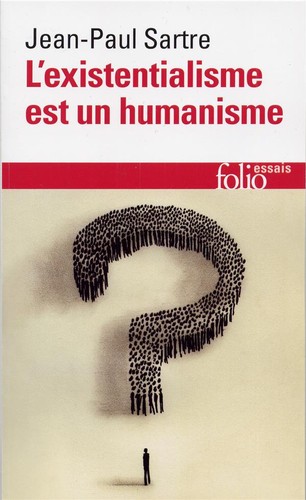 L'existentialisme est un humanismeJean-Paul Sartre
 Les jeux sont faitsJean-Paul Sartre
 Literature & existentialismJean-Paul Sartre