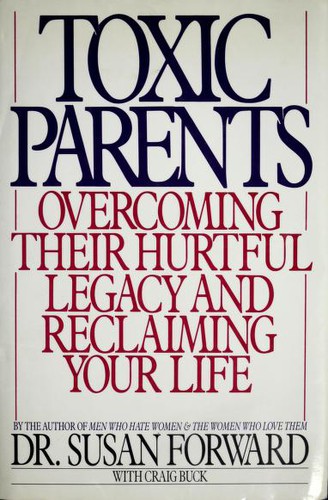
Confronting Toxic People
≈ From memoryToxic people use manipulation to maintain power and evade responsibility; you can only reclaim your autonomy by refusing to participate in their psychological games.
In one sentence
The only way to survive a toxic relationship is to stop trying to "fix" or "change" the other person and instead focus entirely on establishing rigid boundaries and emotional detachment.
Why read this (and who it's for)
This book is for anyone who feels drained, confused, or "crazy" after interacting with a specific person—a parent, spouse, boss, or friend. It solves the problem of emotional exhaustion caused by trying to win an argument with someone who doesn't play by the rules of logic or honesty. After reading, you will be able to identify specific manipulative tactics (like gaslighting or guilt-tripping) in real-time and respond with "gray rock" techniques rather than emotional reactions.
The big idea
Forward argues that toxic people—whether they are narcissists, borderline personalities, or simply manipulative personalities—operate on a system of emotional exploitation. They do not see people as individuals with rights; they see them as sources of "supply" (attention, validation, control, or resources). Because their behavior is rooted in a deep-seated need for power, they will interpret any attempt at healthy communication as a personal attack or a challenge to be crushed.
The central thesis is that you cannot win a game where the rules are rigged. If you try to explain your feelings to a toxic person, they will use your vulnerability as a weapon. Therefore, the goal of the reader is not to "win" the argument or get the toxic person to see the light. The goal is to protect your own sanity by creating a "psychological firewall." You must stop seeking their approval and start seeking your own self-preservation.
Key ideas
The "Toxic" Personality as a System
- What it is — Toxicity is not a character flaw that can be "cured" with a good conversation; it is a consistent pattern of behavior designed to maintain the other person's ego.
- Why it matters — If you believe they will eventually "get it" if you just explain yourself better, you will stay in the line of fire forever.
- In the book — Forward emphasizes that toxic people are often highly skilled at "impression management," appearing charming to outsiders while being abusive behind closed doors.
The Trap of "JADE" (Justify, Argue, Defend, Explain)
- What it is — When you try to justify your actions or explain your feelings to a toxic person, you provide them with more "ammunition" to twist and use against you.
- Why it matters — Explaining yourself gives the manipulator a roadmap of your insecurities. Stopping the JADE cycle preserves your energy.
- In the book — Forward argues that you must stop explaining why you are doing something and simply state what you are doing.
Emotional Manipulation as a Tool of Control
- What it is — Tactics like guilt-tripping, playing the victim, and "the silent treatment" are not accidents; they are calculated tools used to induce feelings of obligation or fear.
- Why it matters — Recognizing these as tools rather than emotions allows you to remain objective. You see the "move" instead of feeling the "sting."
- In the book — The author breaks down how "the victim" role is often a weapon used to shut down any accountability for the toxic person's behavior.
The Importance of "Gray Rocking"
- What it is — The practice of becoming as uninteresting as a gray rock to make yourself a "boring" target for a manipulator.
- Why it matters — Toxic people thrive on emotional reactions (both positive and negative). If you provide no reaction, they eventually look elsewhere for their "supply."
- In the book — Forward describes this as a way to minimize interaction while maintaining a necessary connection (like co-parenting or working together).
Boundaries as "No-Go" Zones
- What it is — Boundaries are not about changing the other person's behavior; they are about what you will do when the other person crosses a line.
- Why it matters — Most people think a boundary is a command to the other person ("Don't yell at me"). A real boundary is a consequence for yourself ("If you yell at me, I am hanging up the phone").
- In the book — Forward stresses that boundaries are only effective if they are enforced consistently, even when it's uncomfortable.
Frameworks & tools
The "Stop JADE-ing" Protocol
When a toxic person tries to bait you into an argument or demands an explanation for your boundaries, follow these steps:
- Identify the Bait: Recognize when they are asking "Why?" or "How could you?" to make you feel guilty.
- The One-Sentence Rule: Provide a statement of fact, not a justification. (e.g., "I'm not able to discuss this right now" instead of "I can't talk because I'm really stressed and I need a break.")
- The Pivot: Immediately change the subject or end the interaction.
- Silence the Internal Critic: Remind yourself that their disapproval is not a reflection of your worth, but a symptom of their pathology.
The Boundary Enforcement Checklist
Use this to decide how to handle a specific interaction:
- Identify the Behavior: What exactly is the toxic behavior? (e.g., "Calling me names.")
- Identify the Limit: What is your "line"? (e.g., "I will not be spoken to with insults.")
- Determine the Consequence: What will you do? (e.g., "I will leave the room.")
- The Action: State the boundary clearly once. Do not argue about it. Execute the consequence immediately.
Memorable examples & stories
The "Parental Guilt" Trap
Forward describes a parent who uses their age and "sacrifices" to make a child feel guilty for setting a boundary. The lesson: Their guilt-tripping is a tactic to regain control, not a valid reason for you to abandon your needs.
The "Professional Saboteur"
A story of a coworker who constantly undermines a colleague's work while acting like a "helper" to others. The lesson: Toxic people often use "triangulation"—bringing in a third party to validate their lies and isolate their target.
The "Emotional Vampire"
The description of a friend who only calls when they need to vent or dump their problems, then disappears when you need support. The lesson: This is a "one-way" relationship where you are being used as a dumping ground for their emotional waste.
Key quotes
"You cannot change a person who does not see a problem with their behavior." (Paraphrased) Why it matters: This kills the hope that will keep you trapped in a cycle of trying to 'fix' them.
"The goal is not to win the argument, but to protect your peace." (Paraphrased) Why it matters: It shifts the metric of success from 'getting them to agree' to 'keeping yourself sane.'
"Stop explaining yourself to people who are committed to misunderstanding you." (Paraphrased) Why it matters: It highlights the futility of the JADE cycle.
How to apply it
This week
- Identify your "Toxic Trigger": Write down the three most common ways a specific person in your life tries to manipulate you (e.g., "The Guilt Trip," "The Gaslight").
- The "No-Explanation" Challenge: The next time you say "No" to a request, do not provide a reason. Just say, "No, that doesn't work for me." Observe how it feels to hold that boundary.
- The Gray Rock Test: If you have to interact with a toxic person this week, practice giving "boring" answers. Use "Okay," "I see," or "That's interesting" to avoid giving them emotional data.
Ongoing
- The "Internal Firewall": Whenever a toxic person speaks, visualize a glass wall between you. They can talk, but their words cannot reach your "inner house."
- The Boundary Audit: Every Sunday, review your interactions. Did you JADE? Did you let a boundary slide? Where can you be firmer next week?
- Detach from the Outcome: Stop expecting the toxic person to apologize or change. Your success is measured by your own calm, not their reaction.
Common pitfalls
- The "Hope" Trap: Many readers struggle because they still hope for a "breakthrough" moment. Forward is clear: these breakthroughs rarely happen with toxic personalities.
- The "Aggressive" Mistake: Readers often think "confronting" means yelling or being confrontational. In this book, "confronting" means setting firm boundaries and withdrawing from the toxic dynamic. Aggression just gives the manipulator more "victim" fuel.
- Inconsistency: The biggest failure is setting a boundary but then "giving in" when the other person cries or acts angry. If you give in once, you teach them that they just need to be more toxic to get what they want.
Connects to
- "Boundaries" by Henry Cloud and Martin Frome: Provides a broader psychological framework for what boundaries are, whereas Forward focuses specifically on the toxic application of those boundaries.
- "The Disease to Believe You're Always Right" by Steven Carter: Explores the cognitive distortions that make toxic behavior possible.
- "Emotional Intelligence" by Daniel Goleman: Helps in understanding the "why" behind the emotional manipulation and how to manage your own emotional reactions.
If you remember only three things
- Stop explaining yourself (Stop JADE-ing).
- Your goal is self-preservation, not "winning" an argument with a toxic person.
- Boundaries are about your actions, not their behavior.
Internalize it
-
Reflection questions
- Who is the person in my life who makes me feel "crazy" or exhausted?
- What is the specific "payoff" they get when they make me angry or guilty?
- In what ways have I been trying to "explain" my needs to someone who isn't listening?
- What is one boundary I have been afraid to enforce because I fear their reaction?
-
Flashcards Q: What does JADE stand for in the context of toxic relationships? A: Justify, Argue, Defend, Explain. Q: What is the primary goal of "Gray Rocking"? A: To become uninteresting to a manipulator so they lose interest in targeting you. Q: Why is explaining your feelings to a toxic person often counterproductive? A: Because it provides them with a roadmap of your vulnerabilities that they can use to manipulate you further. Q: What is the difference between a "command" and a "boundary"? A: A command tries to control the other person; a boundary defines what you will do if a certain behavior occurs. Q: What is the "supply" a toxic person seeks? A: Attention, validation, control, or any emotional reaction that feeds their ego. Q: How should you respond when a toxic person uses a guilt trip? A: Acknowledge the statement but do not offer a justification; maintain the boundary.
Fidelity note
I have a high level of confidence in the core psychological principles presented by Susan Forward, specifically the concepts of JADE-ing, Gray Rocking, and the distinction between "commanding" and "bounding." However, because this is a summary from memory, specific anecdotes or the exact phrasing of certain case studies may vary slightly from the original text. The core methodology—shifting from "fixing the other" to "protecting the self"—is the definitive pillar of her work.