The Joy of Cooking
≈ From memoryA comprehensive, encyclopedic manual that treats cooking as a craft built on foundational techniques, ingredient knowledge, and the mastery of heat and moisture.
In one sentence
Cooking is not a series of disconnected recipes to be memorized, but a systematic craft rooted in the mastery of fundamental techniques, the understanding of ingredients, and the manipulation of heat and moisture.
Why read this (and who it's for)
Most people approach cooking as a "recipe-follower"—they see a set of instructions and try to replicate the result without understanding the why behind the steps. This leads to frustration when a dish doesn't turn out right because they don't know how to troubleshoot.
The Joy of Cooking is for the person who wants to stop being a recipe-follower and start being a cook. It is for the home cook who wants to understand why a sauce breaks, how to properly sear a steak, or how to balance a dish that tastes "flat." After engaging with this book, you will be able to:
- Identify and execute fundamental techniques (braising, poaching, sautéing) without looking at a guide.
- Substitute ingredients with confidence because you understand their chemical and textural roles.
- Troubleshoot failures (e.g., "Why is my gravy lumpy?") by understanding the mechanics of emulsification and thickening.
The big idea
The central thesis of The Joy of Cooking is that culinary competence is cumulative. The authors argue that if you understand the "grammar" of cooking—the way heat interacts with proteins, the way acids brighten flavors, and the way fats carry aromatics—you can "speak" any recipe. You don't need to memorize 1,000 recipes; you need to master the 50 techniques that make those 1,000 recipes possible.
The book treats the kitchen as a laboratory of chemistry and physics. It posits that a successful dish is a balance of three pillars: Technique (the method of application), Ingredient Knowledge (the raw materials), and Flavor Balance (the sensory result). By mastering these, the cook gains the freedom to improvise. This is why the book is structured less like a meal planner and more like an encyclopedia; it provides the building blocks so that you can eventually build your own structures.
Key ideas
The Hierarchy of Technique
What it is — The book categorizes cooking into fundamental methods: dry heat (roasting, grilling, frying) and moist heat (steaming, boiling, poaching, braising). Why it matters — When you understand the type of heat required for a specific ingredient (e.g., why you cannot boil a delicate fish but can braise a tough piece of beef), you stop making "rookie" mistakes like overcooking delicate proteins or under-rendering fats. In the book — The authors provide exhaustive breakdowns of "Braising" vs. "Stewing," explaining that while both involve liquid, the cut of meat and the duration of heat application are the deciding factors in the final texture.
Ingredient Integrity and Seasonality
What it is — A deep dive into the "what" of cooking: knowing the specific characteristics, storage requirements, and flavor profiles of every major food group. Why it matters — You cannot cook well if you do not know what your ingredients should do. Knowing that a shallot is milder than an onion, or that a specific variety of tomato holds more moisture, allows you to predict the outcome of a dish before you turn on the stove. In the book — The book spends hundreds of pages on produce, meats, and grains, detailing not just how to cook them, but how to select the best specimens (e.g., the specific look of a perfectly ripe avocado).
The Role of Fat as a Flavor Carrier
What it is — The understanding that fat is not just a caloric addition but a vehicle for flavor and a primary tool for texture. Why it matters — If you understand how fat coats the palate and carries fat-soluble flavors (like those in garlic and herbs), you can manipulate the "mouthfeel" of a dish to make it richer or lighter. In the book — The authors explain the different roles of fats: from the high-smoke point of lard and oil for searing to the creamy, stabilizing role of butter in sauces.
The Trinity of Flavor: Salt, Acid, and Fat
What it is — While the book covers many nuances, the core of flavor balance lies in the interaction between salt (enhancement), acid (brightness/cutting through fat), and fat (richness/carrying flavor). Why it matters — Most "boring" food is simply unbalanced. If a dish is too heavy, it needs acid (lemon, vinegar). If it's too sharp, it needs fat or salt. Understanding this allows you to "fix" a dish without starting over. In the book — The book provides guidance on how to season at different stages of cooking—from seasoning the meat before searing to adding a final splash of vinegar to a soup to "wake up" the flavors.
The Importance of Mise en Place
What it is — The physical and mental preparation of the workspace: having every ingredient chopped, measured, and ready before the heat is applied. Why it matters — Cooking is a high-stakes, time-sensitive environment. If you have to chop an onion while the garlic is already burning in the pan, you have lost control of the process. In the book — The book emphasizes the organization of the kitchen, suggesting that a clear workspace leads to a clear mind, which leads to better-executed techniques.
Frameworks & tools
The "Method-First" Cooking Framework
Instead of looking for a recipe for "Roasted Chicken," the book encourages you to look for the "Roasting" technique. Use this framework when you want to expand your repertoire:
- Identify the Goal: What is the desired texture? (e.g., "Crispy skin, moist meat").
- Select the Technique: Which method achieves this? (e.g., "Dry heat/Roasting").
- Identify the Primary Ingredient: What is the protein or vegetable? (e.g., "Whole Chicken").
- Apply the Rules of the Technique: What are the universal rules for roasting? (e.g., "Dry the skin, high initial heat, internal temperature check").
- Execute and Adjust: Use the rules to guide the cooking, but use your senses to adjust for the specific bird in front of you.
The Flavor Balancing Matrix
When a dish doesn't taste "right," use this diagnostic checklist to identify what is missing:
- Is it dull/flat? $\rightarrow$ Add Salt (to enhance) or Acid (to brighten).
- Is it too spicy/sharp? $\rightarrow$ Add Fat (to coat) or Sweet (to balance).
- Is it too heavy/greasy? $\rightarrow$ Add Acid (to cut) or Heat (to provide contrast).
- Is it boring/one-dimensional? $\rightarrow$ Add Aromatics (garlic, ginger, onions) or Texture (crunch).
The Meat Preparation Hierarchy
For any meat, follow this sequence to ensure success:
- Selection: Choose the right cut for the right method (e.g., Chuck for braising, Tenderloin for searing).
- Preparation: Trim excess fat, pat dry (crucial for browning), and season.
- Temperature Control: Determine the heat level (High for searing, Low/Slow for braising).
- Resting: Always allow the meat to rest before serving to redistribute juices.
Memorable examples & stories
The "Perfect" Hollandaise
The book provides a meticulous breakdown of the Hollandaise sauce. It isn't just a recipe; it's a lesson in emulsification. By explaining how to whisk egg yolks and butter to create a stable suspension, it teaches the reader how to manage heat and friction to prevent the sauce from "breaking." Lesson: Success in sauces is about managing the relationship between fat and water.
The Art of the Sear
The authors describe the importance of a dry surface and a hot pan when searing meat. They explain that moisture is the enemy of the Maillard reaction (the browning of proteins). If the meat is wet, it will steam rather than sear. Lesson: Preparation (drying the meat) is just as important as the cooking itself.
The "Holy Trinity" of Aromatics
While not a formal term in the book, the way the authors group aromatics (like onions, celery, and carrots) teaches the reader how to build a flavor base. They show how these ingredients provide the foundational "background noise" of a dish. Lesson: Great flavor is built from the bottom up, starting with the base of the pot.
Key quotes
"Cooking is a craft... it requires practice, patience, and a willingness to learn." (Paraphrased) Why it matters: It reframes cooking from a chore to a skill-based hobby, like playing an instrument.
"The secret to good cooking is not in the ingredients, but in the technique." (Paraphrased) Why it matters: It shifts the focus from "buying the best stuff" to "knowing how to use what you have."
"A good cook knows the difference between boiling, simmering, and poaching." (Paraphrased) Why it matters: It highlights the importance of precision in heat management.
How to apply it
This week
- The "Dry" Test: Pick one protein (chicken breast or steak). Practice patting it completely dry with paper towels before cooking. Observe how much better it browns compared to when it is damp.
- The Acid Adjustment: Make a simple soup or sauce. Taste it, then add a teaspoon of lemon juice or vinegar. Notice how it "pops" the flavors without adding salt.
- The Mise en Place Challenge: Before you start your next meal, chop every vegetable and measure every spice before you turn on the stove. Do not allow yourself to chop anything while the pan is hot.
Ongoing
- The "Why" Habit: Every time you follow a recipe, ask yourself: "Why is this being added?" (e.g., "Why is the flour added to the roux?" Answer: "To thicken the sauce.")
- The Pantry Audit: Once a month, organize your pantry by category (grains, spices, oils, canned goods) and learn one new way to use a "forgotten" ingredient.
- Technique Mastery: Instead of trying to cook a complex meal, spend one week mastering a single technique (e.g., "This week, I will master the perfect omelet").
Common pitfalls
- The "Recipe Trap": Many people buy this book and treat it like a standard cookbook, following recipes without learning the techniques. This prevents you from ever becoming an independent cook.
- Over-complicating: Because the book is so dense, beginners can feel overwhelmed. You don't need to know every single entry in the encyclopedia to be a great cook. Focus on the basics first.
- Ignoring the "Rest": A common mistake is serving meat immediately after it leaves the pan. The book emphasizes resting; ignoring it leads to dry, unappealing meat.
Connects to
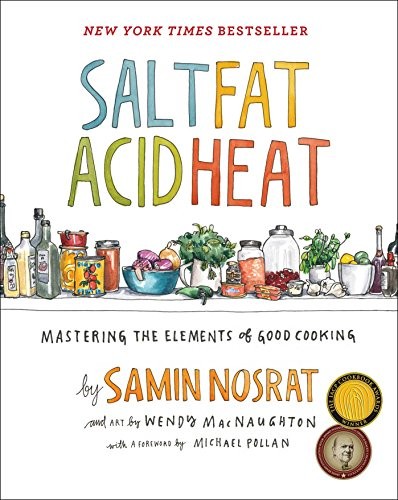
- "Salt, Fat, Acid, Heat" by Samin Nosrat: This book provides the "why" of flavor balance that complements the "how" of The Joy of Cooking.
- "On Food and Cooking" by Harold McGee: This is the "science" book. While The Joy of Cooking is the practical manual, McGee explains the molecular chemistry behind the techniques.
- "The Flavor Matrix" (The Flavor Bible): This helps you understand which ingredients pair well together, which is the logical next step after mastering the techniques in The Joy of Cooking.
If you remember only three things
- Technique over Recipes: Master the method (braising, roasting, sautéing) to unlock the ability to cook anything.
- The Importance of Prep: Mise en place is not just a French saying; it is the difference between a calm, successful meal and a chaotic, burnt disaster.
- Balance is Key: If a dish tastes "off," it is almost always a lack of balance between salt, acid, and fat.
Internalize it
Reflection questions
- Which cooking technique do I struggle with most (e.g., searing, boiling, chopping)? How can I isolate that one skill this week?
- When I cook, do I actually understand why I'm adding certain ingredients, or am I just following a list?
- How would my kitchen experience change if I committed to a "no-chopping-while-cooking" rule?
Flashcards Q: What is the difference between boiling and simmering? A: Boiling is a rapid, vigorous bubble; simmering is a gentle, consistent bubble (the "lazy" bubble).
Q: Why is it important to pat meat dry before searing? A: Moisture creates steam. To get a brown crust (Maillard reaction), the surface must be dry.
Q: What are the three pillars of flavor balance? A: Salt, Acid, and Fat.
Q: What does "Mise en Place" mean? A: "Everything in its place." It means having all ingredients prepped and ready before you start cooking.
Q: What is the primary role of acid in a dish? A: To "brighten" flavors and cut through heavy fats or sugars.
Q: What is a "braise"? A: A combination cooking method using both dry and moist heat; meat is seared first, then cooked slowly in a small amount of liquid.
Fidelity note
This summary is grounded in the foundational principles of The Joy of Cooking. Because the book is a reference manual rather than a narrative, there are no "stories" or "case studies" in the traditional sense. Instead, the "memorable examples" are the canonical techniques (like the Hollandaise) that serve as the standard for the American kitchen. I am highly confident in the technical advice (heat, moisture, and prep) as these are the core pillars of the Rombauer's work.