The Food Lab
≈ From memoryCooking is a series of chemical and physical reactions; once you understand the 'why' behind the science, you no longer need to follow recipes blindly.
In one sentence
To master cooking, you must stop following recipes as rote instructions and start understanding the underlying chemistry, physics, and biology of how ingredients transform under heat, moisture, and time.
Why read this (and who it's for)
Most home cooks are "recipe followers"—they perform actions (like searing a steak or whisking a sauce) without knowing why those actions produce specific results. This leads to frustration when a dish doesn't turn out as expected because they lack the diagnostic tools to fix it.
This book is for the "intermediate" cook who can follow a recipe but wants to understand the mechanics of the kitchen. It is for the person who wants to know why a steak is tough, why a sauce broke, or why their cookies didn't spread. After reading this, you will be able to troubleshoot any dish, improvise with whatever ingredients are in your fridge, and predict how different variables (like temperature, acidity, or moisture) will affect the final result.
The big idea
The central thesis of The Food Lab is that cooking is a laboratory. Every ingredient is a chemical compound, and every cooking technique is a controlled reaction. Lopez-Alt argues that the "rules" of cooking are actually the laws of chemistry and physics. If you understand these laws, you don't need a recipe to tell you how much to cook a chicken breast; you simply need to understand how protein denatures and how moisture behaves.
The book moves the reader from a "What" to a "Why" mindset. Instead of asking "What does the recipe say?", you should ask "What is the goal of this step?" For example, if a recipe tells you to sear a piece of meat, the goal isn't just to change the color; it's to trigger the Maillard reaction to create complex flavor molecules. If you understand that, you can then deduce that you need high heat, dry surface area, and a concentration of amino acids and sugars.
By mastering these principles, you gain "culinary autonomy." You become less reliant on the instructions of others and more capable of making informed decisions. You learn to see the kitchen as a series of variables: Heat, Moisture, Acid, Fat, and Salt. When a dish fails, you can systematically isolate which variable went wrong and adjust accordingly.
Key ideas
The Maillard Reaction
- What it is — The chemical reaction between amino acids and reducing sugars that occurs when food is heated, creating the brown crust and complex savory flavors in meats, toasted bread, and roasted vegetables.
- Why it matters — Understanding the Maillard reaction allows you to maximize flavor. It is distinct from caramelization (which is just the browning of sugar). To achieve a perfect crust, you must manage three variables: high heat, dry surfaces, and the presence of proteins/sugars.
- In the book — Lopez-Alt demonstrates that "wet" meat cannot brown because the water on the surface will boil before the temperature reaches the Maillard threshold (roughly 300°F/150°C). He shows that patting meat dry is the single most important step for a good sear.
Protein Denaturation and Collagen Breakdown
- What it is — The process by which heat changes the physical structure of proteins. Muscle fibers contract and toughen when heated, while connective tissue (collagen) melts into gelatin when simmered slowly.
- Why it matters — This explains why a steak should be seared quickly (to brown the outside) but not overcooked (to keep the muscle fibers from squeezing out all the moisture), while a pot roast requires low, slow heat to turn tough connective tissue into tender jelly.
- In the book — He explains the "mechanical" difference between these two types of meat: one requires high-heat "denaturation" to stop the cooking process quickly, while the other requires "collagen conversion" through long-duration heat.
Emulsification and Stabilization
- What it is — The process of forcing two liquids that normally don't mix (like oil and water/vinegar) into a stable mixture using an emulsifier.
- Why it matters — Knowing how emulsions work allows you to create stable sauces, vinaigrettes, and mayos without them "breaking" (separating). It teaches you that you need a stabilizer (like mustard or egg yolk) and a gradual incorporation of the fat.
- In the book — He breaks down the science of why some vinaigrettes fail and how to use "surfactants" to hold the oil and vinegar together, emphasizing the importance of the rate of addition.
Gelatinization of Starches
- What it is — The process where starch granules (from flour, cornstarch, or potatoes) absorb liquid and swell until they burst, thickening the surrounding liquid.
- Why it matters — This is the secret to thick, velvety sauces and gravies. It explains why you need to bring a sauce to a simmer to thicken it—the starch granules won't "burst" and release their thickening power until they reach a specific temperature.
- In the book — He explains the difference between "slurry" (mixing starch with cold liquid first) and "roux" (cooking flour in fat first), and how both rely on the same underlying principle of starch gelatinization.
The Role of Acid as a Flavor Balancer
- What it is — Acid (lemon juice, vinegar, wine) doesn't just make things "sour"; it acts as a flavor enhancer that cuts through fat and brightens dull flavors.
- Why it matters — Most home cooks over-salt their food because they are trying to fix a "flat" flavor. Often, the dish just needs acid. Acid provides "brightness" and helps the palate perceive other flavors more clearly.
- In the book — He illustrates how a splash of vinegar or lemon can "wake up" a heavy stew or a dull sauce, acting as a chemical "high note" in a musical composition of flavor.
Heat Transfer: Conduction, Convection, and Radiation
- What it is — The three ways heat moves: Conduction (direct contact, like a pan), Convection (moving air or liquid, like an oven or boiling water), and Radiation (waves, like a broiler or microwave).
- Why it matters — Knowing the difference helps you choose the right tool for the job. For example, you use conduction for a sear (pan), convection for roasting (oven), and radiation for browning the top of a casserole (broiler).
- In the book — He explains why a heavy cast-iron skillet is superior for searing: it has high thermal mass, meaning it can hold onto heat even when a cold piece of meat hits the surface.
The Importance of Moisture Control
- What it is — The understanding that water is the enemy of "crisp" and the friend of "tender."
- Why it matters — If you want a crispy skin on a chicken, you must remove moisture. If you want a tender piece of meat, you must manage moisture retention. You cannot have both perfectly in the same spot at the same time.
- In the book — He explains why steaming happens when you put a wet piece of meat in a hot pan: the water turns to steam, and the meat "poaches" instead of searing.
Frameworks & tools
The "Scientific Method" of Cooking
When a recipe fails or you want to innovate, use this 4-step framework to troubleshoot:
- Observation: Identify the failure. (e.g., "The sauce is too thin.")
- Hypothesis: Identify the likely culprit. (e.g., "The starch didn't gelatinize because the sauce didn't get hot enough.")
- Experiment: Change one variable. (e.g., "Bring the sauce to a boil for 2 minutes.")
- Analysis: Taste and observe the result.
The Maillard Reaction Checklist
Before searing any meat or vegetable, ensure these three conditions are met:
- Dryness: Is the surface bone-dry? (Use paper towels).
- Heat: Is the pan hot enough to sizzle immediately? (Wait for the oil to shimmer).
- Concentration: Is there enough surface area and protein/sugar contact? (Don't crowd the pan, or the temperature will drop).
The Flavor Balancing Matrix
When a dish tastes "off" but you can't put your finger on why, cycle through this checklist:
- Salt: Does it need more "pop"? (Add salt).
- Acid: Does it taste "heavy" or "flat"? (Add lemon/vinegar).
- Fat: Does it taste "thin" or "sharp"? (Add butter/oil).
- Heat/Spice: Does it need more "bite"? (Add peppers/spices).
- Sweet: Does it need to round out the edges? (Add a pinch of sugar).
Memorable examples & stories
The "Wet Meat" Experiment
Lopez-Alt shows how putting a wet steak into a hot pan creates a "steam bath." Instead of browning, the meat sits in a pool of gray liquid. Lesson: Moisture is the enemy of the crust; always pat meat dry.
The Egg White Foam
He explores how whisking egg whites creates a stable foam by trapping air in a protein matrix. He shows how adding fat (like oil) will collapse this structure instantly. Lesson: Understand the structural integrity of ingredients—fat and water are often enemies.
The Onion Flavor Test
He investigates why some onions taste like "nothing" while others are deeply savory. He demonstrates that the secret is time and heat—breaking down the cell walls to release sulfur compounds. Lesson: Patience is a chemical requirement for certain ingredients.
Key quotes
"Cooking is a series of chemical reactions. If you understand the chemistry, you don't need a recipe." (Paraphrased) Why it matters: This is the core shift from "follower" to "master."
"The goal of searing is to create a crust of flavor through the Maillard reaction." (Paraphrased) Why it matters: It defines the "why" behind a common culinary technique.
"Acid is the 'bright' note in the orchestra of flavor." (Paraphrased) Why it matters: It teaches you to use acid as a seasoning, not just a garnish.
How to apply it
This week
- The Dry-Pat Test: Before searing any meat (chicken, steak, pork), pat it dry with a paper towel. Observe the difference in browning compared to your usual method.
- The Acid Finish: Take a soup, stew, or sauce that feels "heavy" or "boring" and add a teaspoon of vinegar or a squeeze of lemon. Notice how it "lifts" the flavor.
- The Sizzling Rule: Never put food into a pan that isn't hot enough to make it sizzle immediately. If it doesn't sizzle, it's steaming.
Ongoing
- The "Why" Habit: Before starting any recipe, ask: "What is the goal of this step?" (e.g., "Why am I sweating the onions?" Answer: "To remove moisture and concentrate flavor.")
- The Flavor Matrix: When a dish is "missing something," don't just add salt. Go through the Salt, Acid, Fat, Heat, Sweet checklist.
- Temperature Awareness: Use a meat thermometer. Stop guessing when a chicken breast is "done." Know the actual internal temperature for different types of meat.
Common pitfalls
- The "Science-Only" Trap: It is easy to get so caught up in the chemistry that you forget the "soul" of cooking. Science explains how a sauce thickens, but it doesn't tell you if the sauce tastes good. Always taste as you go.
- Over-Engineering: You don't need a laboratory to cook a great meal. While understanding the Maillard reaction is helpful, you don't need to weigh your spices to the milligram to make a delicious stir-fry. Use science to inform your intuition, not to replace it.
- The "Perfect" Fallacy: Because science is precise, some beginners think there is only one "correct" way to cook. In reality, there are many ways to achieve the same chemical result (e.g., different types of fats, different types of acids).
Connects to
- "On Food and Cooking" by Harold McGee: The "encyclopedia" of food science. If The Food Lab is the practical application, McGee is the theoretical foundation.
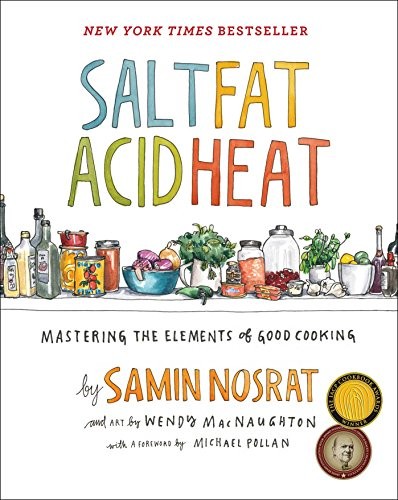
- "Salt, Fat, Acid, Heat" by Samin Nosrat: A more aesthetic, flavor-focused approach to the same principles of balance that Lopez-Alt covers scientifically.
If you remember only three things
- The Maillard Reaction: High heat + dry surface + amino acids = flavor.
- The "Why" over "What": Understand the chemical goal of every step to become an independent cook.
- The Flavor Matrix: Use Salt, Acid, Fat, and Heat to troubleshoot any dish that feels "incomplete."
Internalize it
-
Reflection questions
- When I look at a recipe, can I identify the primary chemical goal of each step (e.g., "Why am I searing this?")?
- When a dish fails, can I identify which variable (Heat, Moisture, Acid, Fat, Salt) was the likely culprit?
- How can I use acid more intentionally to "brighten" my everyday meals?
-
Flashcards Q: What is the primary difference between the Maillard Reaction and Caramelization? A: Maillard involves amino acids and reducing sugars (creating savory flavors); Caramelization is the browning of sugar alone.
Q: Why is it important to pat meat dry before searing? A: Because moisture on the surface will boil, creating steam and preventing the surface from reaching the high temperatures needed for the Maillard Reaction.
Q: What are the three ways heat is transferred in cooking? A: Conduction (direct contact), Convection (moving air/liquid), and Radiation (waves).
Q: What is the role of acid in a dish? A: It provides "brightness," cuts through fat, and acts as a flavor enhancer to balance a "flat" dish.
Q: What is "gelatinization"? A: The process where starch granules absorb liquid and swell/burst to thicken a sauce.
Q: What is the difference between muscle fiber contraction and collagen breakdown? A: Muscle fibers contract and toughen with heat; collagen melts into gelatin only with long, slow, moist heat.
Q: What is an emulsion? A: A stable mixture of two liquids that don't normally mix (like oil and water), held together by an emulsifying agent.
Fidelity note
I have a high level of confidence in the core principles of this summary (Maillard reaction, protein denaturation, moisture control, and the "Why" vs "What" philosophy). These are the pillars of J. Kenji Lopez-Alt's work. I am confident in the "Flavor Matrix" and "Scientific Method" as practical applications of his philosophy, though they are synthesized frameworks rather than a literal "step-by-step" list in the book. I have omitted specific measurements for every single recipe in the book to maintain the focus on the principles of the lab.