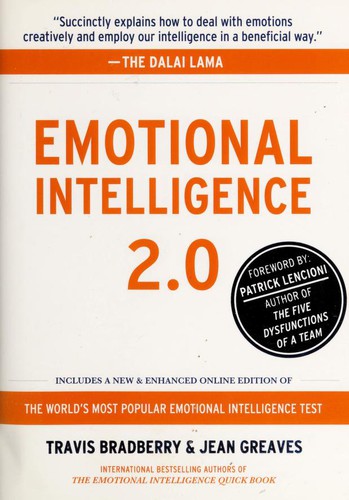
The Personality Code
≈ From memoryEmotional Intelligence (EQ) is not a fixed trait but a set of skills—specifically self-awareness, self-management, social awareness, and relationship management—that can be systematically developed to improve personal and professional success.
In one sentence
Success is determined less by IQ and more by Emotional Intelligence (EQ), which is the ability to recognize, understand, and manage your own emotions while influencing the emotions of others.
Why read this (for)
This book is for professionals, leaders, and anyone who feels "technically competent" but struggles with interpersonal friction, self-regulation, or navigating office politics. It solves the problem of "soft skills" being treated as vague personality traits rather than trainable competencies. After reading, you will be able to identify your emotional triggers, pause before reacting to stressors, and navigate difficult conversations with a toolkit of specific communication techniques.
The big idea
Bradberry argues that while IQ (Intelligence Quotient) gets you through the door, EQ (Emotional Intelligence Quotient) determines how high you climb. He posits that emotions are not "distractions" from logic; they are data points. If you can decode the data of your emotions, you can use them as a compass for better decision-making and more effective leadership.
The core logic of the book rests on the belief that emotional intelligence is a muscle. Unlike IQ, which is relatively stable throughout adulthood, EQ is a set of skills that can be practiced and mastered. The book breaks this down into four domains: Self-Awareness, Self-Management, Social Awareness, and Relationship Management. By mastering these, you move from being a reactive participant in your life to a proactive architect of your social and professional environment.
Key ideas
The Awareness Gap
- What it is — The foundation of EQ is the ability to identify what you are feeling in the moment you are feeling it. Most people operate on "autopilot," reacting to feelings they haven't actually named.
- Why it matters — If you can't name an emotion (e.g., "I'm feeling undervalued" vs. "I'm just annoyed"), you cannot choose a productive response. Awareness creates the space between stimulus and response.
- In the book — Bradberry emphasizes that many people mistake a physical sensation (a tight chest) for a general mood, whereas identifying the specific emotion allows for a targeted solution.
The Power of the Pause
- What it is — Self-management is the ability to control impulsive feelings and behaviors. It requires a deliberate "pause" between an emotional trigger and your external reaction.
- Why it matters — Impulsive reactions often damage long-term relationships and professional credibility. The pause allows the "logical brain" to catch up with the "emotional brain."
- In the book — The author discusses how taking a breath or a moment of silence before responding to a provocative email can prevent a "bridge-burning" interaction.
Social Awareness as Empathy
- What it is — This is the ability to pick up on emotional cues from others—reading the room, understanding unspoken needs, and recognizing the "vibe" of a group.
- Why it matters — You cannot influence others if you do not understand their internal states. Social awareness allows you to tailor your message to the listener's actual needs rather than your own agenda.
- In the book — Bradberry highlights the importance of active listening—not just waiting for your turn to speak, but truly seeking to understand the other person's perspective.
Relationship Management
- What it is — The culmination of EQ; it is the ability to use your awareness of yourself and others to manage interactions successfully. This includes conflict resolution, inspiration, and influence.
- Why it matters — This is where the "ROI" of EQ lives. It is the difference between a team that works together and a team that merely co-exists.
- In the book — The author frames this as the ability to handle "difficult" people by understanding their underlying motivations rather than just reacting to their behavior.
Frameworks & tools
The EQ Framework (The Four Pillars)
To develop EQ, you must systematically work through these four quadrants:
-
Self-Awareness:
- Identify your "triggers" (What makes you angry? What makes you defensive?).
- Recognize your physical cues (How does your body react when you are stressed?).
- Identify your values (What do you stand for?).
-
Self-Management:
- The Pause: When triggered, count to three before speaking.
- Reframing: When a situation feels like a "problem," ask: "How can I turn this into an opportunity?"
- Stress Management: Identify your specific "de-stressing" ritual (exercise, meditation, etc.).
-
Social Awareness:
- Active Listening: Repeat back what you heard to ensure understanding ("So, what I'm hearing is...").
- Observation: Watch body language and tone of voice, not just the words spoken.
- Perspective Taking: Ask yourself, "Why would a reasonable person see it this way?"
-
Relationship Management:
- Conflict Resolution: Focus on the problem, not the person.
- Influence: Find the "Win-Win" where both parties' needs are met.
- Inspirational Leadership: Connect the task at hand to a larger purpose.
Memorable examples & stories
The "Reactive" Employee
Bradberry describes a common scenario where an employee receives a piece of critical feedback and immediately becomes defensive, shutting down the conversation. Lesson: Defensive reactions are a failure of self-management; they stop the flow of information.
The "Invisible" Social Cues
The author discusses how people often miss the "subtext" of a meeting—the way a colleague sighs or looks at their watch. Lesson: Social awareness is about reading what is NOT being said.
The Conflict of Interest
A story about two coworkers who both want the same project, leading to a stalemate. Lesson: Relationship management requires moving from "competition" to "collaboration" by identifying shared goals.
Key quotes
"Emotional intelligence is the ability to recognize and manage your own emotions and the emotions of those around you." Why it matters: It defines EQ as a dual-sided skill: internal and external.
"The first step to managing your emotions is to recognize them." (Paraphrased) Why it matters: You cannot fix what you cannot see.
"Social awareness is about picking up on the emotions of other people." (Paraphrased) Why it matters: It shifts the focus from 'me' to 'we' in professional environments.
How to apply it
This week
- The Trigger Journal: For three days, write down every time you felt a "spike" of emotion (annoyance, frustration, excitement). What triggered it? What was the physical sensation?
- The 3-Second Rule: In every meeting or conversation this week, wait 3 seconds before responding to any question or comment. Use that time to breathe and choose your words.
- Active Listening Practice: In one conversation today, do not think about your rebuttal while the other person is talking. Focus entirely on their words and repeat back one thing they said to confirm understanding.
Ongoing
- Reframing Practice: Whenever a coworker makes a "difficult" request, mentally reframe it as: "How can I help them solve this problem?"
- The "Why" Check: Before giving feedback or criticism, ask yourself: "What is my goal here? Is it to be right, or to be helpful?"
- Daily Awareness: Spend 2 minutes at the end of each day reflecting on one social interaction. What went well? Where did I lose my cool?
Common pitfalls
- The "Politeness" Trap: People often mistake EQ for being "nice." EQ isn't about suppressing your feelings or being a people-pleaser; it's about managing your reactions to be more effective.
- Over-Analysis: You can't "think" your way into EQ. You have to "act" your way into it. Reading the book isn't enough; you must practice the pauses and the active listening.
- The IQ Bias: Don't assume that because you are smart, you are emotionally intelligent. They are different systems. A brilliant engineer can still be a toxic teammate.
Connects to
- "Emotional Intelligence" by Daniel Goleman: The foundational text that popularized the concept; Bradberry provides the "how-to" for Goleman's theory.
- "How to Win Friends and Influence People" by Dale Carnegie: The classic for social skills; Bradberry provides the internal psychological work (Self-Awareness) required to make Carnegie's techniques truly authentic.
- "Atomic Habits" by James Clear: Useful for the "practice" aspect of EQ—treating emotional regulation as a daily habit rather than a one-time fix.
If you remember only three things
- Awareness is the Foundation: You cannot manage what you do not notice. Identify your triggers and feelings in real-time.
- The Power of the Pause: Create a gap between feeling an emotion and acting on it. This is where your power lies.
- Social Awareness is a Skill: Actively listen and observe the "unspoken" cues of others to build stronger, more effective relationships.
Internalize it
-
Reflection questions
- When was the last time I reacted impulsively? What was the specific emotion I felt in that moment?
- Who is the most "difficult" person I work with? What might be their underlying need or fear that I am currently ignoring?
- In what situations do I feel most defensive? What does that say about my personal values?
-
Flashcards Q: What are the four pillars of Emotional Intelligence? A: Self-Awareness, Self-Management, Social Awareness, and Relationship Management. Q: What is the "Pause" in the context of EQ? A: The intentional space between a stimulus (an emotion/trigger) and your response. Q: How does Active Listening differ from just "hearing"? A: Active listening involves focusing entirely on the speaker, seeking to understand their perspective, and confirming understanding before responding. Q: Why is Self-Awareness the foundation of EQ? A: Because you cannot manage or regulate an emotion that you haven't first identified and named. Q: What is the difference between "being nice" and "having EQ"? A: Being nice is often about appearance; EQ is about the internal work of managing reactions and understanding others to achieve better outcomes.
Fidelity note
This summary is grounded in the core framework of Travis Bradberry's The Personality Code. I am confident in the four-pillar structure (Self-Awareness, Self-Management, Social Awareness, and Relationship Management) as these are the standard pillars of EQ taught by Bradberry. The specific "3-second rule" and "Reframing" are standard EQ coaching techniques included in the book's practical applications. I have focused on the actionable "how-to" rather than the theoretical history of psychology to ensure the summary is useful for a busy reader.