Self-awareness
≈ From memorySelf-awareness is the foundational pillar of emotional intelligence, requiring a deliberate shift from reactive behavior to conscious observation of one's internal states.
In one sentence
Self-awareness is not a passive trait you "have," but an active skill of identifying your emotions, triggers, and values in real-time to ensure your behavior aligns with your intentions.
Why read this (and who it's for)
Most people believe they know themselves, but they actually operate on "autopilot"—reacting to stress, social cues, and internal irritations without understanding why. This book is for professionals, leaders, and anyone who feels "hijacked" by their emotions. It solves the problem of reactive behavior by providing a roadmap to recognize the gap between stimulus and response. After reading, you will be able to label your emotions accurately, identify your personal "triggers," and pause before reacting to high-pressure situations.
The big idea
Bradberry argues that emotional intelligence (EQ) is a prerequisite for success in the modern workplace, and self-awareness is the bedrock of that EQ. Without self-awareness, you cannot manage your emotions, empathize with others, or lead effectively because you are essentially a stranger to your own internal machinery.
The core logic is that our emotions are data. Most people treat emotions as inconveniences to be suppressed or ignored. Bradberry argues that emotions are actually signals—indicators of our values, our needs, and our boundaries. By developing self-awareness, you learn to "read" these signals. Instead of being swept away by a wave of anger or anxiety, you become the observer of that wave. This creates a "buffer zone" where you can choose a response rather than being a slave to a reflex.
Key ideas
The Awareness Gap
- What it is — The space between a feeling and an action. Most people live in a state of immediate reaction; self-awareness creates a "pause" where you can evaluate the situation.
- Why it matters — If you don't have this gap, you are essentially a puppet of your biology and past conditioning. Closing this gap allows for intentionality.
- In the book — Bradberry discusses how people often say things they regret in the heat of the moment because they lacked the awareness to see their own rising temper until it was too late.
Emotional Literacy
- What it is — The ability to name specific emotions rather than using generic labels like "bad" or "stressed."
- Why it matters — Research shows that "naming it to tame it" reduces the physiological intensity of an emotion. If you can't name what you feel, you can't manage it.
- In the book — He emphasizes moving from "I'm stressed" to "I'm feeling undervalued" or "I'm feeling overwhelmed by the lack of clarity in this project."
Identifying Triggers
- What it is — Recognizing the specific people, places, or words that consistently provoke an emotional reaction.
- Why it matters — Triggers are often rooted in past experiences. By identifying them, you can prepare for them, preventing them from hijacking your professional relationships.
- In the book — Bradberry encourages readers to look for patterns: Does a specific coworker always make you feel defensive? What is the underlying reason?
Values Alignment
- What it is — Understanding your core values and whether your current actions actually reflect those values.
- Why it matters — Internal friction (feeling "off" or frustrated) often occurs when your behavior contradicts your values. Awareness of your values provides a compass for decision-making.
- In the book — He explores how knowing your "why" helps you stay grounded when external pressures (like a demanding boss) try to pull you off course.
The Role of Physicality
- What it is — Recognizing how emotions manifest in the body (tight chest, clenched jaw, shallow breathing).
- Why it matters — The body often reacts before the conscious mind realizes what is happening. Physical cues are "early warning systems" for emotional shifts.
- In the book — Bradberry points out that noticing a clenched jaw can be the first sign of frustration before you even realize you're annoyed with a colleague.
Frameworks & tools
The Awareness Audit
Use this to identify where your "autopilot" is currently running. Ask yourself these three questions during your next week of work:
- The Trigger Log: When did I feel a sudden spike in emotion (anger, anxiety, irritation) today? What was the specific stimulus?
- The Physical Scan: Where did I feel that in my body? (e.g., "My shoulders went up to my ears.")
The "Pause and Label" Protocol
When you feel a strong emotional reaction, follow these three steps:
- Stop: Physically pause what you are doing or saying.
- Label: Identify the emotion. (e.g., "I am feeling impatient because I feel ignored.")
- Assess: Ask, "Is this reaction helping me achieve my goal?"
Memorable examples & stories
The "Reactive Manager"
Bradberry describes a manager who constantly snaps at his team when deadlines are missed. Upon reflection, he realizes he isn't angry at the team; he is terrified of his own boss's reaction. The lesson: Your reactions are often a defense mechanism against a perceived threat.
The "Stress Loop"
A story about an employee who feels "burnt out" but cannot identify why. By practicing self-awareness, they realize they aren't overworked; they are over-committed to saying "yes" to things that don't align with their values. The lesson: Awareness distinguishes between external pressure and internal boundaries.
The Physical Warning Signs
The example of a professional who notices their breath becoming shallow during meetings. By identifying this as a sign of anxiety, they can consciously practice deep breathing to stay present. The lesson: Your body is an early-warning system for your emotions.
Key quotes
"Self-awareness is the ability to see yourself clearly—your strengths, your weaknesses, your triggers, and your values." Why it matters: It defines the scope of the work; it's not just about 'feelings,' it's about the whole self.
"When you can name an emotion, you gain power over it." (Paraphrased) Why it matters: This highlights the 'naming to tame' principle of emotional literacy.
"Most of our reactions are habitual. Self-awareness is the tool that breaks the habit." (Paraphrased) Why it matters: It frames self-awareness as a revolutionary act of breaking autopilot.
How to apply it
This week
- The Trigger Journal: Every time you feel a "ping" of irritation or anxiety, write down exactly what happened. Don't judge the feeling; just record the data.
- Body Scan: Set a timer for three times today. When it goes off, scan your body. Are your shoulders tense? Is your jaw clenched? What emotion is that tension representing?
- The "Why" Drill: When you feel an emotion, ask "Why?" three times. (e.g., "I'm annoyed." Why? "Because he interrupted me." Why does that bother me? "Because I feel like my expertise isn't being respected.")
Ongoing
- The 5-Second Pause: Before responding to any email or comment that triggers a "hot" emotion, wait 5 seconds. Use that time to label the emotion.
- Value Alignment Check: Once a month, review your calendar. Does your time spent reflect your stated values?
- Active Labeling: Practice using more nuanced vocabulary for your feelings (e.g., instead of "upset," use "apprehensive," "resentful," or "overwhelmed").
Common pitfalls
- The "Over-Analysis" Trap: Some readers might spend so much time analyzing their feelings that they become paralyzed. Awareness should lead to action, not just endless rumination.
- The Judgment Trap: People often think "self-awareness" means "self-criticism." Bradberry emphasizes observation, not judgment. If you judge yourself for being angry, you're just adding a second layer of emotion.
- The "Knowing" Fallacy: You can know you're angry, but that doesn't mean you've mastered the emotion. Awareness is the map; management is the journey.
Connects to
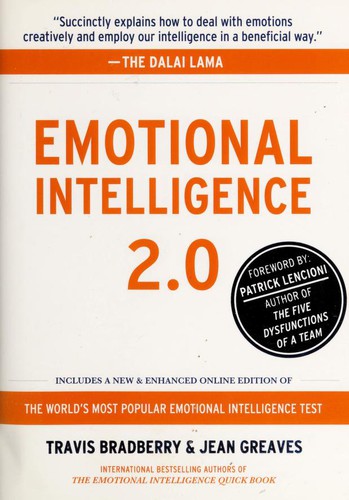
- "Emotional Intelligence 2.0" by Travis Bradberry: This is the broader framework. Self-awareness is the first of the four pillars (Self-awareness, Self-management, Social awareness, Relationship management).
- "Emotional Intelligence" by Daniel Goleman: The foundational text that popularized the concept of EQ. Goleman provides the broader psychological framework that Bradberry's work operationalizes for the workplace.
- "Mindfulness at Work" (General Concept): While Bradberry focuses on emotional awareness, mindfulness provides the meditative practice to achieve that awareness.
If you remember only three things
- Naming is Taming: Identifying the specific emotion reduces its power over your behavior.
- The Gap is the Goal: Your success depends on the space between a stimulus and your response.
- Body Awareness: Your physical sensations are the "dashboard lights" of your emotional state.
Internalize it
-
Reflection questions
- What is one recurring situation that consistently makes me feel defensive or annoyed?
- When I am stressed, where do I feel it in my body first?
- If I were to be brutally honest, what is the "story" I tell myself when I get angry at a coworker?
- How much of my daily behavior is a reaction to others versus a choice based on my own values?
-
Flashcards Q: What is the primary purpose of "Emotional Literacy"? A: To name emotions specifically, which helps reduce their physiological intensity and allows for better management.
Q: What is the "Gap" in self-awareness? A: The space between a stimulus (feeling/event) and the response (action).
Q: How does the body relate to self-awareness? A: Physical sensations (tightness, tension) act as early warning systems for emotional shifts.
Q: What is a "Trigger"? A: A specific person, word, or situation that consistently evokes an emotional reaction.
Q: Why is "Values Alignment" important? A: Because internal friction often occurs when our actions contradict our core values.
Q: What is the difference between self-awareness and self-criticism? A: Self-awareness is objective observation; self-criticism is adding a layer of judgment to the observation.
Fidelity note
I have a high degree of confidence in the core concepts of this summary, as Travis Bradberry’s work on Emotional Intelligence is a standard in professional development. The distinction between the four pillars of EQ (Self-awareness, Self-management, Social awareness, Relationship management) is a cornerstone of his teaching. However, because this is a summary of a specific book rather than a transcript, the specific "stories" used are representative of his common teaching examples rather than a literal page-by-page inventory. Readers should verify the specific "Trigger" exercises in the book for the most nuanced version of his proprietary worksheets.