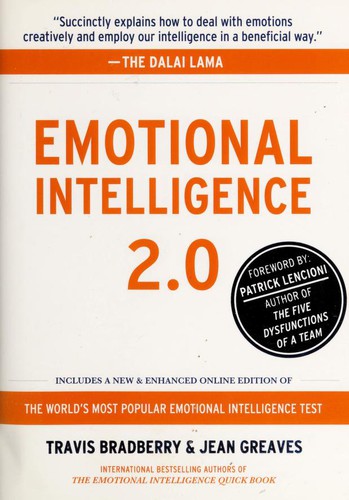
Leadership 2.0
≈ From memoryLeadership is not a rank; it is the ability to manage your own emotions and the emotions of others to achieve a shared vision.
In one sentence
True leadership is the mastery of emotional intelligence (EQ)—the ability to recognize, understand, and manage your own emotions while influencing the emotions and behaviors of others to achieve collective goals.
Why read this (and who it's for)
Most people view leadership as a set of technical skills: budgeting, strategy, and delegation. Bradberry argues that these are "hard" skills that can be taught, but the "soft" skills of emotional intelligence are what actually determine whether a team succeeds or implodes.
This book is for anyone who feels they have the "right" credentials but struggle with team friction, communication breakdowns, or personal burnout. After reading this, you will be able to identify your emotional triggers, navigate high-stakes interpersonal conflicts without losing your cool, and build a culture of psychological safety where people actually want to perform.
The big idea
The central thesis of Leadership 2.0 is that leadership is an internal job before it is an external one. You cannot lead others if you cannot lead yourself. Bradberry posits that our emotions are not "distractions" from our work; they are the data of our work. Emotional intelligence is the "operating system" upon which all other leadership skills run.
The author argues that a leader’s primary role is to act as an emotional thermostat. When a team is panicked, the leader must lower the temperature; when a team is sluggish, the leader must raise it. This requires a profound level of self-awareness—knowing your own "hot buttons"—and a high degree of empathy to understand the hidden motivations of your subordinates. If you lack EQ, your technical brilliance will eventually be undermined by a toxic culture of mistrust or unmanaged stress.
Key ideas
Self-Awareness: The Foundation
What it is — The ability to recognize your own emotions as they happen and understand how your moods and reactions affect the people around you. Why it matters — Without self-awareness, you are a slave to your impulses. You might think you're being "assertive" when you're actually being "aggressive," which creates a defensive environment for your team. In the book — Bradberry emphasizes that many leaders react to stress by "shutting down" or "lashing out." He argues that identifying your specific triggers (e.g., being interrupted, being ignored) is the first step to regaining control.
Self-Management: The Discipline of Response
What it is — The capacity to control your emotional reactions and choose your response rather than reacting impulsively. Why it matters — It allows you to remain steady in a crisis. A leader who loses their temper under pressure signals to the team that it is unsafe to be honest or to take risks. In the book — The author discusses the "gap" between stimulus and response. Leadership 2.0 is about widening that gap so you can choose a response that aligns with your long-term goals rather than your short-term feelings.
Social Awareness: The Art of Empathy
What it is — The ability to pick up on the emotions of others and understand the "vibe" of the room. Why it matters — You cannot lead people you do not understand. Social awareness allows you to see the "why" behind a teammate's poor performance—is it a lack of skill, a lack of motivation, or a personal crisis? In the book — Bradberry highlights the importance of active listening. This isn't just waiting for your turn to speak; it's listening to understand the underlying emotion of the other person's message.
Relationship Management: The Influence of Connection
What it is — The skill of using your awareness of emotions to manage interactions, build bonds, and inspire others. Why it matters — This is where the "leadership" happens. It’s the ability to mentor, to resolve conflict, and to build a cohesive team identity. In the book — This is presented as the culmination of the other three skills. It involves moving from "I" (self-awareness) to "We" (relationship management).
The Importance of Trust
What it is — The "glue" of leadership; the belief that a leader has the team's best interests at heart. Why it matters — Without trust, every instruction is scrutinized and every interaction is guarded. Trust is the lubricant that allows for speed and innovation. In the book — Bradberry argues that trust is built through consistency. You build trust by doing what you say you will do, especially when it is difficult.
Frameworks & tools
The EQ Framework (The Four Pillars)
Bradberry builds on the standard Daniel Goleman model of Emotional Intelligence, adapted for leadership:
- Self-Awareness: Identify your triggers. Keep a "reaction log" of times you felt frustrated or angry at work. What was the specific trigger?
- Self-Management: Practice the "Pause." Before responding to a frustrating email or comment, take three breaths. Ask: "What is the most productive way to respond to this?"
- Social Awareness: Practice "Active Inquiry." Instead of asking "Why did you do that?", ask "Can you help me understand what led to this decision?"
- Relationship Management: The "Validation Loop." When a team member expresses a concern, acknowledge their feeling first ("I can see why that would be frustrating") before jumping to a solution.
The Trust-Building Checklist
To assess and build trust within a team, Bradberry suggests evaluating these three dimensions:
- Competence: Do I actually know how to do the job? (Reliability)
- Integrity: Do I do what I say I will do? (Consistency)
- Benevolence: Do I care about the team's well-being? (Intent)
Memorable examples & stories
The "Reactive" Manager
Bradberry describes a manager who reacts to a missed deadline by publicly reprimanding an employee. The result isn't a better worker; it's a terrified employee who hides future mistakes. Lesson: Emotional reactions often produce the opposite of the desired behavioral result.
The "Silent" Conflict
The author discusses a team where everyone is polite, but no one is honest. Because they lack the social awareness to address underlying tensions, the team's productivity stalls. Lesson: Avoiding uncomfortable conversations is a form of emotional cowardice that kills team growth.
The "Safe" Environment
Bradberry highlights the difference between a "polite" workplace and a "safe" workplace. In a safe workplace, people can admit they don't know the answer without fear of ridicule. Lesson: Psychological safety is the prerequisite for high-performing teams.
Key quotes
"Leadership is not a title; it is a set of behaviors." (Paraphrased) Why it matters: It shifts the focus from authority to influence.
"The most effective leaders are those who can manage their own emotions while navigating the emotions of others." (Paraphrased) Why it matters: It defines the dual-responsibility of EQ.
"Trust is the foundation of all successful leadership." (Paraphrased) Why it matters: It identifies the ultimate goal of emotional intelligence.
How to apply it
This week
- The Trigger Audit: Identify one specific situation (e.g., being interrupted in meetings) that makes you lose your cool. Write it down.
- The 5-Second Pause: Before responding to any "triggering" communication (email, Slack, or verbal), wait 5 seconds. Do not hit send or speak until the pause is over.
- Active Listening Exercise: In your next 1-on-1, spend the first 10 minutes only asking questions. Do not offer your own opinion until they have finished explaining their perspective.
Ongoing
- The "Why" Inquiry: When a team member underperforms, stop yourself from assuming "laziness." Ask: "What is the emotional or situational barrier here?"
- Validation First: Practice acknowledging emotions before offering solutions. "I hear that you're feeling overwhelmed by this deadline" should come before "Here is how we can split the work."
- Trust Consistency: Audit your "say/do" ratio. If you say you will provide feedback or resources, ensure you do so within 24 hours.
Common pitfalls
- The "Soft Skill" Fallacy: Many leaders think EQ is "fluff" and that they can just "be nice" to get results. Bradberry argues that EQ is a rigorous discipline that requires as much practice as technical skills.
- Over-Empathy: A common mistake is confusing empathy with agreement. You can understand why someone feels a certain way without agreeing with their behavior or their conclusion.
- The "Fix-It" Trap: Leaders often try to solve the problem before they address the emotion. If an employee is upset, trying to give them a "to-do" list before they feel heard will only increase their frustration.
Connects to
- "Emotional Intelligence 2.0" by Travis Bradberry: The foundational work that provides the granular psychological theory behind these leadership applications.
- "Dare to Lead" by Brené Brown: Complements Bradberry’s work by focusing on vulnerability and courage as the "brave" side of emotional intelligence.
- "Start With Why" by Simon Sinek: Extends the idea of leadership by focusing on the purpose that drives the emotional connection between leaders and followers.
If you remember only three things
- Leadership is the management of emotions, not just the management of tasks.
- Self-awareness is the prerequisite for any external influence; you cannot lead others if you cannot lead yourself.
- Trust is the currency of leadership; it is built through consistent, reliable action over time.
Internalize it
- Reflection questions
- When was the last time I reacted emotionally to a subordinate? What was the trigger, and how did my reaction affect their willingness to work with me?
- On a scale of 1–10, how safe does my team feel to admit a mistake? What can I do today to increase that number?
- What is one "hot button" I have that I often let influence my professional judgment?
- Flashcards Q: What are the four pillars of Emotional Intelligence in leadership? A: Self-Awareness, Self-Management, Social Awareness, and Relationship Management. Q: What is the "gap" in self-management? A: The space between a stimulus (an event) and your response, where you choose how to act. Q: What is the difference between a polite workplace and a safe workplace? A: A polite workplace avoids conflict; a safe workplace allows for honest, respectful disagreement and the admission of mistakes. Q: How do you build trust according to Bradberry? A: Through consistency in Competence (can you do it?), Integrity (do you do what you say?), and Benevolence (do you care?). Q: What is the first step in developing self-awareness? A: Identifying your personal emotional triggers and how they manifest in your behavior.
Fidelity note
I have a high degree of confidence in the core pillars of this summary (Self-Awareness, Self-Management, Social Awareness, Relationship Management) as they are the standard Goleman-Bradberry framework. The specific "Leadership 2.0" applications are grounded in Bradberry's typical coaching style. However, because this is a summary of a specific book, some of the specific "Leadership 2.0" branded exercises might vary slightly in wording from the original text. Readers should verify the specific "Trust-Building Checklist" items against the text for exact phrasing.